
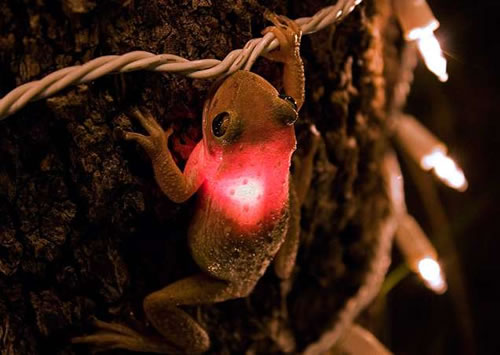
 I took the dogs outside this morning, and the air turned liquid. Drops of rain fell in the trees, Tampa’s humidity condensed amid leaves and branches. The stars gleamed hazy through the trees, and the two dogs sniffed their way around the yard. A frog called beside the house. I walked down the driveway, looked at the other neighbors’ trash, and still I smiled.
I found this apropos photo, a Cuban tree frog photographed by James Snyder in southern Florida, and originally featured on National Geographic’s Daily Dozen. Find out what he had to say about the shot over at Neatorama.
This week I’ve done my favs, then an excellent selection on culture and cognition. After that some health, some anthropology, some cognition, some A. afarensis tool use. Cannabis and the Last Word, a poem this time, finish it off.
I had a lot of help from my new graduate assistant Ethel Saryee in putting this round up together. So thanks to her!
Top of the List
Brian Mossop, The Brains of Our Fathers: Does Parenting Rewire Dads?
Uh oh, my sons have reprogrammed me! Must be why I love playing video games with them… (Not sure my wife will buy that…) Very nice piece on neural plasticity, development, and father-son relationships over at Scientific American
Melody Dye, A Thinking Machine: On Metaphors of the Mind
Are we pre-programmed spreadsheets or search algorithms? Metaphors matter, because they can dictate our assumptions.
Paul Thagard, Why Cognitive Science Needs Philosophy and Vice Versa
Cognitive science and philosophy NEED each other. In this article (pdf), critiques of rationalist, analytic, and postmodern approaches while talking about how to do synthesis.
Awkward Family Photos – Hall of Fame
Oh, these made me laugh!
PZ Myers, Ray Kurzweil Does Not Understand the Brain
Pharyngula takes the computer guru to task for claiming he’ll be able to reverse engineer the brain in a decade. My favorite line:
To simplify it so a computer science guy can get it, Kurzweil has everything completely wrong. The genome is not the program; it’s the data. The program is the ontogeny of the organism, which is an emergent property of interactions between the regulatory components of the genome and the environment, which uses that data to build species-specific properties of the organism.
Vaughan Bell, A Gut Reaction to Moral Transgressions
Mind Hacks on how gut feelings and reactions can be the “unrecognised basis of moral judgements and social customs”
David Harvey, RSA Animate – Crises of Capitalism
An animated Marxist perspective! The graphical animation alone is worth it, but Harvey’s analysis is as illustrative as the drawings.
Psychology around the World
Ed Yong, Genes and Culture: OXTR Gene Influences Social Behaviour Differently in Americans and Koreans
Not Exactly Rocket Science on some intriguing research: “In both cases, the G carriers were more sensitive to the social conventions of their own cultures. But the differences between these conventions led to different behaviour.”



 Neuroanthropology