Intelligent Design & Creationism

Dr. X recently posted this YouTube video on how creation “science” lead directly into intelligent design, a key component in the Dover legal case that went against the teaching of intelligent design. The video summarizes the work done by the National Center for Science Education to show that the textbook Of Pandas and People was “creationism in disguise.”

I also found this related video about the work of Barbara Forrest, a philosophy professor at Southeastern Louisiana University, a key witness who analyzed the early drafts of Of Pandas and People to show how drafts of the book went from talking about creationism to framing everything in terms of intelligent design.

Call for Change in HIV Prevention in Africa

Daniel Halperin, a medical anthropologist at Harvard, is leading the call for a change in HIV prevention. As a recent BBC article reports, “Substantial investment in condom promotion, HIV testing and vaccine research has had limited success in Africa, [Halperin and others] argue in Science. Instead male circumcision and reducing multiple sexual partners should become the ‘cornerstone’ of prevention.”

Their overall argument actually takes aim at one of the biggest sacred cows in current anthropology—the role of inequality. In Reassessing HIV Prevention, Potts, Halperin et al. write, “Such devastating epidemics [of HIV/AIDS] have frequently been attributed to poverty, limited health services, illiteracy, war, and gender inequity. Although these grave problems demand an effective response in their own right, they do not appear to be the immediate causes of generalized epidemics.”

The immediate causes, and thus the immediate foci for prevention, are more concrete:

Where multiple sexual partnerships, especially concurrent ones, are uncommon, and particularly where male circumcision (MC) is common, HIV infection has remained concentrated in high-risk populations (7). Niger, a Muslim country where sexual behavior is relatively constrained and MC is universal, has an adult HIV prevalence of 0.7% (1), despite being the lowest ranking country in the Human Development Index. Botswana, the second wealthiest country in Sub-Saharan Africa, has high levels of multiple concurrent partnerships among both sexes and lack of MC (8), with an HIV prevalence of 25%.

I would also add mother-to-child prevention, given work I help guide in Lesotho. That research, in affiliation with the Touching Tiny Lives project which helps children, shows the importance of access to preventive drugs during pregnancy and breastfeeding, while also addressing the stigmas and sociocultural limitations that often keep women from having access to these drugs.

And for those larger causes? Halperin wrote a powerful editorial back in January, Putting A Plague in Perspective. There he wrote:

Many other public health needs in developing countries are being ignored. The fact is, spending $50 billion or more on foreign health assistance does make sense, but only if it is not limited to H.I.V.-AIDS programs… Many millions of African children and adults die of malnutrition, pneumonia, motor vehicle accidents and other largely preventable, if not headline-grabbing, conditions. One-fifth of all global deaths from diarrhea occur in just three African countries — Congo, Ethiopia and Nigeria — that have relatively low H.I.V. prevalence. Yet this condition, which is not particularly difficult to cure or prevent, gets scant attention from the donors that invest nearly $1 billion annually on AIDS programs in those countries.

Shout Outs

Alayna’s Favorites has consistently linked to the stuff we post here, so time to shower a little attention on her. Her site provides links to other sites. Here’s one that I found through her favorites: a nice reflection on the absurdity of the summer mini-mester, one semester supposedly crammed into two weeks.

Erkan’s Field Diary, run by an anthropologist who covers both anthro blogs and European and Middle East politics and culture, has consistently included us in some of his round ups. Here’s his most recent anthro one, which covers a lot of excellent ground and also provides us an introduction to some of his own work. You can also download his paper, Blogging as a Research Tool for Ethnography.

Dr. X’s Free Associations. Where else can you get vintage photos and psychology in one place? Plus a little politics too. The recent man with hyena photo really struck me. And he has a fun take on Jerry Springer speaking at Northwesetern’s commencement.

And of course the biggie for last. Greg and I both appreciate how Vaughan at MindHacks helps promote so many mind-related blogs, including our own. And where else can you find out about the brains of dead Russian geniuses and electronic lovers with fake online identities?

There are other places that have mentioned us over the last months, such as Neurophilosophy and Purposive Drift. And if you dig into some of our archives, you’ll find links to places we like. Or check out our blogroll. So this is just today’s shout out. But if you really like us, well then, feel free to comment with a link! We’d love to hear from you.

Love Dem Bones

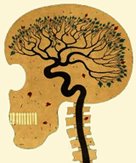
Sue Sheridan, who blogs as The Life of Wiley with updates on life, round ups, and comments on politics as well as biological anthropology, osteology, and more, posted this really cool image to the right when she linked to our student posts. On the left is one she put up yesterday.

If you want more of these images, check Sue’s blog out, as well as Primatebonz, the place where she helps contribute as well as scrounge over at Flickr. And she links to other image-laden sites like Skull-A-Day and Home of the Skulls. For real-life replicas (yeah, that made sense), check out Fossils as Art and Bone Clones. Bone Clones is one of my favorite exhibits to visit at anthro meetings. You haven’t lived until you’ve held a boisei skull in your hands!