Connector or Polarizer by Wondermark

I recently posted Demons on the Web, which discussed the phenomenon of internet-based communities that arise around what many of us might label mental disorders. (I am absolutely sure that all of you read Kotaku religiously for its coverage of gaming…) So here is a great cartoon from the web-comic Wondermark which is penned by David Malki:

All are Shaped by Circumstance
Wondermark: All are Shaped by Circumstance

Many thanks to Brian Johnson of Recursive Sagacity for pointing this out!

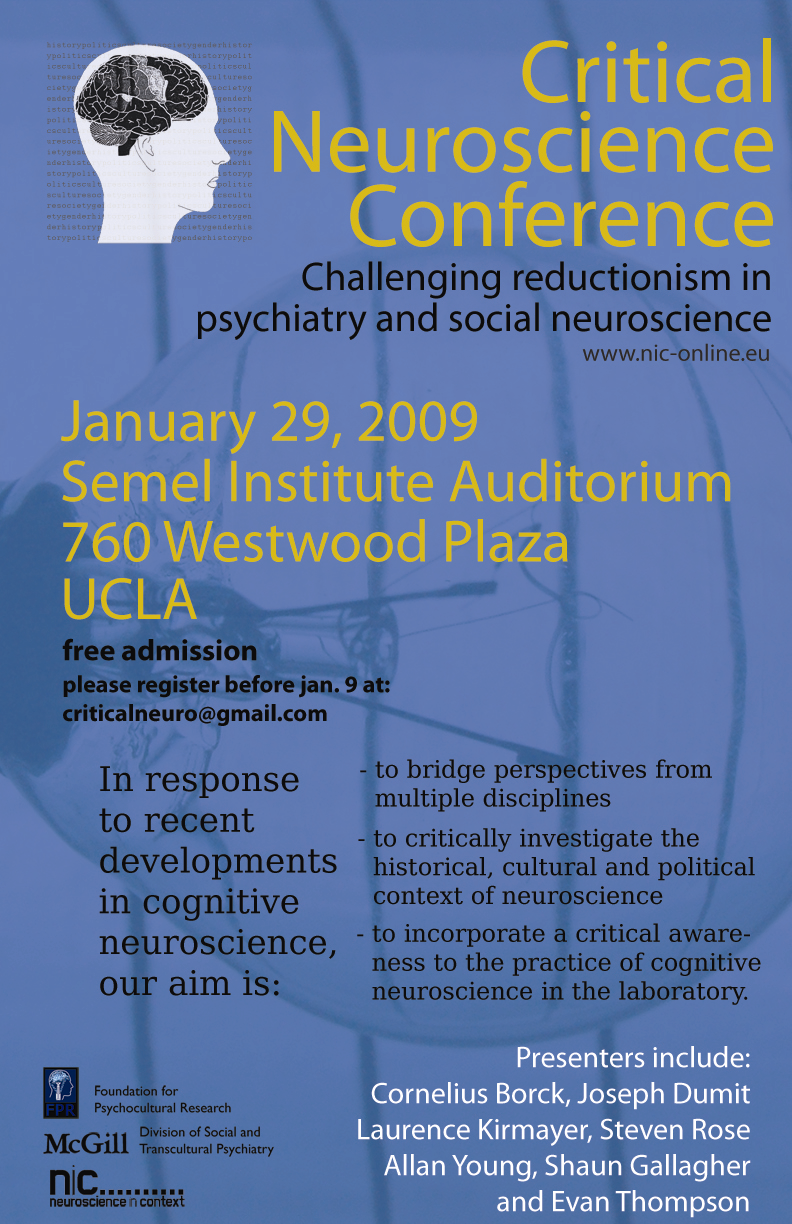
Critical Neuroscience Conference at UCLA

The next Critical Neuroscience conference will be held January 30, 2009 at UCLA. The theme this time is “Challenging Reductionism in Psychiatry and Social Neuroscience.” It will be held at the Semel Institute Auditorium and there is free admission as long as you register. To register, send an email to criticalneuro at gmail.com. For more details, you can also contact Suparna Choudhury, one of the main organizers (and a promising young scholar in her own right!), at schoudhury at mpiwg-berlin.mpg.de

critical-neurosci-conf-at-ucla

The presenters include Joseph Dumit, whose book Picturing Personhood: Brain Scans and Biomedical Identity is a must-read in this area.

Shaun Gallagher is another heavy-hitter, and author of the recent book How The Body Shapes The Mind.

Steven Rose recently penned Lifelines: Beyond the Gene and The Future of the Brain: The Promises and Perils of Tomorrow’s Neuroscience.

Evan Thompson just came out with Mind in Life: Biology, Phenomenology, and the Sciences of Mind.

(Reminder to self: start writing heavy books with big titles… instill awe in other bloggers as they copy Amazon links.)

Cornelius Borck and Laurence Kirmayer are also coming, two people who presented at the last Critical Neuroscience workshop in July in Montreal.

Neuroscience in Context, the European group, is again sponsoring this conference. It fits well, as NIC is all about “critical perspectives, neuroethics, and anthropology.” McGill’s Division of Social and Transcultural Psychiatry is sponsoring the conference once more as well.

The new sponsor is The Foundation for Psychocultural Research. Founded by Robert Lemelson, the Foundation’s mission is “to support and advance interdisciplinary research projects and scholarship at the intersection of psychology, culture, neuroscience and psychiatry, with an emphasis on Psychocultural factors as central, not peripheral.”

The workshop in July produced a string of popular posts here at Neuroanthropology, as I was lucky enough to attend that conference. Here are some fan favorites: The Three Aspects of Critical Neuroscience; Neurotosh, Neurodosh, and Neurodash; Pop Goes the Media; Psychopharma-parenting (very funny!); and The Cultural Brain in Five Flavors.

Katherine MacKinnon, Capuchins, and People

katie-mackinnon
Primates and neuroanthropology? Most definitely! Katherine MacKinnon and Agustín Fuentes will deliver a talk at our Encultured Brain session on “Primate Social Cognition, Human Evolution, and Niche Construction: A Core Context for Neuroanthropology.” Here is the abstract:

Primates exhibit a strong proclivity towards sociality and social group living. Some argue for a specific pattern of social cognition as a core adaptation for the primates. Modern monkeys, apes and humans all live in some form of social networks or communities, suggesting that our last common ancestors also lived as such. Sociality is a crucial part, possibly defining part, of our adaptive strategies. This paper will explore the evolutionary implications for primate cognitive ability as a mechanism for niche construction and human evolutionary success. In humans enhanced cognitive capabilities, extra-somatic manipulations of the environment, and enhanced communicative abilities has enabled our genus to successfully exploit myriad social and structural environments across space and time. Additionally, our extended period of infant development (cognitive, motor, social) necessitated increasing support from group members throughout our evolutionary history. The interactions between our central nervous system and our social and physical environments have demanded increased complexity and connectivity in our social networks, relative to other primates species, in which information about the habitat, food, predator detection, and infant care are disseminated. Here we discuss how the intersections of environment, culture and biology have deep tangled roots in our lineage and how comparative phylogenic and behavioral data from other primates can illuminate the complex interweaving of the social outcomes of our cognitive abilities. Examples from our phylogenic history, as well as from the living nonhuman primates effectively expand on reductionist explanations of variable patterns of social and cognitive complexity.

I’ll profile Katie here, with Agustin in this post. First off the great shot of Katie comes from Costa Rica, where she works with capuchin monkeys. I had the pleasure of watching capuchins in the Colombian Amazon – if I had to pick a species to study, this could be the one! They were magical as they jumped through the trees and chattered among themselves.

young-capuchin-by-matthew-wyczalkowski
Katie is a biological anthropologist at Saint Louis University, and has focused on primate social behavior since she started fieldwork in Central and South America in 1992. Her current work focuses on the social behavior and development of wild infant and juvenile capuchin monkeys – those cute baby monkeys that get lots of awww… But she is also deeply concerned with conservation efforts, in particular how primate communities interact with local human communities. Katie has done much of her recent work in Suriname, where in addition to her capuchin interests, she is also concerned with the responsibilities (such as giving back, helping local economies, and educational efforts about the forests) that field primatologists, usually non-local, have to the local human communities in which they work.

Thus, besides primate behavior in itself, work with capuchins reflects in two ways on people – insights into ourselves as primates and pressing issues of how we relate to our environment, including the wonderful creatures that share their lives with us.

Specifically with neuroanthropology, if we now see the brain as more plastic and accept arguments like Andy Clark’s about the extended mind, then we need to understand how our brains and the functions therein (thereout?) evolved. We are social creatures, and primates place our claims of cognition in context.

Katie just co-edited the great compilation Primates in Perspective, which won the CHOICE Outstanding Academic Title for 2007. Why? Because it provides a comprehensive overview of primatology from the best researchers in the field.

Katie also helped establish the Midwest Primate Interest Group (MPIG), along with colleagues (including Agustin) at Washington University-St. Louis, University of Illinois Urbana-Champaign, and University of Notre Dame.

Here is the MacKinnon Short CV if you want to see more of what Katie has done. And to get in contact with her, her email is mackinn at slu.edu

Agustin Fuentes and Niche Construction

agustin-fuentes
Along with Katherine MacKinnon, Agustin Fuentes is giving the Primate Social Cognition, Human Evolution, and Niche Construction paper at our Encultured Brain session. Here’s the abstract:

In humans enhanced cognitive capabilities, extra-somatic manipulations of the environment, and enhanced communicative abilities have enabled our genus to successfully exploit myriad social and structural environments across space and time. Additionally, our extended period of infant development (cognitive, motor, social) necessitated increasing support from group members throughout our evolutionary history. The interactions between our central nervous system and our social and physical environments have demanded increased complexity and connectivity in our social networks, relative to other primates species, in which information about the habitat, food, predator detection, and infant care are disseminated. Here we discuss how the intersections of environment, culture and biology have deep tangled roots in our lineage and how comparative phylogenic and behavioral data from other primates can illuminate the complex interweaving of the social outcomes of our cognitive abilities. Examples from our phylogenic history, as well as from the living nonhuman primates effectively expand on reductionist explanations of variable patterns of social and cognitive complexity.

Based on his work with macaques, human evolution, and primate-human interactions, Agustin has increasingly advocated for an integrative approach to understand human behavior and cognition. He has a new book out, The Evolution of Human Behavior. The Amazon blurb goes like this:

This unique volume reviews a wide array of approaches–including human behavioral ecology, evolutionary psychology, memetics, and gene-culture co-evolution–on how and why humans evolved behaviorally… Fuentes incorporates recent innovations in evolutionary theory with emerging perspectives from genomic approaches, the current fossil record, and ethnographic studies. He examines basic assumptions about why humans behave as they do, the facts of human evolution, patterns of evolutionary change in a global environmental-temporal context, and the interconnected roles of cooperation and conflict in human history. The net result is a text that moves toward a more holistic understanding of the patterns of human evolution and a more integrated perspective on the evolution of human behavior.

With co-authors James Loudon and Michaela Howells, Agustin wrote the article The Importance of Integrative Anthropology (pdf) where they examined interactions between humans and macaques in Bali using both ethnographic and primatological methods. The result? Better methods bring better understanding.

In his 2004 American Anthropologist article It’s Not All Sex and Violence: Integrated Anthropology and the Role of Cooperation and Social Complexity in Human Evolution, Fuentes issues a direct challenge to the Hobbesian view of our “primitive” past – Leviathan’s “life of man, solitary, poor, nasty, brutish, and short.”

Agustin advocates niche construction as a way to bring evolutionary thought to bear on arguments about brain-environment interactions, the impact of social relations, and the understanding of embodiment and our extended minds. John Odling-Smee and Kevin Leland have a 2003 book Niche Construction: The Neglected Process in Evolution as well as a 2001 Behavioral and Brain Sciences article Niche Construction, Biological Evolution and Cultural Change. This 2007 article by Laland and colleagues The Niche Construction Perspective: Implications for Evolution and Human Behaviour (pdf) gives us the latest update. Here’s the abstract:

The vibrancy of the field of evolution and human behaviour belies the fact that the majority of social scientists are deeply unhappy with evolutionary accounts of human behaviour. In part, this reflects a problem within evolutionary biology: neo-Darwinism fails to recognize a fundamental cause of evolutionary change, “niche construction”, by which organisms modify environmental states, and consequently selection pressures, thereby acting as co-directors of their own, and other species’, evolution. Social scientists are rarely content to describe human behaviour as fully determined by naturally-selected genes, and view humans as active, constructive agents rather than passive recipients of selection. To be aligned with this viewpoint, evolutionary biology must explicitly recognize the changes that humans bring about in their world to be drivers of evolutionary events. Learning and culture have played important evolutionary roles, by shaping the pattern and strength of selection acting on our ancestors. The incorporation of niche construction as both a cause and a product of evolution enhances the explanatory power of evolutionary theory and provides what ultimately will prove to be a more satisfactory evolutionary framework for understanding human behaviour. Here we spell out some of the important implications of the niche-construction perspective for the field of evolution and human behaviour.

If you want to know more about the work of Agustin, you can contact him at afuentes at nd.edu

Demons on the Web

vaughan-bell-by-paul-smith
Vaughan Bell of Mind Hacks makes the New York Times today! So finally a picture of the man! He is seated in the garden outside the Department of Psychiatry at the Universidad de Antioquia, where he now works in Medellin, Colombia.

The NYT piece Sharing Their Demons on the Web begins:

For years they lived in solitary terror of the light beams that caused searing headaches, the technology that took control of their minds and bodies. They feared the stalkers, people whose voices shouted from the walls or screamed in their heads, “We found you” and “We want you dead.”

When people who believe such things reported them to the police, doctors or family, they said they were often told they were crazy. Sometimes they were medicated or locked in hospital wards, or fired from jobs and isolated from the outside world.

But when they found one another on the Internet, everything changed. So many others were having the same experiences.

The article goes on to discuss this “extreme” online community that gives peer support a whole new meaning! Mind control, stalking and paranoia become the delusions of the net. “The views of these belief systems are like a shark that has to be constantly fed,” Dr. Hoffman said. “If you don’t feed the delusion, sooner or later it will die out or diminish on its own accord. The key thing is that it needs to be repetitively reinforced.”

On the other hand, Derrick Robinson, a janitor in Cincinnati, says “It was a big relief to find the community. I felt that maybe there were others, but I wasn’t real sure until I did find this community.” Mr Robinson has gone on to become the president of Freedom from Covert Harassment and Surveillance.

Vaughan estimates that there are a small number of these intense sites that are frequented around the Internet. I ran across a similar phenemenon exploring pro Ana websites that support anorexia a couple years back. But Vaughan has published everything! The article ‘Mind Control’ Experiences on the Internet: Implications for the Psychiatric Diagnosis of Delusions (pdf) appeared in Psychopathology (also available here through Scribd).

As expected, Vaughan documents the NY Times article over at Mind Hacks. He described the outcomes of this research in an earlier post on Internet mind control and the diagnosis of delusions. As Vaughan concludes about this research:

This is interesting because the diagnostic criteria for a delusion excludes any belief that is “not one ordinarily accepted by other members of the person’s culture or subculture”, whereas these individuals have formed an online community based around their delusional belief, creating a paradox.

Peter Stromberg, Smoking and Entrainment

peter-stromberg
Peter Stromberg, a professor of anthropoology at the University of Tulsa, is also part of our Encultured Brain session. His paper is entitled Cultural Neuroscience and the Idea of Addiction: Thoughts from the Early Phase Routines of Tobacco Use. Here is the abstract:

It has been repeatedly demonstrated that aspects of social context shape the experience of drug use. This paper extends our understanding of this relationship by exploring the cognitive and emotional effects of routines of self-administration of tobacco among one group of beginning smokers. This information is derived from a one-year qualitative study of 55 first-year college students on two campuses. Analysis of interviews done in the project has revealed that low level smokers on these campuses use tobacco almost exclusively at collective gatherings. Thus interactive processes such as social entrainment, imitation, and absorption (an attentive state) are heavily implicated in early-phase routines of self-administration. As one student says, “…when you see someone else light a cigarette, you get this urge to do the same.” I look briefly at the neurobiology of these mental processes, pointing out that these are all very important mechanisms that function to regulate social interaction among some species of monkeys and non-human primates. Thus these mental processes have a long evolutionary history, and much research now suggests that there are aspects of these processes that are not under voluntary control. As such, beginning smokers who become entrained with other smokers, for example, may experience their activity as being influenced by something beyond their familiar ability to control their own action. Such experiences may contribute to the cultural idea of tobacco as a substance with the capacity to override the will of the user and foster dependency.

Peter has published previously on early stage smoking in the paper Taking Play Seriously. Here are some relevant lines: “Cigarettes have been socially engineered to become potent symbols. Therefore, they need to be understood as cultural products invested with cognitive and emotional salience as well as nicotine delivery devices engineered to create a population of dependent users. In this paper, we look at the symbolism of cigarettes, but unlike many researchers examining this topic, we attend as much to what tobacco users do with cigarettes as to what smoking means to them cognitively. Based on interviews with low-level smokers conducted on two college campuses, we suggest that students use tobacco in order to accomplish interactional goals and to structure social time and space that would otherwise be ambiguously defined.”

Peter got his start at Stanford, graduating with his PhD in cultural anthropology in 1981. He subsequently published the 1993 book Language and Self-Transformation: A Study of the Christian Conversion Narrative. Over his career his main interests have been the anthropology of mental health and the religious and secular meaning systems in contemporary Western societies. Of late, he has turned his attention to the rhetoric of self-transformation in contemporary society and is planning to extend that work by looking at self-transformation in dynamic psychotherapy.

Peter has a forthcoming book Caught in Play: How Entertainment Works on You. Stanford University Press gives us this blurb:

Most of us have become so immersed in a book or game or movie that the activity temporarily assumed a profound significance and the outside world began to fade. Although we are likely to enjoy these experiences in the realm of entertainment, we rarely think about what effect they might be having on us. Precisely because it is so pervasive, entertainment is difficult to understand and even to talk about.

To understand the social role of entertainment, Caught in Play looks closely at how we engage entertainment and at the ideas and practices it creates and sustains. Though entertainment is for fun, it does not follow that it is trivial in its effect on our lives. As this work reveals, entertainment generates commitments to values we are not always willing to acknowledge: values of pleasure, self-indulgence, and consumption.

If you are interested in knowing more, you can contact Peter at peter-stromberg at utulsa.edu.

As for onsite, you might check out what I just wrote about craving and compulsion, but the pieces on Grand Theft Auto and on Running and Dissociation are also relevant. Plus I wrote a whole series on play back in February.