Laurie Edwards at The Chronic Dose gives us this week’s Grand Rounds, touted as being the Best of the Year in medical blogging. And most of the material is indeed posts that regular bloggers selected as their best of the year.
One post I particularly enjoyed was Code Indigo from Notes of an Anesthesioboist, a poignant story of a patient gone missing.
Another was this reflection on the dictum “first do no harm” from Leslie, a chronic pain sufferer, who blogs over at Getting Closer to Myself.
Overall, Laurie splits the Rounds up into the best of health practice, the best of health policy, the the best of health humor, the best of health inspiration, and the best of health debut. Plenty of great material, so check out the Chronic Best Rounds.
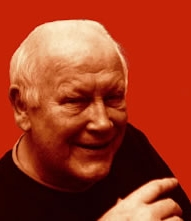
In the depths of the Bad Semester (how I now refer to the last four months), Dr. Charles Whitehead contacted me to share notes on neuroanthropology. I’m trying to catch up with the immense backlog of material I need to work through, but I thought I would post a short note and a link to his website, Social Mirrors. It’s a pretty interesting spread of thinking, and Dr. Whitehead has provided numerous links to his papers and other material.Dr. Charles Whitehead
I especially like his piece with Prof. Robert Turner, downloadable here, on the effects of collective representations on the brain. In particular, the Turner and Whitehead article argues that the idea that certain areas of the brain are networked into a ‘social brain’ — implying that the rest of the brain is ‘not social’ — is hard to support. I’ll admit that I don’t necessarily use the same language or conceive of how the brain works in the ways described by Turner and Whitehead, but it is well worth the read to check it out, if for no other reason that it provides a corrective to some emerging ways of theorizing brain enculturation.
Turner and Whitehead take the multiple senses of the word, ‘representation,’ especially the conflicting use by anthropologists and social scientists, on the one hand, and brain sciences, as a point of departure. Normally, I just find the overlap annoying and have argued that it is one reason that anthropologists don’t ‘get it’ when it comes to neurosciences (for example, in Beyond Bourdieu’s ‘body’ — giving too much credit?). But Turner and Whitehead have something more constructive to say about the unstable term (from their conclusion):
The second in this occasional series, the featured artist today is the Congolese musician Sam Mangwana. He is one of the leaders of the Soukous genre, derived from the French “secouer” (to shake) and once known as the African rumba. That means it’s fun! I also find it fascinating how it mixes African and Latin rhythms and sound together.
This YouTube clip is just the music really, not much video, but it’s a great tune with Franco and TPOK Jazz.
If you like that, the best place I’ve found to listen to some of Sam Magwana’s music is over at Rhapsody.
In his early years, Mangwana formally studied music as a member of the Salvation Army Chorus. While in his mid-teens, Mangwana began his professional career. At age 17, he became the lead singer of the group ‘Tabu Ley Rocherau’s Africa Fiesta’, in addition to singing with the band for over 10 years, Mangwana appeared with other popular Soukous bands. In 1976, he formed his own band called the ‘African All Stars’, in 86′ their single “Maria Tebba,” became a huge soukous hit. He sings in seven different languages, both African and European and has toured extensively inside and outside Africa, justifying his tag as the ‘International Sam Mangwana’ and the ‘Pigeon Voyager’. Mangwana serves up a blend of Cuban and Congolese sounds, seamlessly fusing them together. Mangwana’s style is referred to as the Congolese Rumba because he deftly takes Cuban styles and puts any number of Congolese (or Mangwanese) twists to it.
The Beautiful Mind is a spectacular online photo exhibition that features images of the brain taken by neuroscientists themselves. The enception.org site features a Flash display of the exhibit, with a useful roll-over feature where you can see the person who took the shot, where it was taken, and what anatomical feature is being displayed.
The online exhibit will become a traveling exhibition beginning in the new year, starting in London and then moving around Europe. The exhibition is being organized by CORTEX: Cooperation in Research and Training for European Excellence in the Neurosciences.
The hattip goes to Mind Hacks, who just featured the exhibit info in the post The Fire Within. Almost all The Beautiful Mind images use flourescence techniques, which we have shown before in Brainbows and More on Brainbow.
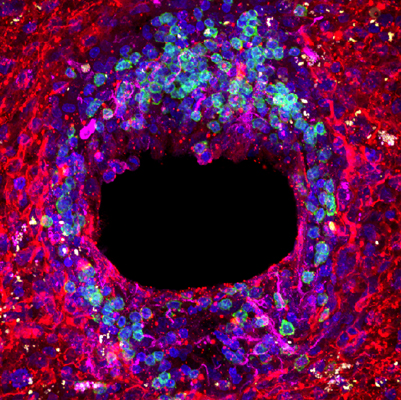
Below I feature some of the images. For more go for a visit to The Beautiful Mind.
Here are the photographers and their images:
-Carlos Barcia, Blood vessel, tumor, and infiltration of T cells
-Veronica Kurscha, Tranverse section of the spinal cord
-Matei Bolbora, Neural precursor cells from the embryonic striatum
-Jean-Marc Fritschy, Purkinje cell in the cerebellum
The Online Education Database published their list of 101 Fascinating Brain Blogs this week. There are psychology, psychiatry, technology, neuroscience, ethics and law, multidisciplinary, mental disorders and abnormal psychology, mental health and various brain blog categories. We land in the multidisciplinary category, along with fellow anthro blog Somatosphere.
If you see some that are missing, please feel free to leave a comment below. I didn’t see one on addiction, and recently I have been checking out Addiction Inbox.
One blog on the list that I didn’t know about is the Neuro-Journalism Mill, separating neuroscience stories in the press into wheat and chaff. No suprise that the chaff list is much longer…
I also discovered Half-Full, which covers “science for raising happy kids.” Television, family conflict, being connected – all things that happen in my house!

 Neuroanthropology