Wednesday Round Up #71

So this week, we’ve got a bunch of short things up front – faves, science & health journalism, brain health, book recommendations, and the environment. Then I go onto anthropology and neuroscience.

Top of the List

Bruno Latour, What Is the Style of Matters of Concern?
Latour’s Spinoza lectures – one on our understanding of nature, the other on aesthetics and active philosophy (or, stop committing violence to our common sense…)

Jason Mitchell, Contributions of Functional Neuroimaging to the Study of Social Cognition
Pdf of a 2008 paper from the Harvard psychologist – a nice overview that also addresses some of the critiques

Nicolas Baumard, In Praise of Neuroscience (for once)
Looking at how parts of the brain are specialized for culture, seen through the localization of the Visual Word Form area (part of how you read) across subjects and societies and in neuronal constraints on writing systems

Alex Golub, Golublog
Alex has been writing on his return to fieldwork in Papua New Guinea – great to read the series of posts sharing the trials and dilemmas of doing ethnographic work

Incubus, Are You In?
Just a song I enjoyed

Bob Herbert, Behind the Façade
The best thing I read this past week -the NY Times columnist discusses Michael Jackson and our culture of immaturity and irresponsibility.

Troublemaker’s Fringe – Problems in the Journalism of Science and Health

Petra Boyton, Reporting Back from Last Night’s Troublemaker’s Fringe
Petra, Vaughan Bell and Ben Goldacre get together to discuss bad journalism of science and health. What an event. Petra slants her comments towards the eight problems she sees in today’s journalism.

Continue reading “Wednesday Round Up #71”

In praise of partial explanation (and flowcharts)

Created by RPM at Evolgen
During our panel at the American Anthropology Association last year, Prof. Naomi Quinn warned that ‘a flowchart is not a theory.’ She stressed the limits to the explanatory power of a simple diagram; her skepticism, of course, is entirely warranted.

But since I was one of the prime offenders with the explanatory flowchart, and I seem to be using them more and more, I wanted to offer a stalwart defense of the use of flowcharts and diagramming in neuroanthropology, especially as both contribute to the practice of partial explanation. So, to pick up a theme from a number of my posts, ‘yes-you’re-right-but-I-still-disagree,’ here’s why I find flowcharts particularly useful and think anthropologists should be doing a lot more diagramming to highlight complex patterns of causation, situating more broadly the parts of complex systems that they are exploring.

But before I go any further, I need to direct all our readers to the recent announcement of the first Neuroanthropology conference which Daniel posted. Although I want to post, I feel like I also want to keep drawing attention to this announcement. But on with it…

As with all of her comments, I felt that Prof. Quinn cut to the quick, highlighting an issue in a cautionary fashion rather than rejecting specific arguments our panelists were making (at least I don’t think she was just calling me out…). In the case of flowcharts, Prof. Quinn suggested that diagramming relationships was a preliminary step, not a final goal – at least that’s one of the ways that I took her comments – and I agree.

Continue reading “In praise of partial explanation (and flowcharts)”

Hosting Four Stone Hearth – send submissions

Cartoon by Hugh MacLeod at gapingvoid.com
We’ll be hosting Four Stone Hearth, the itinerant carnival of anthropology, on 15 July 2009.

So please send us links to your recent postings on anthropology of all sorts. If you can submit them to me by the 12th or 13th, that’d be brilliant; you can reach me at greg{dot}downey{at}mq{dot]edu{dot}au. If you’ve read something totally boss on someone else’s anthropology blog, please don’t hesitate to send along the link, and we’ll try to direct more readers to the piece.

Four Stone Hearth brings together the four subfields of anthropology: archaeological, linguistic, biological and socio-cultural. It’s a veritable anthro-polooza of anthro-blogilization, so make sure you’re part of it!

And check back after the 15th to see who showed up, and whether any of our guests drank too much and went crowd surfing or hooked up with someone inappropriate.

Credits: If you like this cartoon, visit Hugh MacLeod at Gapingvoid.com for many more of his back-of-a-business-card sketches.

Monday Morning Artist: Robbie Cooper

Immersion Gaming by Robbie Cooper
Robbie Cooper is a photographer and videographer who mixes his artistic work with an ethnographic eye and a neuroanthrological sensibility. After all, this is someone who goes from Gilles Deleuze to Paul Ekman as he describes his work!

As a photographer Robbie has recently focused on capturing our digital representation of our selves – the avatars we create in online worlds like Everquest and World of Warcraft. Previously he had done photojournalism in Africa. As a video artist, he shoots stunning and provocative video, capturing people in some of their most intimate, involved moments with a clear and human-centered approach.

Avatar by Robbie CooperHe published his avatar photographs in the glossy book The Alter Ego, featuring portraits and bios of gamers from the United States, Europe, China, and Japan. You can read more about the book in reviews by Colin Pantall and Escapist Magazine, as well as read this interview with Robbie and his co-author and listen to some good coverage of Alter Ego on NPR.
On his homepage you can access a good slice of these pictures, complete with a text overview you can all up. This is the Alter Ego series in the Immersion side of his work. For just the photos you can go directly to this slideshow from the NY Times.

The NY Times also featured his Immersion video, which captured young gamers as they played. The portrayal of their involvement is intimate and intense, and I recommend either the Times video for the quality (you can also get even better video on Robbie’s homepage through the Immersion – but it’s a few more clicks).

The Immersion video is also up on YouTube so I’ve embedded it below. Alongside the video, you can see the Immersion photo series on Robbie’s website – it’s there in the Immersion link after you click on Simulations.

His latest work builds on the Immersion approach. This time it’s Immersion – Porn (yes, you can get the video on that link). In this video informants introduce themselves and then we get to see their own immersion into themselves, top-up only. It was produced exclusively for Wallpaper.

I’ve also been enjoying his Immersion blog. Of late he’s had a humorous take on Ekman’s emotional faces, an intense video of close combat in Iraq, and babies as challenging both science and philosophy.

Link to Robbie Cooper’s homepage and art.
Link to Robbie Cooper’s Immersion blog.

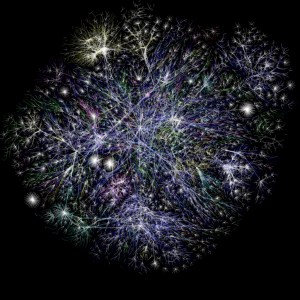
The Breadth of the Net

Internet_map_1024

Five links that range across the things that interest us here at Neuroanthropology.net. Enjoy!

Global Voices Online
“The world is talking. Are you listening?”: Bringing together and highlighting stories that most global media ignore

Top 10 Psychology Blogs for Curious Minds
From BPS Digest to We’re Only Human, it’s a quality list

The You Tube Reporters’ Center
Interviews and advice from top-notch journalists on how we can all do better reporting

Top 20 TED Talks for Busy School Administrators
Definitely not for professors – they might watch too much. Especially if they are trying to get tenure.

Neuroimages
Neurophilosophy’s Mo Costandi has set up an image-only site, Neuroimages. Some beautiful stuff.

Four Stone Hearth #70

Afarensis
A great issue of Four Stone Hearth, the anthropology carnival, is over at Afarensis: Anthropology, Evolution and Science.

From sex on the moon and virtual communities to orangs as our closest relatives?, this edition is extensive, with highlights from all four fields.

Also note that Afarnesis is now at a new site – moving from the old scienceblogs to the new wordpress. Besides getting his own real-life monster name, you can find out why your dog looks guilty and the relationships between lungfish, trout and humans.

From this edition I’d like to highlight two pieces on evolution of intellience, Blair Bolles’ meditation on tool use, language evolution, and the context of adaptation, and Razib’s piece on the evolution of the brain and the role of social competition in the increasing cranial size in our lineage. The two pieces work quite well together.

There is plenty more great stuff over at Four Stone Hearth #70, so run or walk (like a good afarensis) there now.

Link to Four Stone Hearth #70