Your Brain on Nature: Outdoors and Out of Reach 2

Daniel and I exchanged emails about the recent piece in The New York Times, ‘Outdoors and Out of Reach, Studying the Brain,’ by Matt Richtel. We both responded strongly to the article; although we liked the discussion of technology’s effects on cognition and the positive benefits of being in nature (and away from digital technology), getting down to thinking through the various points left us both feeling pretty cranky (maybe not enough time in nature, eh?). Daniel’s already taken on some of the issues that could be raised with the piece, but I just wanted to pick up a few other threads.

The article discusses a river trip including five neuroscientists who took time away from their typical routine of digital interaction, dwelling in built environments, and conducting research to float down a river valley in Utah and spend some quality time with bats and cliffs as well as each other. To be honest, this sounds pretty idyllic to me, and I think far more conferences should be held outdoors in tents rather than in rented hotel meeting rooms with PowerPoint slides, 15-minute papers and cellophane-wrapped muffins. A whole new industry of Adventure Academic Meetings could allow physicists to discuss new breakthroughs while spelunking or philosophers to reflect on Continental theory while snowshoeing. Sign me up for the Anthropologists Hike the Appalachian Trail conference, but count me out of International Neuroanthro-Bungee 2012!

The participants in the white-watering brain sciences tête-à-tête seem to share my enthusiasm for a change in conference formats:

“There’s a real mental freedom in knowing no one or nothing can interrupt you,” Mr. Braver says. He echoes the others in noting that the trip is in many ways more effective than work retreats set in hotels, often involving hundreds of people who shuffle through quick meetings, wielding BlackBerrys. “It’s why I got into science, to talk about ideas.”

One of the first things that irritated me in the NYTimes piece, however, was the conflation of living the ‘life uninterrupted’ — having a small, intimate retreat with a handful of people — and being ‘in Nature,’ as if the two were inherently inextricable. Of course, one wouldn’t have to invite hundreds of people to the hotel for a conference, and the conversations would likely be a lot more intimate and less distracted, even if your small group was at a spa or dude ranch. Likewise, you can go to Nature at an outdoor music festival and feel completely over-stimulated, even though you have no access to electricity or indoor plumbing.

Continue reading “Your Brain on Nature: Outdoors and Out of Reach 2”

Chronicle on Marc Hauser

Big update on the Marc Hauser affair, and the seriousness of the research misconduct allegations and the irony of this from the author of Moral Minds. The Chronicle for Higher Education has a piece out today which sheds light on the internal investigation and the assertions by research assistants in Hauser’s Harvard lab of misconduct.

The research assistant who analyzed the data and the graduate student decided to review the tapes themselves, without Mr. Hauser’s permission, the document says. They each coded the results independently. Their findings concurred with the conclusion that the experiment had failed: The monkeys didn’t appear to react to the change in patterns.

They then reviewed Mr. Hauser’s coding and, according to the research assistant’s statement, discovered that what he had written down bore little relation to what they had actually observed on the videotapes. He would, for instance, mark that a monkey had turned its head when the monkey didn’t so much as flinch. It wasn’t simply a case of differing interpretations, they believed: His data were just completely wrong.

Here’s the link for more – Document Sheds Light on Investigation at Harvard

And if you’re looking for more background, Nicholas Wade at the NY Times had a very good piece a week ago, In Harvard Lab Inquiry, a Raid and 3-Year Wait.

Update: Nicholas Wade came out with further coverage at NYT in the article Harvard Finds Scientist Guilty of Misconduct.

Harvard University said Friday that it had found a prominent researcher, Marc Hauser, “solely responsible” for eight instances of scientific misconduct.

Hours later, Dr. Hauser, a rising star for his explorations into cognition and morality, made his first public statement since news of the inquiry emerged last week, telling The New York Times, “I acknowledge that I made some significant mistakes” and saying he was “deeply sorry for the problems this case had caused to my students, my colleagues and my university.”

Also, you can find the entire letter/email here sent by Harvard Dean Michael Smith to the faculty, where he confirms the scientific misconduct to the entire Faculty of Arts and Sciences

Wednesday Round Up #116

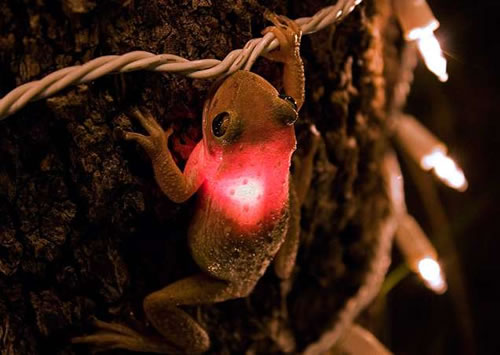
I took the dogs outside this morning, and the air turned liquid. Drops of rain fell in the trees, Tampa’s humidity condensed amid leaves and branches. The stars gleamed hazy through the trees, and the two dogs sniffed their way around the yard. A frog called beside the house. I walked down the driveway, looked at the other neighbors’ trash, and still I smiled.

I found this apropos photo, a Cuban tree frog photographed by James Snyder in southern Florida, and originally featured on National Geographic’s Daily Dozen. Find out what he had to say about the shot over at Neatorama.

This week I’ve done my favs, then an excellent selection on culture and cognition. After that some health, some anthropology, some cognition, some A. afarensis tool use. Cannabis and the Last Word, a poem this time, finish it off.

I had a lot of help from my new graduate assistant Ethel Saryee in putting this round up together. So thanks to her!

Top of the List

Brian Mossop, The Brains of Our Fathers: Does Parenting Rewire Dads?
Uh oh, my sons have reprogrammed me! Must be why I love playing video games with them… (Not sure my wife will buy that…) Very nice piece on neural plasticity, development, and father-son relationships over at Scientific American

Melody Dye, A Thinking Machine: On Metaphors of the Mind
Are we pre-programmed spreadsheets or search algorithms? Metaphors matter, because they can dictate our assumptions.

Paul Thagard, Why Cognitive Science Needs Philosophy and Vice Versa
Cognitive science and philosophy NEED each other. In this article (pdf), critiques of rationalist, analytic, and postmodern approaches while talking about how to do synthesis.

Awkward Family Photos – Hall of Fame
Oh, these made me laugh!

PZ Myers, Ray Kurzweil Does Not Understand the Brain
Pharyngula takes the computer guru to task for claiming he’ll be able to reverse engineer the brain in a decade. My favorite line:

To simplify it so a computer science guy can get it, Kurzweil has everything completely wrong. The genome is not the program; it’s the data. The program is the ontogeny of the organism, which is an emergent property of interactions between the regulatory components of the genome and the environment, which uses that data to build species-specific properties of the organism.

Vaughan Bell, A Gut Reaction to Moral Transgressions
Mind Hacks on how gut feelings and reactions can be the “unrecognised basis of moral judgements and social customs”

David Harvey, RSA Animate – Crises of Capitalism
An animated Marxist perspective! The graphical animation alone is worth it, but Harvey’s analysis is as illustrative as the drawings.

Psychology around the World

Ed Yong, Genes and Culture: OXTR Gene Influences Social Behaviour Differently in Americans and Koreans
Not Exactly Rocket Science on some intriguing research: “In both cases, the G carriers were more sensitive to the social conventions of their own cultures. But the differences between these conventions led to different behaviour.”

Continue reading “Wednesday Round Up #116”

Your Brain Unleashed – Outdoors and Out of Reach

Ah, rafting the San Juan River in southern Utah, camping and hiking for a week – for most people, a vacation. But for a select group of brain researchers, and some accompanying journalists, it was “serious work.”

It was a primitive trip with a sophisticated goal: to understand how heavy use of digital devices and other technology changes how we think and behave, and how a retreat into nature might reverse those effects.

The whole technology vs. nature theme is a hit, as the NY Times article, Your Brain on Computers: Outdoors and Out of Reach, Studying the Brain, is the most popular article there right now. But that dichotomy of technology as bad and nature as good is a false one. Worse, the prism of the brain proves to be dangerous rapids rather than a river of explanation.

I’ll start with the money quote for me:

Back in the car, Mr. Kramer says he checked his phone because he was waiting for important news: whether his lab has received a $25 million grant from the military to apply neuroscience to the study of ergonomics. He has instructed his staff to send a text message to an emergency satellite phone the group will carry with them.

Mr. Atchley says he doesn’t understand why Mr. Kramer would bother. “The grant will still be there when you get back,” he says.

“Of course you’d want to know about a $25 million grant,” Mr. Kramer responds. Pressed by Mr. Atchley on the significance of knowing immediately, he adds: “They would expect me to get right back to them.”

It is a debate that has become increasingly common as technology has redefined the notion of what is “urgent.” How soon do people need to get information and respond to it? The believers in the group say the drumbeat of incoming data has created a false sense of urgency that can affect people’s ability to focus.

The anthropologists among you should already know where I am going – the conflation of a social expectation, a social reality, with a technological cause. The money quote really is just this, “They would expect me to get right back to them.” But rather than dwelling on that, the piece then asserts that “technology has redefined the notion of what is ‘urgent’.” Sorry, but it was actually people who did that, people and their social expectations. Technology doesn’t come to us unmediated by culture. Rather, technology is culture.

Unfortunately a good ethnographic moment, which says one thing about human life, is turned into a reductive, brain-oriented explanation in the next paragraph – the expectation to get back to someone becomes the drumbeat of incoming data. Yet they are two very different things.

Continue reading “Your Brain Unleashed – Outdoors and Out of Reach”

John Hawks Massive Human Evolution Bibliography Online

John Hawks, who runs the excellent John Hawks Weblog, has placed his entire collection of 11,500 citations online. He describes the bibliography in his announcement of this wonderful new feature to his blog:

At present this database includes more than 11,500 entries. These represent a large fraction of the historical and contemporary literature in human evolution…

The bibliography has a search filter, search terms will match author, keyword, title or abstract (where present). With more than 11,000 entries, you want to be a little selective about how you search. Author names work really well, and yield a list separated by year of publication.

You’ll find each reference preceded by a unique citation key in brackets. I did this purely for my own convenience, but for those who may want to download lists of citations, it may also prove useful.

A list of search results can be exported to BibTeX or RTF format for download.

There is also a “filter” tab that allows keyword, author, and year filtering of the list. This is really not very useful; the size of the database makes it much simpler to search than to filter all entries.

Link to John Hawks Bibliography

Link to Hawks Announcement and Description of the Online Bibliography

The drawing above is also by John, and I quite liked it. Here’s the link to its original posting over at his Weblog.