US Presidential campaign wordpiles

What's on your mind?
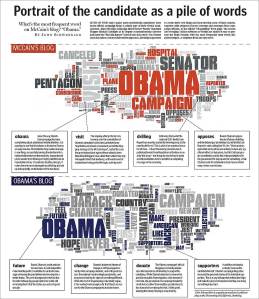
The Boston Globe did a ‘Wordpile’ analysis of both Sen. John McCain and Sen. Barack Obama’s websites and generated some fascinating graphics. Check out the original here. There’s lots one could say about these graphics — the Globe only highlights a few of the fascinating terms, and I’d want to try to chase down the context of a few that show up prominently because they look pretty ambiguous — but some factors stand out clear as day. The most obvious is that ‘Obama’ is the most mentioned word on both blogs. ‘Veeeery inturusting…’

The reason I bring this visual up though is that I found it a fascinating, graphically powerful way to present a basic qualitative-quantitative bit of research. Although I’m intrigued by research tools like nVivo and Atlas.ti, I sometimes wish that there were richer ways to present the data. This ‘Wordpile’ output is rich enough to put on a t-shirt! I’ll have to find some way to integrate it into my seminars on hybrid research methods.

And if anyone knows where I can lay my hands on the software or script to generate this sort of thing, please send along the link. A quick search didn’t give me anything, and I don’t want to sit in my office all Friday obsessing about this.

Les Perceptions Culturelles

Je voudrais parler de mes observations sur la vie en France et en Indonesie et expliquer pourquoi le fait d’avoir vecu un an en Indonesie m’a aidé a mieux comprendre le comportement des Parisiens.

Les Parisiens courent dans le metro, sont vite agressifs et s’enervent facilement. Par contre, les Indonesiens sont toujours des modeles de politesse et restent souriants en (presque) toutes circonstances. Les complications de la vie quotidienne sont acceptees comme inevitables et ne provoquent pas de colere. Ce n’est pas convenable de critiquer son prochain, la critique est mal vue et mal recue. Cette absence d’esprit critique suggere une contribution de la resignation et n’est que partiellement due aux conditions economiques. A mon avie, cette mentalité augmente aussi ces conditions economiques.

Je realise qu’on ne peut pas comparer une culture a une autre par des generalites mais il est parfois difficile de les eviter; en fait le terme “culture” est, lui-meme, une generalité. Bien sur tous les Indonesiens ne sont pas paresseux et tous les Parisiens ne sont pas “stressés”. Mais, lorsqu’on a l’occasion de vivre dans un certain milieu et de se conformer aux usages et habitudes locales de cette societe, on s’apercoit que certaines de ces coutumes sont considerees comme un trait specifique par une autre societe. Une analyse plus approfondie mêne a la notion de “caracteres nationaux”. Si on interroge un nombre de personnes qui ont voyagé dans le Metro Parisien et dans un “Angkot” a Sumatra, la similarité des remarques et observations conduit naturellement a une generalisation.

C’est a Paris que j’ai decouvert et apprecie l’aspect positif de la culture de la critique. C’est regrettable, bien sur, de voir la tension arterielle monter a cause de problemes auxquels on a, peut-etre, donné une importance exagerée, mais cette reaction est associée a la volonté de faire face a ces problemes et de les resoudre. De ce point de vue, l’apparente (ou reelle?) indifference de l’Indonesien aux vicissitudes de la vie quotidienne suggere une sorte de resignation qui tend a faire accepter les problemes comme inevitables et insolubles.

Quel est le comportement a choisir? Il n’y a probablement pas de réponse valide car le comportement de l’individu est conformé a celui de la societé dans laquelle il a evolué, de ses lois, ses coutumes, ses religions, son environnement etc, etc…

Lorsqu’un individu est introduit dans une societé de differente culture, l’assimilation est tres souvent achevée en une ou deux generations. Cette assimilation est probablement catalysée par le desir  “d’appartenance”.

En depit des differences caracteristiques separant les deux cultures ,je pense qu’ on peut detecter dans chacune un desir d’ameliorer  ses structures sociales et un certain sens de l’esthetique revelé par ses industries et ses arts.

Somatosphere: Science, Medicine and Anthropology


Somatosphere is a new blog focusing on medical anthropology. Eugene Raikhel, a post-doc at McGill, is the primary blogger but there is also a group of contributing anthropologists.

I met Eugene last December at the big annual anthro conference, then again when I was at McGill in July for the critical neuroscience conference. I’ve been waiting to introduce his blog since then, mostly letting him build up an impressive collection of material.

Just yesterday he posted links to some great podcasts with neuroscientists (including Michael Rutter, whom I’ve always wanted to hear) over at the Wellcome Trust Centre for the History of Medicine.

His recent Web Gleanings includes a nice round up of posts and on-line articles ranging over topics like expertise, the limitations of biological psychiatry, antibiotic-resistant bacteria, and the history of treating fatigue.

And if you’re interested in cultural competence, illness narratives, and grandma’s little drug helper, then you’ll find all that and more at Somatosphere.

Michael Wesch and You Tube

Michael Wesch, anthropologist of the digital age, delivers a lengthy lecture at the Library of Congress on the emergence of You Tube and the uses of video in an Internet age. Viral trends in video, global consumption, and the creation of meaning and connections… Lots in this talk, plus some funny clips.

We’ve featured Wesch and his videos before. He also runs a blog/video site entitled Digital Ethnography. His reflection on “context collapse” is quite interesting. Now here’s his talk.

Wednesday Round Up #25

Interactions

Madeline Drexter, How Racism Hurts – Literally
“racism literally hurts the body. More than 100 studies — most published since 2000 — now document the effects of racial discrimination on physical health”

Jamie Davies, Switching Pain Off? Coping with Pain and Pain Experience
Perception and managing pain and even a You Tube Scrubs clip – very funny

Edward Slingerland, Let’s Get Clear about Materialism
A critical take on David Brooks’ Neural Buddhism, and what materialism (e.g., grounding social and psychological phenomena in the brain) really means

P. Pascal Zachary, Digital Designers Rediscover Their Hands
Software designers get hands-on with real world objects to learn to think more creatively and intuitively

Cordelia Fine, Words that Can Change Your Mind
The transformative effects of books

Globalization, Development and Change

Matthew Trevisan, Social Networking for Social Change
Social entrepreneurs aim to bring people together to help educate and create change

Reflection Café, The UC Atlas of Global Inequality
Get your fix on online, downloadable maps on inequality worldwide. Reflection Café provides a nice introduction and overview, but if you want to go directly to mapping, by all means do so.

NextBillion.Net, The Newsroom
Check out recent articles and blog posts on enterprise and development aimed for non-established markets and for people at the bottom of the economic food chain

Continue reading “Wednesday Round Up #25”

Human evolution syllabus

I’ve been contributing too little to Neuroanthropology of late. To be honest, I’m exhausted. I’m doing a new class on human evolution and diversity for the anthropology department here at Macquarie University, and it’s kicking my posterior. I have all the usual time devouring requirements of a new class, with the added fun of 130 students, my own high expectations, and my desire to put biocultural and biological anthropology on a bit more solid footing here. I was never trained to do this — although I really enjoyed human evolution, archaeology, and biological anthropology as an undergraduate — but I really felt like it needed to be done, even if I’m not the ideal person to do it.

As recently as 2005 and 2006, a very noisy law professor here at Macquarie, Dr. Andrew Fraser, was advocating a return to the ‘White Australia’ immigration policy (see Wikipedia on him here). As Wikipedia explains (I don’t want to do the legwork on this one to give it a deeper reading): ‘In July, 2005, he received national attention in Australia by opposing non-European immigration, saying that Australia should withdraw from refugee conventions to avoid becoming “a colony of the Third World” and that African immigration increased crime rates.’ His explanation was a hodge-podge of ‘scientific racism’, discredited eugenic theory, and over-heated rhetoric. The timing was ironic; when I was trying to negotiate the terms of my contract, Macquarie was sealing off its campus because of the furor.

I felt that anthropologists needed to respond to Fraser’s ideas (as well as a lot of other things) with a serious biological anthropology unit on evolution and diversity in humanity. But our department has, of late, been offering almost entirely sociocultural anthropology, as many European and Australian departments do. And that’s how I got to offer a unit, ‘Human Evolution and Diversity,’ for Macquarie first-year students. It’s been going well, but it’s draining me.

Continue reading “Human evolution syllabus”