
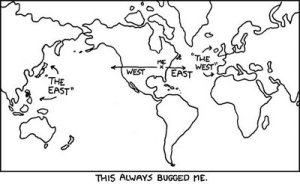
 In a recent article in American Psychologist, Adam Cohen (2009) suggests that a number of fields in psychology have taken up the study of culture, but the results, although interesting, have been limited by what sorts of ‘culture’ have been investigated. As Cohen (2009:194) writes:
A person reading these literatures could be excused for concluding that there is a very small number of cultural identities (North American vs. East or Southeast Asian), that vary principally on the dimensions of individualism–collectivism or independent–interdependent self-construal—whether people are seen as inherently independent from others or whether social roles are most important in defining the self.
In this post, I want to provide a bit of a bibliography of some of the literature fast emerging on cultural difference in psychology, neuroimaging, and related fields, but also focus a bit on the consequences of this limited imagination in considering cultural difference, the almost exclusive focus on East-West contrasts. Just because I love a bit of controversy with my breakfast, I’ll suggest it’s a form of what Edward Said has called ‘Orientalism.’
Although Cohen brings up the issue and offers a few suggestions for how the problem might be addressed, I think his prescriptions would herald more of the same sickness, although perhaps spreading the infection to more hosts. That is, Cohen puts his finger on a serious problem in the psychological study of culture, but the prognosis won’t improve much unless we actually understand the root of the problem: it’s not studying Europeans (and European-Americans) and Asians (and Asian-Americans) that’s causing the whole problem. Part of it is misunderstanding what is being studied in the first place when cultural difference is under the lens.
This post is based on part of a talk I gave on Tuesday to the Centre for Cognitive Science (MACCS) here at Macquarie. When I got into the subject, I realized it was far more than I could possibly share in a 50-minute presentation, so I thought I’d post it here.
Continue reading “Escaping Orientalism in cultural psychology”

 Intellectual labels are always a tricky business, necessary for talking about ideas and suggesting that a theorist is in a particular ideological neighborhood. Yet, they can drag along so much baggage that they become self-defeating, evoking instant resistance or inevitable misinterpretation if poorly used. In the best of cases, they can help to create a clear identity for innovative work in an academic field, speeding the effort to carve out a space for ideas in a cluttered terrain of thought. Deployed well, they can help to clarify and orient us; applied clumsily, they become intellectual invective, prematurely close off discussion or debate, and substitute labeling for thinking.
 All kinds of conference announcements are coming into us here at Neuroanthropology! We have another one that may be of interest to our readers, scheduled for London in May 2009. Among the guest speakers will be Harvey Whitehouse (Oxford), Rom Harré (LSE), George Gaskell (LSE), and Fathali Moghaddam (Georgetown).
 Neuroanthropology