Neil Scheurich, Time Out of Joint
“I’ve always been interested in the way psychology has struggled to deal with the hulking fact of human depravity.”
Open Anthropology, UAE’s The National on the Human Terrain System (2.0)
Maximilian gives us a well-written critical reflection on the Human Terrain System – as the last entry for the foreseeable future, this is a great one to read
CNN, The World’s Most Heinous Crime
The 60th anniversary of the UN Genocide Convention, a timeline of genocides since then, and questions about how and if genocide will stop
Anthropology
Hannah Fearn, The Great Divide
Social vs. evolutionary anthropology! Biology vs. culture makes a good story, even though there is some “reaching out” moments in the second half of the piece. For some critical reaction, see Michael Stewart’s post
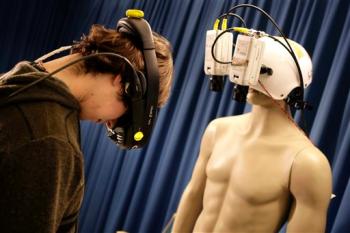
Do psychotherapists now have a new trick? Or is it all smoke and mirrors? The New York Times reports today on Standing in Someone Else’s Shoes, Almost for Real, where neuroscientists have shown that “the brain, when tricked by optical and sensory illusions, can quickly adopt any other human form, no matter how different, as its own.”
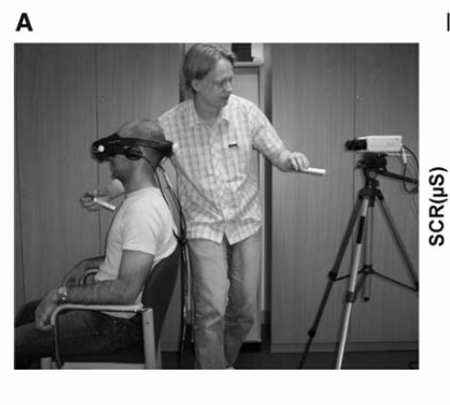
A subject stands or sits opposite the scientist, as if engaged in an interview.. Both are wearing headsets, with special goggles, the scientist’s containing small film cameras. The goggles are rigged so the subject sees what the scientist sees: to the right and left are the scientist’s arms, and below is the scientist’s body. To add a physical element, the researchers have each person squeeze the other’s hand, as if in a handshake. Now the subject can see and “feel” the new body. In a matter of seconds, the illusion is complete.
This “switching” happens because the brain is literally embodied – after growing up with this particular body, it’s a fair assumption to assume that one’s eyes and one’s hand are getting feedback about the same interactive phenomenon. For a first-person view of this, see Karl Ritter’s AP article today on the body-swap illusion, which includes this photo of the two-goggle set-up.
Ehrsson is excited about being able to trick the brain in this way: “You can see the possibilities, putting a male in a female body, young in old, white in black and vice versa.” The NY Times article pushes the uses body swapping can have in therapy.
The second edition of the MetaCarnival, a round up of some of the best carnivals out there, is now up at Emergiblog. The MetaCarnival is the brainchild of Alvaro Fernandez of Sharp Brains fame, and Sharp Brains features the archives, calendar and basic info. The basic format is for carnival administrators to submit 1 or 2 picks from their respective carnivals, and those get gathered together in the “carnival of carnivals.”
Emergiblog’s MetaCarnival features stuff from the bran/mind carnival Encephalon and the anthropology carnival Four Stone Hearth, but also goes further afield into classic science papers, academic life, surgery, medicine, and nursing.
The December 29th edition will be hosted at Science Roll. Carnival administrators can send submissions to berci.mesko at gmail dot com.
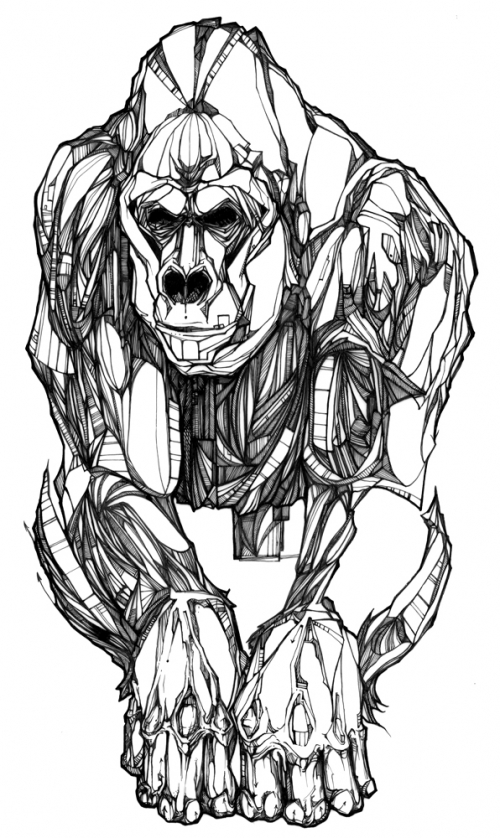
So this starts a new and occasional series, the Monday Morning Artist. I just came across Chow Martin’s work through We Heart It, a new image sharing site that was featured in a recent NY Times article. The two drawings here come from Martin’s 1.5 Exhibit on his Behance Network site. Martin also has his own website. You can reach him at chow [at] chowmartin [dot] com.
Way back in January, I posted ‘Equilibrium, modularity, and training the brain-body.‘ At the American Anthropology Association annual meeting, I presented my current version of this research, significantly updating it with ethnographic material from Brazil, a comparative discussion of different techniques for training balance, and a series of graphics that I hope help to make my points. The title of that paper was ‘Balancing Between Cultures: A Comparative Neuroanthropology of Equilibrium in Sports and Dance.’
I’ve decided to post a version of this paper here, with the caveat that it’s still a work-in-progress. I’d be delighted to read any feedback people are willing to offer.
Introduction
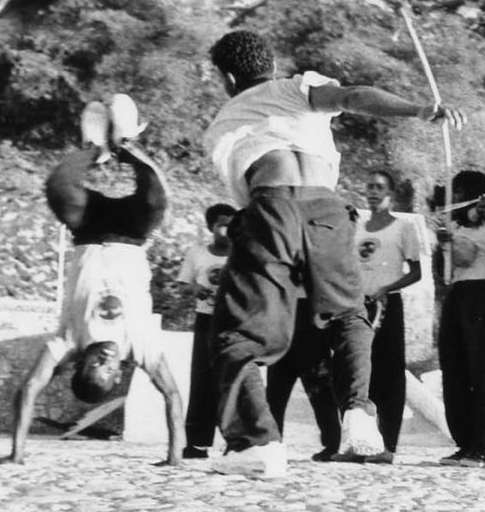
Boca d' Rio does a bananeiraAs a cultural anthropologist interested in the effects of physical training and perceptual learning, I see ‘neuroanthropology’ as a continuation of the cognitive anthropology advocated by Claudia Strauss and Naomi Quinn (1997).
The new label, however, reflects engagement with a new generation of brain research, what Andy Clark (1997) refers to as ‘third wave’ cognitive science, or work on embodied cognition.1 Much of the ‘third wave’ does not focus strictly on what we normally refer to as ‘cognition,’ that is, consciousness, memory, or symbolic reasoning. Rather embodied cognition often highlights other brain activities, such as motor, perceptual and regulatory functions, and the influence of embodiment on thought itself; this is the reason I’m thrilled to have endocrinologist Robert Sapolsky as part of this panel, as his work is part of the expanded engagement of neuroanthropology with organic embodiment.2.
My own entry into neuroanthropology results from three influences: a phenomenological interest in cultural variation in human perception, anthropological study of embodiment, and apprenticeship-based ethnographic methods. This method posed an odd question during my field research on the Afro-Brazilian martial art and dance, capoeira. Simply put, as a devoted apprentice-observer, I failed to maintain hermeneutical agnosticism and started to ask, ‘Is what my teachers and peers report — and I too seem to be experiencing — plausible?’


 Neuroanthropology