Fall prevention in older people — Stephen Lord at HCSNet

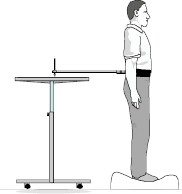
Sway meter, subject on foam
Daniel isn’t the only guy at Neuroanthropology who gets to go to good conferences; last week, while in the throes of a cold brought on by fieldwork with the 15-and-under Sydney city select rugby team, I got to go to the HCSNet Workshop on Speech, Perception and Action held at Western Sydney University.

HCSNet is funded by the Australian Research Council to promote research on human communication. I only got to go to the second day of the two-day conference (because I was cooking meals for 20 hungry rugby hopefuls the first day), but I saw a number of great presentations, including talks by Catherine Best, MARCS Auditory Laboratories, UWS, Beatriz Calvo-Merino, University College London, and Stephen Lord, Prince of Wales Medical Research Institute. I’ll blog soon on Dr. Calvo-Merino, one of the high points of the day, but today I want to make some notes on Prof. Lord’s fascinating research and talk.

Prof. Lord heads the Falls and Balance Research Group. Visit the group’s website for publications and some great information about risk factors for falling. At the conference, Lord discussed the group’s extensive applied research examining different factors that contribute to older people falling and experimental interventions to decrease the contribution of any single factor. The project has created a screening procedure for use by general practitioners to evaluate an older person’s likelihood of falling.

As regular readers know, I’m particularly interested in the way humans maintain equilibrium (see earlier posts, Kids falling down and Equilibrium, modularity, and training the brain-body, and Daniel’s post of some great parkour video, Free Running and Extreme Balance). In the longer of these posts (Equilbrium, modularity…), I specifically discussed how the ‘sense of balance’ is actually a much more complex synthesis of multiple sensory inputs, both exteroception (perception of the world) and interoception (perception of the self).

Continue reading “Fall prevention in older people — Stephen Lord at HCSNet”
Pop Goes the Media

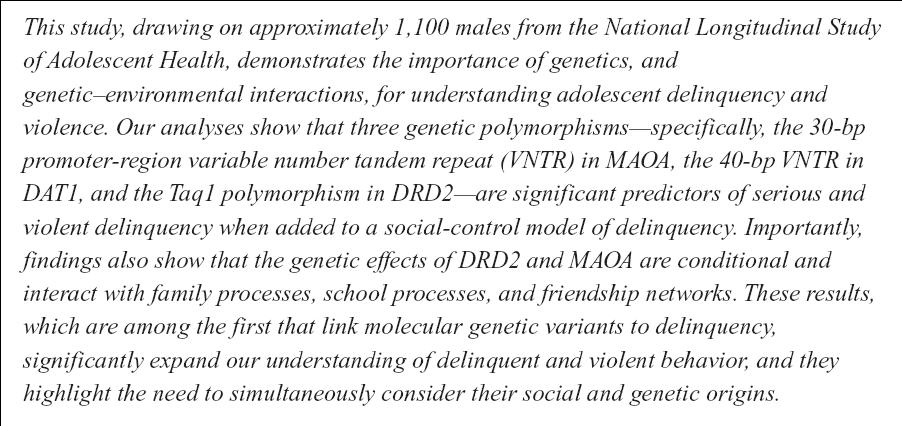
At the Critical Neurosciences meeting in Montreal, Laurence Kirmayer brought up a great example of how research gets transformed and bastardized by the popular media. Here we have sociological research on the complex dynamics behind delinquency becoming the “biology-causes-everything” story.

The original article is entitled “The Integration of Genetic Propensities into Social-Control Models of Delinquency and Violence among Male Youths” (big pdf; supplementary methods materials here) by Guang Guo, Michael Roettger and Tianji Chi at the University of North Carolina – Chapel Hill.

As a featured article in the American Sociological Review, the flagship journal of the American Sociological Association, this article had both a press release and an abstract prepared specially for the media. In other words, there were already digested materials ready for the media! No “misreading” of the original paper allowed.

The press release reads “Sociological Research Shows Combined Impact of Genetics, Social Factors on Delinquency,” with a minor highlight that indicates “Study is among first to tie molecular genetic variants to male delinquency.” The first sentence goes: “[this] sociological research… identifies three genetic predictors—of serious and violent delinquency—that gain predictive precision when considered together with social influences, such as family, friends and school processes.”

The media abstract is even clearer: “[The] genetic effects are conditional and interact with family processes, school processes, and friendship networks. ‘A stronger social-control influence of family, school, or social networks,’ the authors explain, ‘reduces the delinquency-increasing effect of a genetic variant, whereas a weaker social-control influence of family, school, and social networks amplifies the delinquency-increasing effect of a genetic variant’.”

Guang Guo goes on in the ASA media release: “Positive social influences appear to reduce the delinquency-increasing effect of a genetic variant, whereas the effect of these genetic variants is amplified in the absence of social controls. Our research confirms that genetic effects are not deterministic. Gene expression may depend heavily on the environment.”

So how does Reuters, one of the premier reporting services in the world, present the article? “Study finds genetic link to violence, delinquency” reads the title. I’ve included the accompanying photo that comes directly below the title. The Reuters piece got posted at Scientific American, Yahoo and other places, while an even worse photo appears at a “European descent” site.

Continue reading “Pop Goes the Media”

Psychopharma-parenting

Ah, Stephen Colbert with his Word. This very funny and, as always, deadpan accurate video came up at the Critical Neurosciences conference I just attended in Montreal. Kelly McKinney, in her talk about the pop phenomenon of the Teen Brain (see PBS and Time), deserves all the credit for finding it!

Vodpod videos no longer available.

more about "Psychopharma-parenting", posted with vodpod

Here’s the transcript of this segment as well as the NY Times article Colbert mentions.

Update: Mind Hacks has provided a good discussion of “psychopharmaparenting”, in particular the alarming rise in the use of antipsychotics and Ritalin with children (often just to pacify them). As Vaughan writes, “The official line is that these drugs are the last resort, because behavioural interventions – specific programmes that teach parents to manage children’s behaviour in a more effective way – are remarkably effective with a large evidence base to back them up.”

Bench and couch: genetics and psychiatry

Vaughn at Mind Hacks has a nice piece on recent research, reported in Nature, on psychiatric genetics: Mental illness: in with the intron crowd. The original article, Psychiatric genetics: The brains of the family, appeared in Nature on 10 July (but it’s behind a subscription wall if you want to see the original — sorry). Daniel linked to Vaughn’s article in the last Wednesday Round Up (#20), but I wanted to make a further brief comment. Vaughn does a really nice job of laying out the key issues, so I’d recommend jumping over there if this brief discussion whets your appetite.

The problem for neuropsychiatry is that genetic links to psychiatric disorders are proving difficult to clearly define. Abbott explains the situation really well:

Finding genes involved in psychiatric conditions is proving to be particularly intractable because it is still unclear whether the various diagnoses are actually separate diseases with distinct underlying genetics or whether… they will dissolve under the genetic spotlight into one biological continuum. Indeed, some researchers suggest that it would be better to abandon conventional clinical definitions and focus instead on ‘intermediate phenotypes’, quantifiable characteristics such as brain structure, wiring and function that are midway between the risk genes involved and the psychopathology displayed.

Continue reading “Bench and couch: genetics and psychiatry”

Girls gone guilty: Evolutionary psych on sex #2

A while back, I posted a piece on recent evolutionary psychology research on human sexuality, specifically Chicks dig jerks?: Evolutionary psych on sex #1. The previous post discussed a couple of research projects that have found a correlation between the ‘dark triad’ of narcissism, psychopathology, and manipulative Machiavelianism at low levels and the number of sexual partners that college-aged men reported having. The conclusion, baldly stated: chicks dig jerks, according to the researchers.

Today, I’m going to discuss a different set of articles, this time on ‘female guilt,’ sparked by research done by Prof. Anne Campbell, a psychologist at Durham University. Prof. Campbell surveyed people online and found that women regretted ‘one-night-stands’ more than men. This has led her to argue that women are ‘ill adapted’ for promiscuity, that the ‘sexual and feminist revolutions’ didn’t work because women couldn’t shake their inherent nature, which is to long for committed relationships and loathe themselves if they act like cheap floozies.

I delayed posting on this because I cannot get to the original article (my university library has a six-month delay on the journal Human Nature; Springer press release here). I hate posting on second-hand versions, but I feel like I don’t want to wait six months to write #2 in my series on ev psych stereotypes…. I mean, ‘perspectives’ on human sexuality or to put in my own two cents worth of opinionation. So I have to base most of my discussion on the press release from Durham University about Prof. Campbell’s recent article.

I can’t imagine that I’m EVER going to persuade the hardened core of evolutionary psychologists that there is not a thing called ‘human nature’; I’m not opposed to the concept for political, feminist reasons but because I don’t think living organisms have ‘essences,’ especially when it comes to behaviour. Nothing I can say, no theoretical point or comparative data from around the world of human variation, will convince the evolutionary psychologists because they know, they just know, that human nature — especially sex — has been shaped by evolution, hardened and set in our genes (or brains or hormones…), to rear it’s head when we do something against our nature (like a woman having sex and not trying to find a mate).

Continue reading “Girls gone guilty: Evolutionary psych on sex #2”

Letter from Ashwin about studying ‘neuroanthropology’

One of our readers, Ashwin, who’s completing his PhD at UCSD posted the following letter on one of our earlier pieces, Where to study neuroanthropology? (it’s response #5), and I thought I should move it up to the front page and make a few comments. It was quite thoughtful and touched on topics that extended beyond merely the issue of where a person might do a PhD in ‘neuroanthropology,’ which really doesn’t exist as a recognized specialization, not only because it is new but also because of certain blind spots in contemporary cultural anthropology. First, I let Ashwin do the talking (and thanks very much for the letter):

My two cents on this query is that as important than what a department looks like on paper/website, past reputation, is to contact faculty to inquire how feasible integrated work will be and will be tolerated.

I am finishing up my PhD in Anthropology and Cognitive Science at UCSD. Ed Hutchins and Tom Csodas (both mentioned above [ed note: see previous post]) are on my committee. Even though I am doing an interdisciplinary degree through an institutionalized mechanism it does not mean that everyone in either department is supportive or even understands what it is I am up to. There is a lot of buzz about interdisciplinary research these days, but persons like me still run up against a lot of traditional disciplinary boundaries/stigmas/epistemological insecurities.
Unfortunately, mainstream (cultural) anthropology still has its head in the sand.
My own experience is that there are still disciplinary dues to be paid, gods to be worshipped, whatever. So it pays to be resilient and fairly clear of intent.
Just something to look out for.

Continue reading “Letter from Ashwin about studying ‘neuroanthropology’”