‘Party on, dude,’ pre-Columbian style

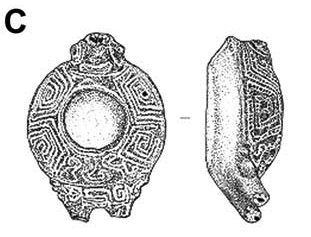
Red fine-walled ceramic snuff bowl from Puerto Rico
The UK Telegraph has run with a story, ‘Stone Age man took drugs, say scientists,’ about recent discoveries by a research team led by Quetta Kaye, of University College London, and Scott Fitzpatrick, of North Carolina State University. The drug taking ‘paraphernalia’ were dated to approximately 400 to 100 BCE, and were found in the Caribbean island Carriacou, 400 miles from where they probably originated on the South American continent. Daniel’s usually the one covering the posts on drugs (see, for example, his recent Drugs Round Up and the older Addiction Round Up), but I thought I’d put in my two cents on this one.

According to the Telegraph, the best guess for the mind altering substance involved is cohoba, a psychedelic substance produced from the ground seeds of the cojóbana tree. According to a quick surf around the web, cojóbana is likely a common name for Anadenathera peregrina, a tree native to both the Caribbean and South America, which also happens to be a good source of dietary calcium (the miracles offered by Mother Nature never cease).

Continue reading “‘Party on, dude,’ pre-Columbian style”

Cooperative Hunting by Chimpanzees

The following video is the best illustration I have ever seen of how chimpanzees hunt together in coordinated fashion, with different individuals having different roles. It combines both on-the-ground video and overhead infrared to illustrate just how this group of chimpanzees manages a successful hunt of colobus monkeys. Incredible footage!

(If it doesn’t play, try going directly to the You Tube clip.)

Christophe Boesch has spear-headed the research to document hunting roles among chimpanzees. He published on cooperative hunting in a 1994 Animal Behaviour article (pdf) and discussed hunting roles, meat sharing, and learning more specifically in a 2002 Human Nature article (pdf).

Craig Stanford is another researcher who has focused on hunting by chimpanzees. He has written this online essay, The Predatory Behavior and Ecology of Wild Chimpanzees, which is an excellent overview of what we know about chimpanzee predatory behavior.

John Mitani has also published on why male chimpanzees hunt and share meat; in 2002 John also provided an overview about recent developments in the study of wild chimpanzee behavior. I posted more video on chimpanzee behavior, including hunting, just this week – so check that out for more footage.

For what chimpanzee hunting means about our own evolution, we have two contrasting views – hunters vs. being hunted. Craig Stanford has a 2001 popular book The Hunting Ape: Meat Eating and the Origins of Human Behavior. That book should be tempered by the more recent Man the Hunted: Primates, Predation and Human Evolution.

The Moral Sense Test

Eric Schwitzgebel, a professor of philosophy at the University of California at Riverside, is running an on-line test about moral dilemmas with his colleague Fiery Cushman, a psychologist at Harvard. Eric runs the blog The Splintered Mind, which I have quite enjoyed reading lately – it covers “the philosophy of psychology, broadly construed.”

So they want to recruit some anthropologists, neuroanthropologists, and other related ilk to take the Moral Sense Test. They need you! Otherwise the test, promoted on a philosophy site, will only get philosophy type answers. While we know that both philosophers and anthropologists can give screwy answers about moral questions, the burning question is: will they give different screwy answers?

Eric assures me the moral dilemmas will do just that, create dilemmas. But you have the power to decide! (Well, assuming your mind just doesn’t freeze up.) Plus you’ll get 15 to 20 minutes of edu-tainment, becaue that’s how long the test takes.

So mosey on over to the test site for your Moral Sense. Eric and Fiery send their splintered, burning thanks!

Wednesday Round Up #33

This week, besides the tops, we have education, animals, genetics, anthropology, and the brain.

Top of the List

Garrison Keillor, Dying of the Light
A captivating review of the new book, Nothing to Be Frightened Of, by Julian Barnes. The accomplished writer and “atheist turned agnostic” confronts (and reflects on) his fear of death at the age of 62

Sean Hurley/NPR, Boston Orchestra Makes Typewriters Sing
The Boston Typewriter Orchestra plays the QWERTY Waltz. Listen to the entire NPR story here.
This story highlights the difficulties of a brain-based or culture-based approach to creativity. Here we have a story about effort and spontaneity, where practice and the adaptation of technology, social settings and finding rhythms all “coalesced into a form” that is quite a show.

Bruce Bower, Body in Mind
Science News covers embodied cognition! How new experimental studies and robot designs are changing our very old views of cognition.

Steve Higgins, The Ass Area of the Brain Exists in Chimps
On top for the title alone! Chimps recognize each other by their asses – and what parts of the brain process that

Kenneth Chang, A Guiding Glow to Track What Was Once Invisible
The Nobel Prize in Chemistry went this year to three scientists who developed green fluorescent protein (from jellyfish!) to study cell function.
To see the amazing outcome of using a range of fluorescent colors to study the brain, check out our previous posts on Jeff Lichtman’s Brainbows and More on Brainbow. Truly some of the most striking science images I have even seen.

Education

Sam Dillon, Under ‘No Child’ Law, Even Solid Schools Falter
The perils of prescribing standardized change – schools making progress and using tough tests are not making the grade

Open Anthropology, A Crisis of Vast Quantities in Academia?
Publish or perish – academics on the production line

Chris Kelty et al., Anthropology Of/In Circulation: The Future of Open Access and Scholarly Societies
Discussion by some prominent anthropologists concerned with open access over at Cultural Anthropology – and yes, it’s the actual pdf (not hidden behind a fee-access door)

Continue reading “Wednesday Round Up #33”

Ian Kuijt and Guns, Germs & Steel

Ian Kuijt, my colleague here at Notre Dame, is an archaeologist who has specialized in the origins of agriculture, food storage, and the emergence of social inequality. He appeared in the PBS series Guns, Germs and Steel, based on the best-selling book by Jared Diamond. So it is my pleasure to present that particular clip from the PBS documentary , where Ian discusses the emergence of food storage, agricultural practices, and changes in social complexity.

The clip with Ian Kuijt is prefaced by segments one and two on You Tube. You can click here for all the clips (1-18) from the series. Ian also has a lot of good online material about the Dhra site itself.

In the documentary, Diamond argues for an ecological approach to human history, where local ecology, microbes and geography make a large difference in which societies demonstrate “progress” or “civilization.” There is a Wikipedia site on Guns, Germs and Steel, where both Diamond’s basic argument and some relevant criticisms are presented.

If you want something directly from the horse’s mouth, here is a short interview with Diamond. He also has a longer, but still accessible, essay over at Edge. And finally Diamond discusses why agriculture isn’t all that great for human health in this essay entitled The Worst Mistake in the History of the Human Race.

Chimpanzees: Too Close for Comfort

Back in 1992, David Attenborough narrated the film Too Close for Comfort, a documentary on chimpanzee life and behavior in the Tai Forest. The Tai Forest is a national park in Cote d’Ivoire in West Africa. The film centers on the work of Christophe Boesch and Hedwige Boesch-Achermann, who have been working in the Ivory Coast for years. Together the two wrote the book The Chimpanzees of the Tai Forest: Behavioral Ecology and Evolution.

I use this film in my Introduction to Anthropology class, it just has some extraordinary footage. Mike Richards, the cameraman, spent two years on this project! Here is one clip, where the chimps are filmed cooperatively hunting colobus monkeys. Wow.

There are four other clips available:

Closest links to man – the intro to the movie and the Tai chimps

Hard nuts to crack – the chimps cracking nuts with tools

Fall of Brutus – the confrontation between two dominant males that takes place over a bonanza of nuts

Eat them before they eat you – where chimps use tools to eat safari ants and a leaf sponge to drink water

Christophe Boesch has his extensive publications available for download at the Max Planck Institute for Evolutionary Anthropology. One recent publication is: Is Culture a Golden Barrier between Chimpanzees and Humans? where he argues that chimpanzees display a broad cultural repertoire, similar to humans. He wrote a 2001 piece for Scientific American on The Cultures of Chimpanzees. And if you want to know more about cooperative hunting, here’s a 2002 Human Nature paper on that.

Update: I have posted another spectacular video of chimpanzee hunting, including infrared views of their group tactics from the air as they hunt a pack of colobus monkeys.