Throwing like a girl(‘s brain)

We’ve all read some of the discussions about differences in men’s and women’s brains, but the case of throwing overhand offers a cautionary tale about thinking we’ve found something inherent in being male or female. The danger is that we accept too quickly observed differences without digging a bit deeper into their variation and potential causes. In the United States, most of our readers will have run across the idea that women throw like, well, … girls.

Jennie Finch can strike you out.
In fact, the empirical gulf between average throwing ability in men and women is huge (just as it is symbolically important), dwarfing virtually any other measurable difference between the sexes, even things like aggression, frequency of masturbation, attitudes towards casual sex, and spatial abilities on paper-and-pencil tests.

Janet Shibley Hyde, one of the leading proponents of the ‘gender similarity hypothesis,’ concedes that there are some marked differences between men and women, singling out throwing ability as the most pronounced among them (2007: 260; see also 2005).

Thomas and French (1985: 266 & 276), in a meta-analysis reviewing all available research on sex differences in throwing, found that the gap stood at 1.5 standard deviations at three years of age, and increased over time, widening to between three and five standard deviations by puberty. By contrast, the much discussed ‘math gap’ between boys and girls, in Hyde’s meta-analysis of 48 studies, was a +0.08 on problem solving and +0.16 on national math tests (Hyde 2005; 2007: 260). In other words, if you’re impressed by the gap in math scores (I’m not), you should be awestruck at the gap in throwing ability.

I just finished writing the draft of a potential book chapter on throwing ability for a volume Prof. Robert Sands is putting together on biocultural approaches to sports. The chapter steps off from my observations that most of my colleagues in Brazil, men included, ‘threw like girls’ even though they were incredibly talented athletes, some of the most astounding capoeira practitioners I have ever seen. The book chapter is linked to some other work I’ve been doing, so I’ve got notes enough for several chapters – I thought I might put some up on Neuroanthropology.net because they were especially related to some of the things we focus on here.

This is probably going to wind up being at least two or three posts, so in this one, I’m only going to discuss the neurological issues surrounding throwing and the likely mechanical or technical issues that make (some) women (and Brazilian men and others) ‘throw like girls.’ At least one more post is going to deal with physiological plasticity beyond the nervous system, such as the way throwing remodels the shoulder, to explore anatomical plasticity more broadly, but you’re going to have to come back later for that one…
Continue reading “Throwing like a girl(‘s brain)”

Balance between cultures: equilibrium training

Way back in January, I posted ‘Equilibrium, modularity, and training the brain-body.‘ At the American Anthropology Association annual meeting, I presented my current version of this research, significantly updating it with ethnographic material from Brazil, a comparative discussion of different techniques for training balance, and a series of graphics that I hope help to make my points. The title of that paper was ‘Balancing Between Cultures: A Comparative Neuroanthropology of Equilibrium in Sports and Dance.’

I’ve decided to post a version of this paper here, with the caveat that it’s still a work-in-progress. I’d be delighted to read any feedback people are willing to offer.

Introduction

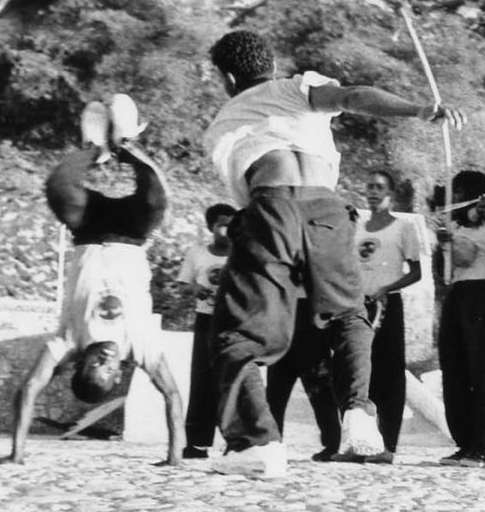
Boca d' Rio does a bananeira
As a cultural anthropologist interested in the effects of physical training and perceptual learning, I see ‘neuroanthropology’ as a continuation of the cognitive anthropology advocated by Claudia Strauss and Naomi Quinn (1997).

The new label, however, reflects engagement with a new generation of brain research, what Andy Clark (1997) refers to as ‘third wave’ cognitive science, or work on embodied cognition.1 Much of the ‘third wave’ does not focus strictly on what we normally refer to as ‘cognition,’ that is, consciousness, memory, or symbolic reasoning. Rather embodied cognition often highlights other brain activities, such as motor, perceptual and regulatory functions, and the influence of embodiment on thought itself; this is the reason I’m thrilled to have endocrinologist Robert Sapolsky as part of this panel, as his work is part of the expanded engagement of neuroanthropology with organic embodiment.2.

My own entry into neuroanthropology results from three influences: a phenomenological interest in cultural variation in human perception, anthropological study of embodiment, and apprenticeship-based ethnographic methods. This method posed an odd question during my field research on the Afro-Brazilian martial art and dance, capoeira. Simply put, as a devoted apprentice-observer, I failed to maintain hermeneutical agnosticism and started to ask, ‘Is what my teachers and peers report — and I too seem to be experiencing — plausible?’

Continue reading “Balance between cultures: equilibrium training”

Free Running and Extreme Balance

Mostly this is an excuse to link to these great videos of free running and parkour, unusual because they show much of the full sequence rather than mash-ups. But to go all scholarly on you, Cognitive Daily had a recent piece on learning to walk and children’s sense of balance. Leaning with backpack weights was a learned process, not an intuitive one, even with toddlers who knew how to walk.

These videos also give me the chance to plug Greg’s early piece on our sense of balance. Rather than an innate module gifted to us by evolution, “The evidence seems very clear that the sense of balance (again, with all the caveats of calling it ‘a’ single ‘sense’) can be trained to wide range of different challenges and to operate more efficiently or from different sets of information depending upon the task constraints. The variability of equilibrium was driven home to me in my research on capoeira, an Afro-Brazilian martial art and dance.”

Similarly with “l’art de displacement” through mixing balance, jumping, climbing and running. Wow!

Just like elite runners, I bet they stay focused on the task on hand, and not on the pain of a misstep or the fear over a missed jump—dissociation from risk and worry through expert technique. And this focused and skilled activity also relies on significant sensory integration of balance, vision, and touch. In turn, sensory integration, plenty of training and experience, and focus on the task help make free running predictable, understandable and controllable, and thus integrated into the person’s everyday interactive design.

Anyways, here’s a couple popular YouTube videos in the mash-up music video style:

I’m Not Really Running: Flow, Dissociation, and Expertise

The British long-distance runner Paula Radcliffe won last year’s New York City Marathon.  In a later interview, discussing the struggles and pains of running a marathon, Radcliffe said, “When I count to 100 three times, it’s a mile.  It helps me focus on the moment and not think about how many miles I have to go. I concentrate on breathing and striding, and I go within myself.” 

Gina Kolata used that quote in her article, I’m Not Really Running, I’m Not Really Running, which talked about dissociation strategies and peak performances: “The moral of the story? No matter how high you jump, how fast you run or swim, how powerfully you row, you can do better. But sometimes your mind gets in the way.  ‘All maximum performances are actually pseudo-maximum performances,’ Dr. [Bill] Morgan said. ‘You are always capable of doing more than you are doing’.”

Kolata recounts how this applies even to the everyday struggles of training: “Without realizing what I was doing, I dissociated a few months ago, in the middle of a long, fast bike ride. I’d become so tired that I could not hold the pace going up hills. Then I hit upon a method — I focused only on the seat of the rider in front of me and did not look at the hill or what was to come. And I concentrated on my cadence, counting pedal strokes, thinking of nothing else. It worked. Now I know why.  Dr. Morgan, who has worked with hundreds of subelite marathon runners, said every one had a dissociation strategy.”

Besides covering her own experience and having a brief mention of Tibetan monks, Kolata writes about how the brain can affect training and performance: “ ‘Imagine you are out running on a wet, windy, cold Sunday morning,’ said Dr. Timothy Noakes, an exercise physiologist at the University of Cape Town. ‘The conscious brain says, “You know that coffee shop on the corner. That’s where you really should be”.’ And suddenly, you feel tired, it’s time to stop.  ‘There is some fatigue in muscle, I’m not suggesting muscles don’t get fatigued,’ Dr. Noakes said. ‘I’m suggesting that the brain can make the muscles work harder if it wanted to’.” 

Continue reading “I’m Not Really Running: Flow, Dissociation, and Expertise”

Mind, body and Wiimote

Blogging on Peer-Reviewed ResearchI’m not usually the one blogging on video games; this tends to be Daniel’s department. After all, he’s got three boys at home, and I live with two horse-obsessed women, so it’s a bit out of my habitual orbit. I get more interaction with tractors than video game consoles. But Daniel tossed this reference my direction, and I decided to write on it for a number of reasons (thanks to Daniel).

According to a recent post on Psyorg.com, ‘The Wiimote as an interface bridging mind and body,’ a research team led by Rick Dale at the University of Memphis has been using the Wiimote from Nintendo to study how people reach as they learn new tasks. As the Psyorg story discusses, the Memphis team taught people a symbol matching task and used the Wiimote to judge the quality of their movements when doing the task.

As people learned, their bodies reflected the confidence of that learning. Participants moved the Wiimote more quickly, more steadily, and also pressed on it more firmly as they became familiar with the symbols. While everyone knows that you get better at moving in tasks that require intricate movement (such as learning to use chopsticks), these results suggest that your body movements are related to learning other information as well.

Continue reading “Mind, body and Wiimote”

Brainy muscles

A recent story in The New York Times by Gina Kolata, one of my favorite science writers, highlights one reason why I think neuroanthropology has to be broader than ‘cognitive anthropology’ was in the 1980s and 1990s (and why ‘cognitive science’ itself has really expanded with the more recent wave of thinking about embodied cognition). In an article on whether or not weight training is really good for athletes, titled Does Weight Lifting Make a Better Athlete?, I think Kolata does a much better job presenting the case for the efficacy of weight training than the arguments against it. Even several of the physiologists and trainers who Kolata suggests are less than rapt with weight training make comments that are more specifically about weight training done badly than against the practice as a whole; they criticize poor form, badly designed programs, and even not working hard enough, hardly criticisms of the overall efficacy of weight training.

Most of the athletes and other experts seem to me to be pretty strongly in favor of weight training, and I have no doubt that there’s good reason. Most athletic training has been radically transformed with the advent of weight training, and approaches that have come out of weight training (such as targeting specific muscle groups and working different parts of the body to failure) are also applied even in non-weight training exercises, such as selective sprinting, whole body exercises, and the like. Some of my research on capoeira, no-holds-barred fighting (or MMA), and other forms of wresting training suggest that actually training with ‘weights’ — barbells, dumbbells, and the like — can be less than ideal, but most of the modifications that this research suggests are consistent with the theory and practice of weight training, even if they expand the activities involved (body weight exercises, whole body dynamic lifting, jumping, etc.).

But one of the few critics says something that I found extremely interesting, and it resonated with some of the stuff I’ve been writing in my sports-related manuscript (hopefully a book soon) about how neural plasticity affects athletic performance. Specifically, Dr. Patrick O’Connor, a University of Georgia exercise scientist, says that ‘a sport like rowing, swimming or running requires specific muscles and nerve-firing patterns that may best be developed by actually doing the sport.’ A sport like ‘rowing, swimming or running’ that ‘requires specific muscles and nerve-firing patterns…’ hmmmm? So that would be like, what, every sport?

Continue reading “Brainy muscles”