Donald Tuzin and the Breath of a Ghost

Donald Tuzin
Donald Tuzin

In the Scientific American piece Ghost Stories: Visits from the Deceased, Vaughan Bell describes how the dead stay with us. An embodied sense of them, present yet gone, comes strongly through our memories and our perceptions: “for many people [loved ones] linger in our senses—as sights, sounds, smells, touches or presences.”

Bell issues a call for more research on grief and embodied remembrances, and then notes, “There are hints that the type of grief hallucinations might also differ across cultures. Anthropologists have told us a great deal about how the ceremonies, beliefs and the social rituals of death differ greatly across the world, but we have few clues about how these different approaches affect how people experience the dead after they have gone.”

I wrote previously on Bell’s article and how writers have explored this terrain in Grief, Ghosts and Gone. Still, the anthropologist in me took Vaughan’s point as a challenge. Ethnographic work is not as widely known in the larger scientific literatures, but it is both broad and deep. My search was rewarded!

Donald Tuzin has a striking 1975 article, “The Breath of a Ghost: Dreams and the Fear of the Dead.” In this piece (scribd full text) he describes his research with the Ilahita Arapesh of northeastern Papua New Guinea and the confluence of their beliefs and practices surrounding the dead with everyday experience.

Tuzin pays particular attention to “the functional implications of (1) the different ghost types encountered by the Arapesh dreamer as distinguished by degrees of familiarity in life, and (2) the strikingly different beliefs held about ghosts as against the more temporally remote ancestors (556).”

Continue reading “Donald Tuzin and the Breath of a Ghost”

Body Swapping

Do psychotherapists now have a new trick? Or is it all smoke and mirrors? The New York Times reports today on Standing in Someone Else’s Shoes, Almost for Real, where neuroscientists have shown that “the brain, when tricked by optical and sensory illusions, can quickly adopt any other human form, no matter how different, as its own.”

The article “If I Were You: Perceptual Illusion of Body Swapping” by the Swedish researchers Henrik Ehrsson and Valeria Petkova appears this week in PLoS ONE, and is ably summarized over at Neurophilosophy. You can also read Ehrsson’s previous article on the virtual arm illusion and his Science piece on the experimental induction of out-of-body experiences.
out-of-body-illusion
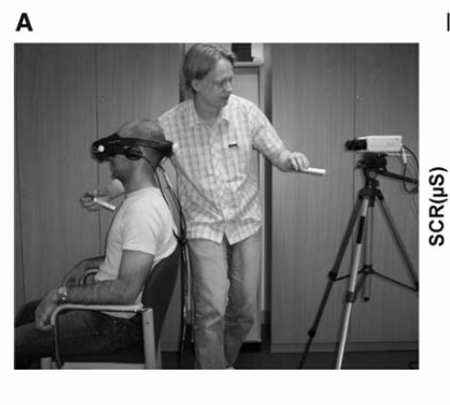
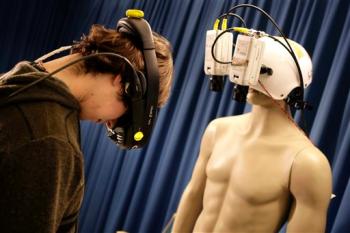
The approach in all of this research is rather simple. You can see the out-of-body experiment design pictured to the right. Body swapping adds another person with goggles.

A subject stands or sits opposite the scientist, as if engaged in an interview.. Both are wearing headsets, with special goggles, the scientist’s containing small film cameras. The goggles are rigged so the subject sees what the scientist sees: to the right and left are the scientist’s arms, and below is the scientist’s body. To add a physical element, the researchers have each person squeeze the other’s hand, as if in a handshake. Now the subject can see and “feel” the new body. In a matter of seconds, the illusion is complete.

body-swap-by-niklas-larsson
This “switching” happens because the brain is literally embodied – after growing up with this particular body, it’s a fair assumption to assume that one’s eyes and one’s hand are getting feedback about the same interactive phenomenon. For a first-person view of this, see Karl Ritter’s AP article today on the body-swap illusion, which includes this photo of the two-goggle set-up.

Ehrsson is excited about being able to trick the brain in this way: “You can see the possibilities, putting a male in a female body, young in old, white in black and vice versa.” The NY Times article pushes the uses body swapping can have in therapy.

Continue reading “Body Swapping”

Demons on the Web

vaughan-bell-by-paul-smith
Vaughan Bell of Mind Hacks makes the New York Times today! So finally a picture of the man! He is seated in the garden outside the Department of Psychiatry at the Universidad de Antioquia, where he now works in Medellin, Colombia.

The NYT piece Sharing Their Demons on the Web begins:

For years they lived in solitary terror of the light beams that caused searing headaches, the technology that took control of their minds and bodies. They feared the stalkers, people whose voices shouted from the walls or screamed in their heads, “We found you” and “We want you dead.”

When people who believe such things reported them to the police, doctors or family, they said they were often told they were crazy. Sometimes they were medicated or locked in hospital wards, or fired from jobs and isolated from the outside world.

But when they found one another on the Internet, everything changed. So many others were having the same experiences.

The article goes on to discuss this “extreme” online community that gives peer support a whole new meaning! Mind control, stalking and paranoia become the delusions of the net. “The views of these belief systems are like a shark that has to be constantly fed,” Dr. Hoffman said. “If you don’t feed the delusion, sooner or later it will die out or diminish on its own accord. The key thing is that it needs to be repetitively reinforced.”

On the other hand, Derrick Robinson, a janitor in Cincinnati, says “It was a big relief to find the community. I felt that maybe there were others, but I wasn’t real sure until I did find this community.” Mr Robinson has gone on to become the president of Freedom from Covert Harassment and Surveillance.

Vaughan estimates that there are a small number of these intense sites that are frequented around the Internet. I ran across a similar phenemenon exploring pro Ana websites that support anorexia a couple years back. But Vaughan has published everything! The article ‘Mind Control’ Experiences on the Internet: Implications for the Psychiatric Diagnosis of Delusions (pdf) appeared in Psychopathology (also available here through Scribd).

As expected, Vaughan documents the NY Times article over at Mind Hacks. He described the outcomes of this research in an earlier post on Internet mind control and the diagnosis of delusions. As Vaughan concludes about this research:

This is interesting because the diagnostic criteria for a delusion excludes any belief that is “not one ordinarily accepted by other members of the person’s culture or subculture”, whereas these individuals have formed an online community based around their delusional belief, creating a paradox.

Studying Sin

By Daniel Lende

“You study sin,” my dinner companion said with a smile at a recent conference. I reached for my wine, and after a modest sip (really!), replied, “Vicio. In Colombia it’s called vicio. Vices.”

In Colombia vicio covers a whole range of activities—video games, playing pool, and yes, drugs. Even better, when vicio becomes the adjective “enviciador,” favorite snacks and sweets come into the picture. People start to eat, and it’s hard to stop until every piece of candy is gone.

I like the Colombian category of vicio, because I see something common in the way people get hooked on things, the way they want and crave this or that. I have seen it with food, with sex, with gambling and smoking cigarettes in both the United States and Colombia. But I have seen “getting hooked” best with drugs.

In today’s world drugs stand in for sin pretty well. Just in April Pope Benedict XVI declared drug use a deadly sin. In the United States drug users are often seen as moral degenerates. In this moral model of addiction, people lack willpower. As the tagline to a recent HBO series on addiction went, Why can’t they just stop?

But with addiction, the disease model has slowly come to the fore, highlighted by Alan Leshner, the then-head of the National Institute of Drugs Abuse, declaring in Science that “Addiction Is a Brain Disease, and It Matters.”

Morals versus brains. Or culture versus biology. Just yesterday in a talk someone asked about gender, “So is this biology or is this culture?”

How can we escape this constricting dichotomy? As I discussed in an interview with Jonah Lehrer over at Scientific American’s Mind Matters, I think a focus on concrete problems is the way to go. Specifics will help get us to where we need to go, not theories based on old ideas.

Indeed, grand pronouncements of consilience or some over-arching theory forget about Newton and his very concrete apple. As the poet Lord Byron wrote:

When Newton saw an apple fall, he found
In that slight startle from his contemplation –
‘Tis said (for I’ll not answer above ground
For any sage’s creed or calculation) –
A mode of proving that the earth turn’d round
In a most natural whirl, called “gravitation;”
And this is the sole mortal who could grapple,
Since Adam, with a fall or with an apple.

Today we’ve got the physics of an apple down, and we are turning back to the problem facing Adam. The tree of knowledge is both tempting and sweet. So just how are we to understand the apple of my eye?

Translation

My concrete problem has been craving, that compulsive desire drug users can experience and which plays such a powerful role in relapse in excessive use and relapse. In both the popular accounts and scientific literature on addiction, dopamine often takes the blame for addiction. In understanding dopamine function, two prominent ways have been developed over the past decade – one focused on incentives and motivation, and the other on computation and learning. With addiction, the incentives and motivation approach has gained more traction, largely through the “incentive salience” work of Terry Robinson and Kent Berridge. Robinson and Berridge have often glossed dopamine function as “wanting” – and wanting just needs a little push to get to craving.

Their elegant work and sophisticated hypothesis testing have helped tease out a particularly thorny problem around addiction, that of pleasure versus desire. Earlier behaviorist theories largely assumed that pleasure was the ultimate reinforcer; no other mechanism was necessary to account for why animals went towards something rewarding. The work by Robinson and Berridge helped separate “wanting” versus “liking,” or as I explain to my students, the difference between that late-night craving for pizza, just a phone dial away, and that first exquisite bite of cheese and sauce and dough.

So the leap from lab to real life can be perilous. It’s a leap that I think anthropologists are better equipped to make than most. For my research on compulsive wanting and craving, what really made the difference was the combination of two strange bedfellows – evolution and ethnography. While for many that combination would be sinful in itself, the two helped take research on dopamine function and translate it into something I could use.

Continue reading “Studying Sin”

Craving and Compulsive Involvement Scales

By Daniel Lende

In the previous post Wanting to Craving: Understanding Compulsive Involvement with Drugs, I wrote:

Different domains of subjective involvement can be linked to dopamine [function] – wanting more and more, the sense of an urge or push to use (often not a conscious desire), and the heightened focus on places and actions and times that lead to using. The scale I developed showed good internal consistency, adding support that these three senses of compulsive involvement are linked. If you want to know more about the scale, I have done a separate post detailing the compulsive involvement scale in both Spanish and English versions.

So this post gives you those scales! But first a little information. The scale in Spanish consists of eight items and shows good consistency. For the English version I have not fullly tested the scale, and have deliberately included more items there (a total of 13). One aim of future research (collaboration, anyone?) would be to test the items and hopefully winnow the size down.

So without further ado, here are the scales themselves:

Lende Craving-Salience General

Lende Deseo-Salience en Espanol

If you don’t want to click on any version, some typical statements in English include: (a) At times I have started to use and use without thinking about anything else; (b) At times I have felt a powerful impulse or urge to go use; and (c) At times using feels like you want more and more.

If you do want to use these scales, please contact me (Daniel Lende) at dlende@nd.edu. I’d like to hear more!

Results with the Spanish version originally appeared in my 2005 article Wanting and Drug Use: A Biocultural Approach to Addiction (Lende Wanting pdf). Here are excerpts from that article that relate directly to creating the original scale and its use in my study:

Construction of the Incentive Salience Scale
Ethnographic Results
The incentive salience scale was created by drawing on the results of the questionnaire and the first interview. The first step in this process was identifying the common dimensions related to wanting and seeking drugs in the adolescents’ descriptions. One important thing that emerged early in this review process was that the dimensions of wanting, shifts in attention, and behavioral engagement applied to more than just anticipating and seeking out drugs, the main focus of Robinson & Berridge’s theory. The dimensions of incentive salience applied to both seeking out and using drugs, leading to a wider focus on how drugs and drug use were salient to users.

Based on this wider view of salience, six common elements were then identified in the adolescents’ descriptions. First, one of the most typical ways of describing addictive experiences in Colombia was “querer más y más,” to want more and more drugs. During my ethnographic research, this emphasis on wanting—the Colombian’s summary description of what addiction was—took on more relevance as I realized the diversity in positive appraisals and “rewards” from substance use, ranging from “forgetting everything” to riding a skateboard better. Other ways used to describe this experience included “deseo” and “sentir ganas,” to feel a desire to consume drugs. Overall, the emphasis on wanting and desire provided a clear indication of the relevance of the incentive salience approach to understanding drug abuse in this population.

Continue reading “Craving and Compulsive Involvement Scales”

Wanting to Craving: Understanding Compulsive Involvement with Drugs

By Daniel Lende

A long-time research project of mine has been to understand how adolescents get hooked on drugs. Querer más y más, as they say in Colombia, to want more and more. When people get addicted – whatever the substance may be – they often report urges, cravings, and obsessive thinking as a primary force in why they keep using or relapse. Knowing the consequences often doesn’t matter, especially in those moments when that desire feels hot as a knife.

The easiest analogy for me to help people understand this type of desire is to ask people to think about that one time they really craved something to eat. Yes, that time, when you just had to have it. Most people have experienced this one time or another. With substance abuse, craving like this often becomes an unpredictable constant, something that comes on in the morning or while walking by a favorite bar or seeing a friend who has that gleam in his eye and a crooked smile on his face.

So here is what I found in Colombia, reported in a 2005 Ethos article entitled Wanting and Drug Use: A Biocultural Approach to Addiction (click for the full paper: Lende Wanting pdf). The abstract goes:

The integration of neurobiology into ethnographic research represents one fruitful way of doing biocultural research. Based on animal research, incentive salience has been proposed as the proximate function of the mesolimbic dopamine system, the main brain system implicated in drug abuse (Robinson and Berridge 2001). The research presented here examines incentive salience as the mediator of the wanting and seeking seen in drug abuse. Based on field work with adolescents at a school and a drug treatment center in Bogotá, Colombia, this article addresses: 1) the development of a scale to measure the amount of incentive salience felt for drugs and drug use; 2) the results from a risk-factor survey that examined the role of incentive salience and other risk factors in addiction; and 3) the ethnographic results from in-depth interviews with Colombian adolescents examining dimensions of salience in the reported experiences of drug use. Incentive salience proved to be a significant predictor of addicted status in logistic regression analysis of data from 267 adolescents. Ethnographic results indicated that incentive salience applies both to drug seeking and drug use, and confirmed the importance of wanting, a sense of engagement, and shifts in attention as central dimensions of experiences related to drug use.

Several years later, I like to highlight several things about this research. First, different domains of subjective involvement can be linked to dopamine –wanting more and more, the sense of an urge or push to use (often not a conscious desire), and the heightened focus on places and actions and times that lead to using. The scale I developed showed good internal consistency, adding support that these three senses of compulsive involvement are linked. If you want to know more about the scale, I have done a separate post detailing the compulsive involvement scale in both Spanish and English versions.

Continue reading “Wanting to Craving: Understanding Compulsive Involvement with Drugs”