
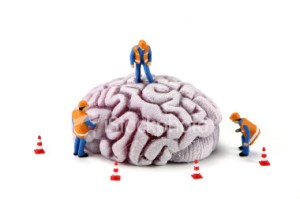
 Intellectual labels are always a tricky business, necessary for talking about ideas and suggesting that a theorist is in a particular ideological neighborhood. Yet, they can drag along so much baggage that they become self-defeating, evoking instant resistance or inevitable misinterpretation if poorly used. In the best of cases, they can help to create a clear identity for innovative work in an academic field, speeding the effort to carve out a space for ideas in a cluttered terrain of thought. Deployed well, they can help to clarify and orient us; applied clumsily, they become intellectual invective, prematurely close off discussion or debate, and substitute labeling for thinking.
Today, I want to write briefly about ‘neuroanthropology’ as a badge, but spend more time on ‘neuroconstructivism,’ as it’s a term that sometimes gets associated with the sort of research and thinking that we are advocating here at Neuroanthropology.net. In a sense, this piece is written for non-anthropologists, to help them understand why they might get a really strange reaction from an anthropologist colleague if they start talking excitedly about new ‘neuroconstructivist’ perspectives.
We’ve obviously decided that ‘neuroanthropology’ is one of the labels that we find helpful. We stand by the neologism, even though some of our readers have described our choice of terms ‘deplorable,’ and we’ve sometimes had to struggle against the term’s use elsewhere. For example, Oliver Sachs, the wonderful chronicler of the lived worlds of people with severe brain lesions, often calls himself a ‘neuroanthropologist,’ as Jovan Maud at Culture Matters pointed out to me and Daniel highlights in a recent, more thorough post on the relation of what we’re doing to what Sachs has done (see also Neuroanthropology).
Continue reading “Who you callin’ a ‘neuroconstructivist’?!”



 Neuroanthropology