Mark Nichter and Global Health

Mark Nichter is a prominent medical anthropologist who teaches at the University of Arizona. In this video Nichter speaks on medical anthropology and health policy. We also get more background on Nichter and his work from colleagues and students.

I am using Mark’s new textbook, Global Health: Why Cultural Perceptions, Social Representations, and Biopolitics Matter, in my Intro to Med Anth class this semester, and the students have responded quite positively. It’s a relatively short book, so I am able to use it in conjunction with other texts – not the mega intro to all things med anthro that seems to be the norm out there now. I also like the practical/applied focus that he provides throughout the book.

The last chapter, “Toward a Next Generation of Social Science Research,” is the real pay-off after previous sections on both popular health culture and international health policy. That’s where he discusses global health, syndemics, ecosocial epidemiology, local biology, the importance of studying up, biopolitics, and more. Yes, he packs a lot in – but that leaves room for me as the teacher to discuss more general issues and to provide background for the points he is making.

Mark has several recent articles which will likely interest readers:

Coming to Our Senses: Appreciating the Sensorial in Medical Anthropology (2008) in Transcultural Psychiatry

Reconsidering the Placebo Response from a Broad Anthropological Perspective (2009) in Culture, Medicine and Psychiatry with Jennifer Jo Thompson and Cheryl Ritenbaugh

Qualitative Research: Contributions to the Study of Drug Use, Drug Abuse, and Drug Use(r)-Related Interventions (2004) in Culture, Medicine and Psychiatry with Gilbert Quintero, Mimi Nichter, Jeremiah Mock and Sohaila Shakib

Forever at War: Veterans’ Everyday Battles with Post-traumatic Stress Disorder

ptsd-iwo-jima“To this day, every time I smell firecrackers or fire arms being shot, I feel like I am right back there. All I have to do is close my eyes and I see the whole scenario over and over again. I can’t erase it.”

Hundreds of thousands of US veterans are not able to leave the horrors of war on the battlefield. They bring the combat home and re-experience it in their minds each and every day, no matter how much time has passed.

“I don’t like people. I just live my life.”

Many PTSD veterans live a life riddled with divorce, unemployment, and loneliness because they are unable to form lasting social networks within civilian life. It is not uncommon for a war veteran plagued with PTSD to desire a solitary life in the mountains. One informant described Montana as the ideal locale – far away and quiet.

“I should have buried him.”

This veteran is still tormented by the fact he did not give an honorable burial to a fellow soldier. He knows he would have met a similar fate if he tried to leave his foxhole; yet his inability to act haunts his memory. He asks himself everyday why he didn’t even try to honor his fallen comrade. He also has never been able to justify why he wasn’t the soldier left unburied on that remote Pacific island.

“I didn’t even have the motivation to kill myself.”

Many of these men and women believe their situation will never improve. Some contemplate suicide as their only relief from the symptoms of PTSD. A number of the veterans we spoke with had thought about or even tried to end their own lives. They also participate in risky activities, threatening their life in a deliberate yet indirect way.

“I always feel like there is someone behind me – following me.”

Being on edge is the only way to survive in combat. Unfortunately, many PTSD veterans are unable to readjust within the civilian world. Everyday life becomes a battlefield.

Something as mundane as walking through a crowded grocery store aisle can be a source of intense anxiety for a veteran suffering from PTSD. Overwhelmed by a feeling that the shoppers behind them are enemies, PTSD veterans always feel as if they are under attack. A trigger as simple as the clashing of shopping carts can make them jump in fear of an imminent explosion. They are forever at war.

OUTREACH

Over the course of 4 months, South Bend veterans with Posttraumatic Stress Disorder (PTSD) have revealed their daily realities to us, five undergraduates at the University of Notre Dame. In conjunction with a course taught by Dr. Daniel Lende entitled Researching Disease: Methods in Medical Anthropology, we have engaged in community-based research with members and supporters of PTSD, Vets, Inc. Here, with the approval and encouragement of these vets, we seek to give their experiences a well-deserved voice.

Continue reading “Forever at War: Veterans’ Everyday Battles with Post-traumatic Stress Disorder”

More Than A Waiting Room

main-waiting-room1By Jillian Brems, Erin Brennan, Katrina Epperson, Jordan Pearce & Anna Weber

“I just don’t want this to be the visit that changes my life,” said the middle-aged woman waiting for a mammogram at the Regional Breast Care Center. For an estimated 240,510 women diagnosed with breast cancer in 2007, their visit to the waiting room did change their lives. This is the concern that patients and their friends, families, and significant others face every time they visit the center.

This feeling of stress and anxiety isn’t just for first-time visitors either. Even women who have had many mammograms worry before a visit because, as one patient put it, “You just never know.” Women are forced to come to terms with the uncertainty factor when they enter the hospital clinic. “It’s the results I’m absolutely terrified of,” another patient said, “not the procedure.”

During this past fall the five of us—all anthropology students at the University of Notre Dame—evaluated the waiting rooms at the Regional Breast Care Center (RBCC). It has been nine years since the waiting room at RBCC last changed, and our ethnographic research focused on determining how to better meet the needs of all who use the space. The director and staff had basic questions whether the waiting rooms still fulfilled the diverse needs of their patients and those who accompany them, and what new things could be done to improve patient satisfaction and comfort.

Continue reading “More Than A Waiting Room”

Just a Place to Talk: Women and HIV/AIDS

By Christine, Dorian, Kristine, Tom & Vanessa
femme-facade-by-peggy-bonnett-begnaud
Nine months ago, Maria birthed a healthy baby girl. Just two days later, the joyous ecstasy of new life quickly led to a striking reality: Maria’s husband was diagnosed with HIV.

“He thought I was going to leave him, but of course I wouldn’t. We’re in this together.” At the time, she didn’t know quite how personal her statement would become. Just three months later Maria and her newborn daughter were also diagnosed with HIV.

“Initially I was able to handle it in the moment, but then it hits. In time, it’s become much more difficult to deal with.”

Maria certainly feels stigmatized and has refrained from telling her other children. In this Midwestern town, the needs of Maria (a pseudonym) and other women with HIV are ripe with concern and lack of viable opportunity. She told us, “What I, and other women need, is just a place to talk.”

Currently there are HIV/AIDS support groups offered locally through a community center. Our community-based student project, focused on understanding and empowering women suffering from HIV/AIDS locally, brought us to these groups. What we found was a support group for homosexual men that did not offer the support women need.

Through research concerning sexual orientation and HIV/AIDS, we discovered that homosexual men and heterosexual women have different coping mechanisms and symptoms. Women experience more illness as a result to their HIV/AIDS status than homosexual men. They also are more likely to need social support to deal with the pain and fear of being HIV/AIDS positive. (Mosack 2009:137) Although the group that exists can be literally defined as a place to talk, it may not be the best place to be heard and understood as a woman.

Continue reading “Just a Place to Talk: Women and HIV/AIDS”

Cosleeping and Biological Imperatives: Why Human Babies Do Not and Should Not Sleep Alone

mother-and-childBy James J. McKenna Ph.D.
Edmund P. Joyce C.S.C. Chair in Anthropology
Director, Mother-Baby Behavioral Sleep Laboratory
University of Notre Dame
Author of Sleeping with Your Baby: A Parent’s Guide to Cosleeping

Where a baby sleeps is not as simple as current medical discourse and recommendations against cosleeping in some western societies want it to be. And there is good reason why. I write here to explain why the pediatric recommendations on forms of cosleeping such as bedsharing will and should remain mixed. I will also address why the majority of new parents practice intermittent bedsharing despite governmental and medical warnings against it.

Definitions are important here. The term cosleeping refers to any situation in which a committed adult caregiver, usually the mother, sleeps within close enough proximity to her infant so that each, the mother and infant, can respond to each other’s sensory signals and cues. Room sharing is a form of cosleeping, always considered safe and always considered protective. But it is not the room itself that it is protective. It is what goes on between the mother (or father) and the infant that is. Medical authorities seem to forget this fact. This form of cosleeping is not controversial and is recommended by all.

Unfortunately, the terms cosleeping, bedsharing and a well-known dangerous form of cosleeping, couch or sofa cosleeping, are mostly used interchangeably by medical authorities, even though these terms need to be kept separate. It is absolutely wrong to say, for example, that “cosleeping is dangerous” when roomsharing is a form of cosleeping and this form of cosleeping (as at least three epidemiological studies show) reduce an infant’s chances of dying by one half.

Bedsharing is another form of cosleeping which can be made either safe or unsafe, but it is not intrinsically one nor the other. Couch or sofa cosleeping is, however, intrinsically dangerous as babies can and do all too easily get pushed against the back of the couch by the adult, or flipped face down in the pillows, to suffocate.

Often news stories talk about “another baby dying while cosleeping” but they fail to distinguish between what type of cosleeping was involved and, worse, what specific dangerous factor might have actually been responsible for the baby dying. A specific example is whether the infant was sleeping prone next to their parent, which is an independent risk factor for death regardless of where the infant was sleeping. Such reports inappropriately suggest that all types of cosleeping are the same, dangerous, and all the practices around cosleeping carry the same high risks, and that no cosleeping environment can be made safe.

Nothing can be further from the truth. This is akin to suggesting that because some parents drive drunk with their infants in their cars, unstrapped into car seats, and because some of these babies die in car accidents that nobody can drive with babies in their cars because obviously car transportation for infants is fatal. You see the point.

One of the most important reasons why bedsharing occurs, and the reason why simple declarations against it will not eradicate it, is because sleeping next to one’s baby is biologically appropriate, unlike placing infants prone to sleep or putting an infant in a room to sleep by itself. This is particularly so when bedsharing is associated with breast feeding.

When done safely, mother-infant cosleeping saves infants lives and contributes to infant and maternal health and well being. Merely having an infant sleeping in a room with a committed adult caregiver (cosleeping) reduces the chances of an infant dying from SIDS or from an accident by one half!

Continue reading “Cosleeping and Biological Imperatives: Why Human Babies Do Not and Should Not Sleep Alone”

‘Party on, dude,’ pre-Columbian style

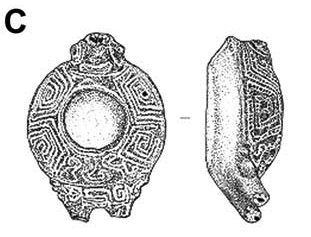
Red fine-walled ceramic snuff bowl from Puerto Rico
The UK Telegraph has run with a story, ‘Stone Age man took drugs, say scientists,’ about recent discoveries by a research team led by Quetta Kaye, of University College London, and Scott Fitzpatrick, of North Carolina State University. The drug taking ‘paraphernalia’ were dated to approximately 400 to 100 BCE, and were found in the Caribbean island Carriacou, 400 miles from where they probably originated on the South American continent. Daniel’s usually the one covering the posts on drugs (see, for example, his recent Drugs Round Up and the older Addiction Round Up), but I thought I’d put in my two cents on this one.

According to the Telegraph, the best guess for the mind altering substance involved is cohoba, a psychedelic substance produced from the ground seeds of the cojóbana tree. According to a quick surf around the web, cojóbana is likely a common name for Anadenathera peregrina, a tree native to both the Caribbean and South America, which also happens to be a good source of dietary calcium (the miracles offered by Mother Nature never cease).

Continue reading “‘Party on, dude,’ pre-Columbian style”