US Presidential campaign wordpiles

What's on your mind?
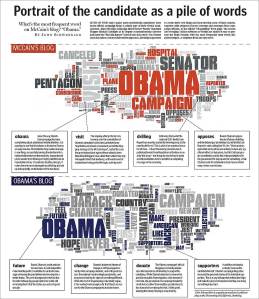
The Boston Globe did a ‘Wordpile’ analysis of both Sen. John McCain and Sen. Barack Obama’s websites and generated some fascinating graphics. Check out the original here. There’s lots one could say about these graphics — the Globe only highlights a few of the fascinating terms, and I’d want to try to chase down the context of a few that show up prominently because they look pretty ambiguous — but some factors stand out clear as day. The most obvious is that ‘Obama’ is the most mentioned word on both blogs. ‘Veeeery inturusting…’

The reason I bring this visual up though is that I found it a fascinating, graphically powerful way to present a basic qualitative-quantitative bit of research. Although I’m intrigued by research tools like nVivo and Atlas.ti, I sometimes wish that there were richer ways to present the data. This ‘Wordpile’ output is rich enough to put on a t-shirt! I’ll have to find some way to integrate it into my seminars on hybrid research methods.

And if anyone knows where I can lay my hands on the software or script to generate this sort of thing, please send along the link. A quick search didn’t give me anything, and I don’t want to sit in my office all Friday obsessing about this.

Somatosphere: Science, Medicine and Anthropology


Somatosphere is a new blog focusing on medical anthropology. Eugene Raikhel, a post-doc at McGill, is the primary blogger but there is also a group of contributing anthropologists.

I met Eugene last December at the big annual anthro conference, then again when I was at McGill in July for the critical neuroscience conference. I’ve been waiting to introduce his blog since then, mostly letting him build up an impressive collection of material.

Just yesterday he posted links to some great podcasts with neuroscientists (including Michael Rutter, whom I’ve always wanted to hear) over at the Wellcome Trust Centre for the History of Medicine.

His recent Web Gleanings includes a nice round up of posts and on-line articles ranging over topics like expertise, the limitations of biological psychiatry, antibiotic-resistant bacteria, and the history of treating fatigue.

And if you’re interested in cultural competence, illness narratives, and grandma’s little drug helper, then you’ll find all that and more at Somatosphere.

Wednesday Round Up #25

Interactions

Madeline Drexter, How Racism Hurts – Literally
“racism literally hurts the body. More than 100 studies — most published since 2000 — now document the effects of racial discrimination on physical health”

Jamie Davies, Switching Pain Off? Coping with Pain and Pain Experience
Perception and managing pain and even a You Tube Scrubs clip – very funny

Edward Slingerland, Let’s Get Clear about Materialism
A critical take on David Brooks’ Neural Buddhism, and what materialism (e.g., grounding social and psychological phenomena in the brain) really means

P. Pascal Zachary, Digital Designers Rediscover Their Hands
Software designers get hands-on with real world objects to learn to think more creatively and intuitively

Cordelia Fine, Words that Can Change Your Mind
The transformative effects of books

Globalization, Development and Change

Matthew Trevisan, Social Networking for Social Change
Social entrepreneurs aim to bring people together to help educate and create change

Reflection Café, The UC Atlas of Global Inequality
Get your fix on online, downloadable maps on inequality worldwide. Reflection Café provides a nice introduction and overview, but if you want to go directly to mapping, by all means do so.

NextBillion.Net, The Newsroom
Check out recent articles and blog posts on enterprise and development aimed for non-established markets and for people at the bottom of the economic food chain

Continue reading “Wednesday Round Up #25”

Got Questions? Find Answers at Encephalon 52

Ouroboros is hosting Encephalon this time around. This edition provides plenty of answers to those questions we’ve always had, such as the relationships between depression and neurogenesis, the molecular basis of bipolar disorder, and particularly important for me, the perceptual basis of tone deafness (I now have an explanation for my wife…). Plus lots of good stuff from the usual suspects.

It’s a comprehensive edition, so check it out. One I really liked was a review of “grandmother neurons,” or the idea that a single neuron encodes a single concept. Over at Neurotic Physiology, we have “context, personality, and brain imaging,” examining recent research on attachment styles, social cues, and differing underlying neural correlates. Finally, the Neurocritic gives us a gender perspective on Olympics coverage, boiling down to fewer clothes = more coverage. So there’s some neuroscience, some interactions, and some anthropology for you!

Drugs Round Up

Brain

Science Daily, Cocaine Addiction Linked To Voluntary Drug Use And Cellular Memory, Study Shows
Voluntary use, memory, and predisposition to use again—active choice matters, and from there, a short jump to meaning (why choose drugs…)

Alexis Madrigal, Memory Disruption Could Aid Addicts
Blocking associative memory in rats works. Are people next?

Hal Arkowitz and Scott Lilienfeld, Do-It-Yourself Addiction Cures?
Self-change happens, and it can work

Reuters, Feeling Poor Spurs Lottery Ticket Purchases
Research confirms what the lottery business already knows—feeling subjectively poor makes it more likely to buy that ticket to a quick-fix dream

Pure Pedantry, Ricardo Ricco & Epo Abuse and Heptaminol? Where Do They Even Find This Stuff
The scientific low-down on performance-enhancing drugs in the Tour de France

Jane Brody, Sorting Out Coffee’s Contradictions
Coffee and your health—sorting out the myths and the realities

Henry Fountain, It’s Always Happy Hour for Several Species in Malaysian Rain Forest
Alcohol-swigging small mammals like their fermented fruit

Mark Kern, The Seductiveness of Bad Habits
Health and unhealthy habits and addiction

Continue reading “Drugs Round Up”

New Four Stone Hearth

So the new Four Stone Hearth, the blog carnival of anthropology, is up at Almost Diamonds. Stephanie may not be an anthropologist, but she puts together a formidable list, including several Olympic-related posts, such as Rex’s (he’s still Alex to me) contribution at Savage Minds, Well I guess we should say something about the Olympics and a fascinating short post by Vaughn at Mind Hacks on cross-cultural studies of the immediate reaction to winning and losing among sighted and blind athletes. There’s a number of good archaeological posts (including Stone Pages pointing to a story about Australia’s less-than-enthusiastic attempts to preserve archaeological sites), a cluster on Neandertal research, and a fascinating piece on artificial language evolution in the laboratory from Anthropology.net (with actual people instead of computers doing the learning).

Lots of good stuff — so why are you still here and not reading it?!