Nicholas Kristof, the most anthropological of the New York Times op-ed writers, now has a You Tube channel. The featured video right now is Kristof applying to stage a protest in China during the Olympics, and then a reflection on China, its politics, and its culture. I’ve put it just below.
The Kristof channel also includes previous videos that Kristof has made as part of his worldwide reporting, including one on Cambodian brothels and another on the Colombian flower industry, which I showed some months back (reminded me of home…). Another is on Mukhtar’s Haven, the story of the woman sentenced to be gang raped in rural Pakistan, who then prosecuted her rapists and used the compensation money to establish a haven for other rape victims.
Kristof, in his push to provide innovative reporting, also runs a blog where he reflects on what he is writing, readers can comment on his editorials, and some good guest bloggers also take on complex social phenomena. You can see all Kristof’s NY Times columns here. He even has a Facebook site!
John Hawks, associate professor of anthropology at the University of Madison – Wisconsin who brings us his paleoanthropological, genetic, and evolution expertise over at his own blog, has set up a new blog Biology of Mind run by his students.
The blog is part of John’s same-titled class which covers “the evolution of human cognition and behavior in a comparative context.” For the most part, the students in their posts provide description and critical commentary on relevant articles. So here’s one on Social Intelligence and Self Awareness, building on the 1998 Gordon Gallup article on that topic.
Besides the students covering and commenting on a wide range of literature, John also puts up weekly readings in pdf format. So this week we have Northcutt on Understanding Vertebrate Brain Evolution and Streidter on Progress in the Study of Brain Evolution.
Last semester I also worked with students blogging. For my medical anthropology class, we ran a student-only blog here at WordPress, where students posted materials, worked up introductions to main readings before discussing them in class, and generally commented on life. It was very easy to set up, and was a closed entity (just for the class and me). So that is one option.
Another option is to have more formal posts done by students, who develop original posts for a public blog (namely this one!). In my class on addiction, groups of students worked on creating some very successful posts on topics ranging from brain imaging to post-conventional outlaws (see them all described here).
So there are lots of ways to get students involved! If you have any more ideas, please let me know with a comment.
Dr. Norman DoidgeStephanie West Allen, who runs the blog Brains On Purpose, alerted me to the fact that the Australian ABC has posted audio files of a couple of interviews with Dr. Jeffrey Schwartz and Dr. Norman Doidge, the author of The Brain That Changes Itself (see her post, NeuroMediators: Understanding the brain is a critical key to resolving conflict (both within a culture and between cultures)). Dr. Doidge has been in Australia, attending several writers’ festivals and a workshop on ‘neuro-leadership.’ My wife caught his interview on The 7:30 Report, one of the better in depth news analysis programs on ABC TV, but I have not been able to attend any of the events where he spoke (what can I say? It’s a really really bad semester here…).
The original radio shows, audio recordings and transcripts (!) are available on the ABC All in the Mind website: Part 1 of 2: The Power of Plasticity Part 2 of 2 – The power of plasticity
See especially Part 2 as there are links to a host of other resources, such as the video of an interview Dr. Doidge did on ABC television while he was here in Australia, and discussions of the work of Prof. Paul Bach-y-Rita, one of the pioneers in work on neuroplasticity, including his research on technological prostheses for missing sensory information.
The material is great, and I’m nearly finished with Doidge’s book, but I still have several reservations about it even though I share the fascination with neuroplasticity and enthusiasm for Doidge’s work: Continue reading “Neuroplasticity on the radio”
Let’s imagine your name is Gaia, you’re a planet and you have a bad case of the humans. For many years you lived in symbiosis with humans, but then they evolved exogenetically, adapted in ways you were unprepared for and started to multiply in extraordinary numbers. Suddenly, the delicate balance of bacteria in your ecological gut got out of whack and now you have a bad case of gas, greenhouse gas! And no Rennie tablet is going to get you out of this one. Continue reading “A bad case of the Humans”
Pour les personnes qui aiment la bierre Belge et un Vendange Tardives autant que moi, voici un petit ‘forward’ que j’ai recu cette apres-midi: Continue reading “La théorie du mouton”
Silent Raves, where people get together to dance while listening to music on their headphones, came to my attention this week through NPR’s “Silent Ravers Dance ‘Together But Individually’.” Get together in a public place, turn on your music at the appointed time, and start dancing!
This particular Silent Rave took place in Boston’s Copley Square, and was promoted through both Facebook and MySpace. Here’s the MySpace ad:
WHAT IS A SILENT RAVE?? A silent rave is a dance party where everyone listens to their own music. Imagine looking out and seeing hundreds of people dancing, but hearing nothing. Pretty cool, eh?
This Myspace page will keep all you ravers updated on upcoming events. It’ll also help promote this event, and attract more people to the raves.
Basically, what you do at a silent rave is bring your MP3 player and headphones. After the countdown to the start time of the event (typically in the evening, but who knows!), everyone presses play at the same time, listening to their own favorite jams. Everyone then starts dancing (dancing, jumping up and down, flailing arms around wildly, it’s all the same at a rave!).
What’s the point? Well, it’s just an event where a bunch of people can get together to have fun, expend pent-up energy, and meet tons of new people with similar interests. These silent raves are supremely exciting (well, with the right attitude) and fun. Silent raves will normally be short and sweet, but everyone is more than welcome to stay afterwards to party and mingle with fellow ravers.
Simple guidelines:
-please Please PLEASE respect the locations where the silent raves are held, i.e. don’t litter and no violence. We don’t want to be attracting any unwanted attention from local authorities…
-Wait for the countdown to start raving, otherwise it’ll be a mess.
-Have fun.
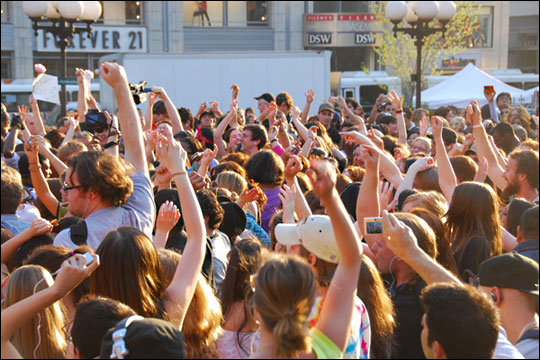
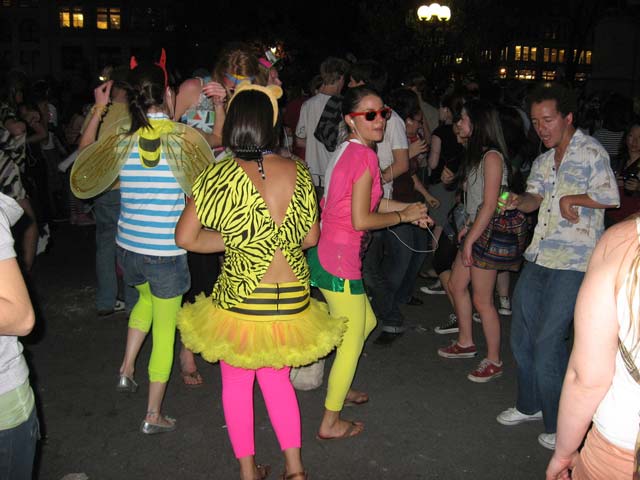
In the States one of the biggest Silent Raves was held last April in NYC’s Union Square. Both the NY Times and ABC News covered it. I’ve included a photo from that rave. For some video go to this You Tube clip.
The odd thing for me was that the You Tube clip included music! I suppose that makes sense for showing off what you were listening to, but as a curious anthropologist (and a guy just out of current style, one of my students commented yesterday) it didn’t help me capture the overall feel of the event. So here’s a video from Calgary. A lot smaller silent rave, but this one gives a better sense of what it looks like to someone on the outside.
And then there was this massive flash mob silent rave in Victoria Station in London!


 Neuroanthropology