A Primate of Modern Aspect (which has the best url ever, zinjanthropus.wordpress.com) is hosting the anthro carnival Four Stone Hearth.
Lots of good stuff – language and culture, online ethnography, female choice over male provisioning, good and bad news about primate conservation, and more. A real four-field one! It’s great.
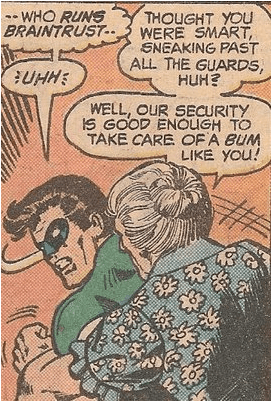
Why Isn’t the Brain Green? asks Jon Gertner in the feature article of the “Green Issue” in this week’s New York Times Magazine. The issue is worth a visit alone for the striking photos, where the Momix Dance Troupe form vivid images of the head and the brain. But Green Lantern is going to come in handy.
So who wants to know why the brain isn’t green? CRED – Center for Research on Environmental Decisions – where they use behavioral research and decision science to understand “the green mind” (or lack thereof). As seems de rigeur today, any topic where we don’t act on the information available and seem to make irrational decisions is the target of this new decision science.
CRED has the primary objective of studying how perceptions of risk and uncertainty shape our responses to climate change and other weather phenomena like hurricanes and droughts. The goal… is to finance laboratory and field experiments in North America, South America, Europe and Africa and then place the findings within an environmental context.
So what are the problems? We’re bad at long-term decision making; we see environmental problems as far away from our everyday lives; we seem to have a “finite pool of worry” and make an occasional decision to help the environment while continuing on with our overall lifestyle.
Intellectual labels are always a tricky business, necessary for talking about ideas and suggesting that a theorist is in a particular ideological neighborhood. Yet, they can drag along so much baggage that they become self-defeating, evoking instant resistance or inevitable misinterpretation if poorly used. In the best of cases, they can help to create a clear identity for innovative work in an academic field, speeding the effort to carve out a space for ideas in a cluttered terrain of thought. Deployed well, they can help to clarify and orient us; applied clumsily, they become intellectual invective, prematurely close off discussion or debate, and substitute labeling for thinking.
Today, I want to write briefly about ‘neuroanthropology’ as a badge, but spend more time on ‘neuroconstructivism,’ as it’s a term that sometimes gets associated with the sort of research and thinking that we are advocating here at Neuroanthropology.net. In a sense, this piece is written for non-anthropologists, to help them understand why they might get a really strange reaction from an anthropologist colleague if they start talking excitedly about new ‘neuroconstructivist’ perspectives.
We’ve obviously decided that ‘neuroanthropology’ is one of the labels that we find helpful. We stand by the neologism, even though some of our readers have described our choice of terms ‘deplorable,’ and we’ve sometimes had to struggle against the term’s use elsewhere. For example, Oliver Sachs, the wonderful chronicler of the lived worlds of people with severe brain lesions, often calls himself a ‘neuroanthropologist,’ as Jovan Maud at Culture Matters pointed out to me and Daniel highlights in a recent, more thorough post on the relation of what we’re doing to what Sachs has done (see also Neuroanthropology).
When I was a lifeguard in high school, two of my fellow lifeguards — Steve and Pete — sought to converse as much as possible quoting directly lines from the Chevy Chase movie, Fletch. This is what qualified as comedy. Steve was apparently the ‘more clever’ of the two as he probably achieved Fletch Quotation Ratios as high as 20%; Pete, though quite well tanned, likely only managed 10% FQR at best. I hadn’t seen the movie, and I was never much for quoting film scripts (not even Monty Python), so I assumed that Steve’s high FQR was either a symptom of premature senility or a sign of the impending collapse of Western civilization.
Recent fears about the negative cognitive consequences of the social networking site Twitter, which I mentioned in an earlier post, Is Facebook rotting our children’s brains?, led me to recall Steve and Pete’s battle for high FQR. In both cases, concerned observers might wonder whether patterns of mental activity can lead to long-term neural degeneration; I haven’t checked in on Steve or Pete in more than 20 years, but I suspect they’re both locked in institutions living out a cruel Chevy Chase imitation from which they can no longer escape.
Twitter, even more than other Internet-based social networking applications, seems to provoke apocalyptic fears of mass mental degradation. Over at Alternet, for example, Alexander Zaitchik asked Twitter Nation Has Arrived: How Scared Should We Be? In the piece, Zaitchik wonders whether what was ‘once an easily avoided subculture of needy and annoying online souls’ was bringing about the apotheosis of all that is loathsome in American pop culture: ‘look-at-me adolescent neediness, constant-contact media addiction, birdlike attention-span compression and vapidity to the point of depravity.’ Rob Horning of Pop Matters warns about ‘Twitterification’ in a piece titled, Foucault’s Facebook. Keith Olbermann named Twitter ‘worst person in the world,’ …for the one episode at least (see video at You Tube); Olbermann found someone already Twittering in his name, even using his email address. And if you’re not already convinced that Twitter is the unmentioned fifth Horseman of the Apocalypse, John Mayer’s Twitter obsession is blamed for Jennifer Aniston pulling the pin on their relationship.
Fortunately, even if we are on the non-stop plane to cognitive Armageddon, Web 2.0 assures us that we will have clever guerilla videos about our own immanent destruction as our in-flight entertainment. From SuperNews, we have a helpful cartoon, ‘The Twouble with Twitters’, to explain to us ‘the latest socially networking micro-bloggy thingy,’ especially if you’re a slow-on-the-uptake parent not sufficiently worried about adolescent technology use (are there any?).
Here’s a 1986 video with Oliver Sacks, where he discusses his work and his early book, The Man Who Mistook His Wife for a Hat.
I found his description of his approach striking:
As a neurologist, as a physician one is concerned with patients and with people in jams, in predicaments. In particular predicaments that are being caused by their nervous system acting up, either their brain, their spinal cord, their peripheral nerves, maybe some disease, maybe some damage. As a neurologist you want to find out what exactly is the matter for the nervous system and what you can do about it, but you are equally concerned with the effect of this on the person, how it may alter their world, their inner experience and if need be, how they can cope best, live and survive in an altered world. And so this way you have to be equally sensitive and equally knowledgeable about the anatomy and the chemistry of the nervous system but also to all the things that make a life and make a world for an individual… One is rooted in the neurosciences at one end and in psychology and in phenomenology and in just what it is to be a person.
In some ways the patients I write of can seem very remote from ordinary life and from normality. But in other ways I think one can… I think as a physician one has to be able to, one has to try to imagine what it is like for them and enter into their situation and their world and relate it to one’s own.
That same impulse inspires neuroanthropology—the bringing together of our nervous systems, individual experience and coping, and our surrounding world, the consideration of the things that make a life. That really is the core of it.
What has changed in the twenty plus years since Sacks spoke is that we are now in the position to take this impulse and direct it into our scholarship. Rather than individual cases and rare neurological problems, we can now speak of establishing a field of inquiry that addresses how we are human through this synthesis.
So what has changed to make this possible? I see the development of four areas as making our work possible. Take one of these four away, and we probably wouldn’t be speaking about neuroanthropology right now. These bases make possible what we now want to do.

 Intellectual labels are always a tricky business, necessary for talking about ideas and suggesting that a theorist is in a particular ideological neighborhood. Yet, they can drag along so much baggage that they become self-defeating, evoking instant resistance or inevitable misinterpretation if poorly used. In the best of cases, they can help to create a clear identity for innovative work in an academic field, speeding the effort to carve out a space for ideas in a cluttered terrain of thought. Deployed well, they can help to clarify and orient us; applied clumsily, they become intellectual invective, prematurely close off discussion or debate, and substitute labeling for thinking.
  Neuroanthropology