Throwing like a girl(‘s brain)

We’ve all read some of the discussions about differences in men’s and women’s brains, but the case of throwing overhand offers a cautionary tale about thinking we’ve found something inherent in being male or female. The danger is that we accept too quickly observed differences without digging a bit deeper into their variation and potential causes. In the United States, most of our readers will have run across the idea that women throw like, well, … girls.

Jennie Finch can strike you out.
In fact, the empirical gulf between average throwing ability in men and women is huge (just as it is symbolically important), dwarfing virtually any other measurable difference between the sexes, even things like aggression, frequency of masturbation, attitudes towards casual sex, and spatial abilities on paper-and-pencil tests.

Janet Shibley Hyde, one of the leading proponents of the ‘gender similarity hypothesis,’ concedes that there are some marked differences between men and women, singling out throwing ability as the most pronounced among them (2007: 260; see also 2005).

Thomas and French (1985: 266 & 276), in a meta-analysis reviewing all available research on sex differences in throwing, found that the gap stood at 1.5 standard deviations at three years of age, and increased over time, widening to between three and five standard deviations by puberty. By contrast, the much discussed ‘math gap’ between boys and girls, in Hyde’s meta-analysis of 48 studies, was a +0.08 on problem solving and +0.16 on national math tests (Hyde 2005; 2007: 260). In other words, if you’re impressed by the gap in math scores (I’m not), you should be awestruck at the gap in throwing ability.

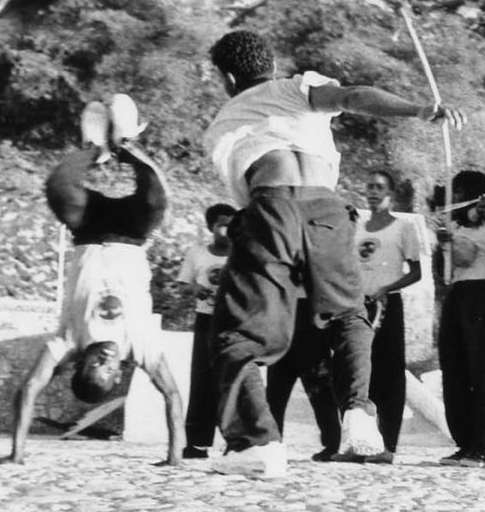
I just finished writing the draft of a potential book chapter on throwing ability for a volume Prof. Robert Sands is putting together on biocultural approaches to sports. The chapter steps off from my observations that most of my colleagues in Brazil, men included, ‘threw like girls’ even though they were incredibly talented athletes, some of the most astounding capoeira practitioners I have ever seen. The book chapter is linked to some other work I’ve been doing, so I’ve got notes enough for several chapters – I thought I might put some up on Neuroanthropology.net because they were especially related to some of the things we focus on here.

This is probably going to wind up being at least two or three posts, so in this one, I’m only going to discuss the neurological issues surrounding throwing and the likely mechanical or technical issues that make (some) women (and Brazilian men and others) ‘throw like girls.’ At least one more post is going to deal with physiological plasticity beyond the nervous system, such as the way throwing remodels the shoulder, to explore anatomical plasticity more broadly, but you’re going to have to come back later for that one…

Continue reading “Throwing like a girl(‘s brain)”

Donald Tuzin and the Breath of a Ghost

Donald Tuzin
Donald Tuzin

In the Scientific American piece Ghost Stories: Visits from the Deceased, Vaughan Bell describes how the dead stay with us. An embodied sense of them, present yet gone, comes strongly through our memories and our perceptions: “for many people [loved ones] linger in our senses—as sights, sounds, smells, touches or presences.”

Bell issues a call for more research on grief and embodied remembrances, and then notes, “There are hints that the type of grief hallucinations might also differ across cultures. Anthropologists have told us a great deal about how the ceremonies, beliefs and the social rituals of death differ greatly across the world, but we have few clues about how these different approaches affect how people experience the dead after they have gone.”

I wrote previously on Bell’s article and how writers have explored this terrain in Grief, Ghosts and Gone. Still, the anthropologist in me took Vaughan’s point as a challenge. Ethnographic work is not as widely known in the larger scientific literatures, but it is both broad and deep. My search was rewarded!

Donald Tuzin has a striking 1975 article, “The Breath of a Ghost: Dreams and the Fear of the Dead.” In this piece (scribd full text) he describes his research with the Ilahita Arapesh of northeastern Papua New Guinea and the confluence of their beliefs and practices surrounding the dead with everyday experience.

Tuzin pays particular attention to “the functional implications of (1) the different ghost types encountered by the Arapesh dreamer as distinguished by degrees of familiarity in life, and (2) the strikingly different beliefs held about ghosts as against the more temporally remote ancestors (556).”

Continue reading “Donald Tuzin and the Breath of a Ghost”

Balance between cultures: equilibrium training

Way back in January, I posted ‘Equilibrium, modularity, and training the brain-body.‘ At the American Anthropology Association annual meeting, I presented my current version of this research, significantly updating it with ethnographic material from Brazil, a comparative discussion of different techniques for training balance, and a series of graphics that I hope help to make my points. The title of that paper was ‘Balancing Between Cultures: A Comparative Neuroanthropology of Equilibrium in Sports and Dance.’

I’ve decided to post a version of this paper here, with the caveat that it’s still a work-in-progress. I’d be delighted to read any feedback people are willing to offer.

Introduction

Boca d' Rio does a bananeira
As a cultural anthropologist interested in the effects of physical training and perceptual learning, I see ‘neuroanthropology’ as a continuation of the cognitive anthropology advocated by Claudia Strauss and Naomi Quinn (1997).

The new label, however, reflects engagement with a new generation of brain research, what Andy Clark (1997) refers to as ‘third wave’ cognitive science, or work on embodied cognition.1 Much of the ‘third wave’ does not focus strictly on what we normally refer to as ‘cognition,’ that is, consciousness, memory, or symbolic reasoning. Rather embodied cognition often highlights other brain activities, such as motor, perceptual and regulatory functions, and the influence of embodiment on thought itself; this is the reason I’m thrilled to have endocrinologist Robert Sapolsky as part of this panel, as his work is part of the expanded engagement of neuroanthropology with organic embodiment.2.

My own entry into neuroanthropology results from three influences: a phenomenological interest in cultural variation in human perception, anthropological study of embodiment, and apprenticeship-based ethnographic methods. This method posed an odd question during my field research on the Afro-Brazilian martial art and dance, capoeira. Simply put, as a devoted apprentice-observer, I failed to maintain hermeneutical agnosticism and started to ask, ‘Is what my teachers and peers report — and I too seem to be experiencing — plausible?’

Continue reading “Balance between cultures: equilibrium training”

Andy Clark & Michael Wheeler: Embodied cognition and cultural evolution

The Cognition and Culture website has posted a link to the new edition of the Philosophical Transactions of the Royal Society B on ‘cultural transmission and evolution of human behaviour.’ I wanted to comment on just one piece on embodied cognition and cultural evolution, by philosophers Michael Wheeler and Andy Clark (unfortunately, Philosophical Transactions B is behind a subscription wall, although there’s a one-page ‘free preview’ [ouch] here). The Cognition and Culture website has the table of contents posted here. I was vaguely familiar with Michael Wheeler’s work before this piece, but Andy Clark (it’s not much of a profile) has written some of the work that’s most influenced my thinking about the effects of varied skill acquisition on cognition, especially his remarkable book, Being There: Putting Brain, Body and World Together Again (Amazon listing).

A ream of Clark’s papers can be found here. A review of Michael Wheeler’s book, Reconstructing the cognitive world: The next step, written by Leslie Marsh can be downloaded here. We’ll come back to Andy Clark’s work again in later posts.

I must admit a certain morbid fascination with how one of my favorite streams of thought — embodied cognition — would fare combined with cultural evolution — an area of scholarship that, well, to put it nicely, is uneven (before you get all defensive, let me just stop you with one word: mimetics). It’s sort of like watching one of your good friends get hit on by a sleazy guy at a bar. She looks happy, but you’re sort of cringing at the chance that she might actually take him home. In spite of this instinctual cringe, this special edition of Philosophical Transactions has some really interesting work on cultural evolution, especially because many of the pieces focus tightly on the enormously problematic issue of cultural transmission.

Continue reading “Andy Clark & Michael Wheeler: Embodied cognition and cultural evolution”

Christof Koch and the Neural Correlates of Consciousness


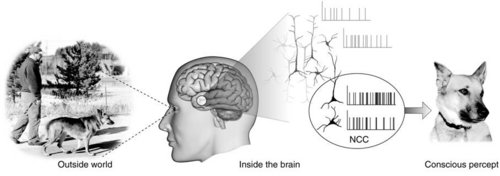
Scholarpedia has an entire entry on the neural correlates of consciousness, which argues for including the neural correlates for conscious precepts (that’s a dog!) as any part of understanding how we are consciously aware. In this case, the neural correlates of both basal arousal (see image below) and activity in the inferior temporal cortex are necessary for us to be consciously aware.

This Scholarpedia page is maintained by Christof Koch and Florian Mormann, both at Caltech. Mormann is a post-doc; his latest article on “Latency and selectivity of single neurons indicate hierarchical processing in the human medial temporal lobe” (pdf) appeared in the Journal of Neuroscience.

Koch wrote the popular book The Quest for Consciousness: A Neurobiological Approach based on his collaborative work with Francis Crick. Here is Michael Shermer reviewing the book at Scientific American:
Continue reading “Christof Koch and the Neural Correlates of Consciousness”

Video Games, Brain and Psychology Round Up

After earlier round-ups on video games (#1 on gaming in itself, as a social form; #2 on social science and game design), I am adding this third round up covering gaming and mind/brain research.

Together all three round ups provide the background for approaching video games through neuroanthropology. Ideally this background would then serve to inform specific research on gaming, which I have addressed previously in discussing avatars, MMORPGs, and Grand Theft Auto, probably my most synthetic piece.

To place that work in context, you can also check out the popular post One Day at Kotaku: Understanding Video Games and Other Modern Obsessions. See also: video games and the neuroanthropology of interaction and gaming and cultural perception.

This round-up draws more on published research than the previous two. At times the best I could provide is a link to an abstract; where possible, I have tracked down pdfs. And if there are other good papers out there that I don’t mention, please leave a comment!

Games and Neuroscience

Shawn Green and Daphne Bavelier, The Cognitive Neuroscience of Video Games
Pdf of a comprehensive chapter that appeared in the book Digital Media: Transformations in Human Communication

Klaus Mathiak & Rene Weber, Toward Brain Correlates of Natural Behavior: fMRI during Violent Video Games
“We propose that virtual environments can be used to study neuronal processes involved in semi-naturalistic behavior as determined by content analysis. Importantly, the activation pattern reflects brain-environment interactions rather than stimulus responses as observed in classical experimental designs.”

Niklas Ravaja et al., Spatial Presence and Emotions during Video Game Playing: Does It Matter with Whom You Play?
Yes it does—playing against another person is different than playing against a computer

CS Green & D. Bavelier, Action-Video-Game Experience Alters the Spatial Resolution of Vision
“Compared with nonplayers, action-video-game players could tolerate smaller target-distractor distances. Thus, the spatial resolution of visual processing is enhanced in this population. Critically, similar effects were observed in non-video-game players who were trained on an action video game; this result verifies a causative relationship between video-game play and augmented spatial resolution.” Gaming can also reduce gender differences in spatial cognition.

Fumiko Hoeft et al., Gender Differences in the Mesocorticolimbic System during Computer Game-play
“males showed greater activation and functional connectivity compared to females in the mesocorticolimbic system. These findings may be attributable to higher motivational states in males, as well as gender differences in reward prediction, learning reward values and cognitive state during computer video games”

MJ Koepp et al., Evidence for Striatal Dopamine Release during a Video Game
Pdf of well-received 1998 Nature paper on reward, dopamine and gaming. Slightly dated now with its view of reward and dopamine, but definitely a foundational piece.

Niklas Ravaja, The Psychophysiology of Video Gaming: Phasic Emotional Responses to Game Events
Ever wonder why it’s fun? Both positive and negative game events when players actively involved in playing elicited “positive emotional responses in terms of facial EMG activity” (pdf)

Games and Embodiment

James Paul Gee, Video Games and Embodiment
Recent article in Games and Culture laying out Gee’s view on gaming and human thinking as both “situated and embodied”.

Continue reading “Video Games, Brain and Psychology Round Up”