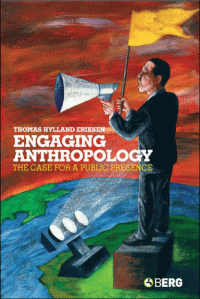
Engaging & Dispatching Memetics

Engaging Anthropology
I am reading the book Engaging Anthropology: The Case for a Public Presence by the anthropologist Thomas Hylland Eriksen. Quite enjoying it – definitely recommended.

I’ve just finished his section on Memetics and the Anthropologists. He systematically dismantles meme theory from an anthropological point of view, just like Greg did in his post, We Hate Memes, Pass It On. (Greg’s version is snarkier…) Eriksen also ties in the popular success of meme theory to a consideration of how anthropology can gain public relevance. This description resonates with much that we do here on this site.

Memetics may be beyond salvation as a theoretical project. However, it raises a few questions which are just right for anthropology seen as an endeavour of public relevance. It sees human culture as part of nature yet rejects the simplifications of human sociobiology, and it asks highly pertinent questions about cultural transmission, cultural diffusion and cultural change. The notion of contagion is useful and has not been properly explored in cultural studies, including anthropology.

But – I repeat- without an understanding of the human subject, no advance will be made, and of course, context is everything. Curiously, in attempts at applying memetics, the biology itself seems to suffer. In Ingold’s words, the genotype exists ‘in the mind of the biologist’ (Ingolg 2000: 382). The ambition of offering a simple and straightforward analytic account of the human mind has led to an untenable abstraction (62-63).

Eriksen pushes us to make generalizations and to take cross-cultural analysis seriously, to examine these big questions of cultural change and diffusion. But he ties that into a grounded understanding of the person, the human subject. Those subjects, or people, are always found in specific contexts, and these local environments help shape culture and subjectivity (beyond the generalizations of, say, contagion). Biology comes in as a crucial mediator here, from helping to understand the contours of cultural change to being a crucial player in the relations of subject and environment. At least that is how I read it. Memetics fails because it is not anthropological, neither grappling with the rich tradition of research on cultural change and meaning nor with the actual realities of people and their lives.

Eriksen then relates his analysis of memetics and anthropology to a larger public project.

The lesson from the experiment of memetics is that we have to do better: those of us who feel that memetics is insufficient have to come up with a better alternative than merely stating that things are more complicated than this. Saying ‘things are more complicated’ is like having endless meetings to avoid making a controversial decision.

The anthropologist’s account of human nature has to be holist – it must include the recipe, the ingredients, the oven and the cook – and it must supersede the conventional culture/nature divide. Looking in the direction of biology, it is likely to find more by way of inspiration in ecology than genetics. It must also take human experience seriously as an area of enquiry. These general delineations notwithstanding, several paths are possible and might shed light on the human condition. The field is open: with a handful of exceptions, there have been few attempts since the Second World War to develop a theory of human nature which draws on biological knowledge without succumbing to the temptations of easy fixes (63).”

Just to be clear, by recipe, ingredients, oven and cook, Eriksen means DNA, development, the environment, and subjectivity (or an actor). So I would certainly agree with a holistic approach that supersedes the conventional culture/nature divide. In biology, I actually hope that both ecology and genetics play a role. But I would point out that neuroscience is actually the closest to many of the areas that interest him as an anthropologist – experience and behavior, interactions with the environment, possible biological dynamics that help shape culture, and so forth. In other words, neuroanthropology.

To be honest, neuroanthropology probably has a branding problem, rather like cognition and culture. The term doesn’t shout out “public relevance.” But as a site to explore the proper combination of recipes, ingredients and cooks, and to gain an online presence, well, it’s a good start. Next stop, a theory of human nature. Right?

In any case, here’s the Google Book link to Engaging Anthropology. The “Memetics and the Anthropologists” section starts on page 57. Just do a search for memetics; it looks like you can read the entire section online to get Eriksen’s excellent analysis of the weaknesses of memetics.

And for more on Thomas Hylland Eriksen, he is a professor at the University of Oslo. He also runs a rich website called Engaging with the World, where you can see how he’s put his words into practice.

Top Ten Ways for Anthropologists to Make A Difference

(1) Critique. Our default position, but sometimes it does work. (Just not as well or as often as we hope.)

(2) Develop basic knowledge of problems. Rather than keeping to analysis, embrace our role as being able to speak directly about the causes and consequences of significant problems.

(3) Investigation. Take critique and go after something that matters to the public, whether that’s a community or the effects of a misguided policy.

(4) Advocacy. Use our understanding and our position as scholars to help advocate for change, to both represent the local point of view and to speak from our status as an expert. (Yes, expert – that research you did and the degree you have help grant that in the eyes of others.)

(5) Involve the community in your research. Besides making for better research and applied outcomes, including the community in your work yields direct and indirect benefits, through salaries, skill development, idea exchange and more.

(6) Have concrete community or applied outcomes. Start by making these outcomes a goal from the beginning, along with more traditional outcomes like peer-reviewed articles. Then do community-based research to make sure your applied outcome is relevant.

(7) Focus on developing or changing policy. Yes you can. As anthropologists we know plenty about unintended consequences, we also know a lot about what works locally. Put that to use.

(8) Get the word out. Communicate your work in an effective and popular way. Write an op-ed or a blog post or, gasp, a popular book. Remember that communication can also be informal. As anthropologists we can act as conduits, communicating among different constituencies in the field, different parties at the negotiating or policy table, and even different fields’ perspectives on a problem.

(9) Help develop organizations. Organizations do make a difference. They can bring people together in common cause and provide a framework through which to work. Indeed, organizations can take all the points made here and ramp them up to the next level.

(10) Create interventions or programs. Have a good idea? What about your community partners? Then try it out to see if it might work. Other fields do it. We can too. Do some investigation, get community involvement, and also check on what other fields recommend. And then see if our anthropology ideas make a difference. Remember, it’s always good to evaluate how effective your program is!

Paul Farmer: This I Believe

Paul Farmer is a doctor and an anthropologist, and spoke as part of NPR’s series This I Believe. Farmer co-founded Partners in Health, a non-profit organization dedicated to improving health care for the poor around the world. He helped develop DOTS (directly observed therapy), a way to provide care for HIV/AIDS that works in resource-poor settings, as well as community-based approaches to treating multi-drug resistant TB in developing countries.

As an anthropologist he has emphasized the importance of structural violence, the negative impact that systems of power can have on people through racism, gender inequality and political violence, with significant articles in both Current Anthropology and PLoS Medicine.

His most recent book is Pathologies of Power: Health, Human Rights, and the New War on the Poor. You can also read about his lifework in Tracy Kidder’s biography, Mountains beyond Mountains: The Quest of Dr. Paul Farmer, a Man Who Would Cure the World.

Hat-tip (and thanks) to Ryan Anderson over at Ethnografix and his anthropological list of inspiring people and work.

Link to full text of Paul Farmer’s This I Believe NPR recording.

Community-Based Work and the Importance of Being Integrative – The Ganey Award and Video

In April I had the honor of receiving the Rodney F. Ganey, Ph.D., Faculty Community-Based Research Award. Given by the Center for Social Concerns at the University of Notre Dame, the Ganey Award goes to a Notre Dame faculty who has done collaborative work in the local community. For those interested in the details of that work, here is the press release – Daniel Lende Wins 2009 Ganey Award.

Neuroanthropology.net has played a central role in the community-based research I have done with my students. These include posts on using humor in recovery from breast cancer, a support group for women with HIV/AIDS, research to help redesign a local hospital waiting room, and the stories that US war veterans wanted to share about their everyday battles with post-traumatic stress disorder.

Two peer-reviewed articles have come out of the community-based research with my students: Embodiment and Breast Cancer among African American Women, and Community Approaches to Preventing Mother-to-Child HIV Transmission: Perspectives from Rural Lesotho. A great community guide, Underneath It All: Humor in Breast Cancer, was put together by the students, community members and myself, and is now used in a local hospital.

One of the best things about the award was that the Center for Social Concerns made this wonderful video with my community partners and my students. Here’s the YouTube link, but I also present it below as it captures why I do this sort of work.

I also want to share a written version of what I said at the CSC award dinner. No, no, not all the thank yous (there were plenty and all richly deserved), but a reflection on my own approach to my work.

I want to close by speaking to why the work I have done has meshed so well with the Center for Social Concerns.

At its core my work is integrative. Notre Dame had encouraged that integrative spirit. These five factors make that spirit a reality.

First is listening, listening to the person across the table. That is the start to doing community-based work and the start to understanding other ideas.

Second is the synthesis of intellectual and social problems. These are human problems, where compassion and involvement can matter as much as intellectual analysis or abstract policy.

Third is a push to make our research international and interdisciplinary, and not just local and field specific. Integration only happens by crossing boundaries.

Fourth is the combination of traditional publishing with other forms of scholarship, such as a community guidebook and electronic publishing. These forms of scholarship can reach many, many more people than a typical peer-reviewed article.

Fifth, being community-oriented, with an insistence that what we do is relevant to more than just the university. Some of the most challenging questions and even our best answers and outcomes can come from those people across the table, the people with whom we are lucky enough to work.

These five factors – listening to others, the synthesis of intellectual and social problems, making our work interdisciplinary, combining traditional publishing with other forms of scholarship, and having a community orientation – all matter. Together they make a tremendous difference in our lives as academics, students, and community partners.

Varieties of Public Anthropology

So I wrote an overview of Rob Borofsky’s efforts in Public Anthropology the other day. But there are plenty of other varieties of public anthropology.

So here’s a quick guide to some that I’ve found in the form of blogs, associations and communities, some literature that you can access online, and graduate programs with a public anthro emphasis. It’s a US emphasis, as that is what I am most familiar with – though I really wish it could be more international. Feel free to comment to add more!

Blogs

Society for Applied Anthropology – Podcasts
See in particular the podcast from this session, Public Anthropology, Applied Anthropology and Ethically Engaged Ethnographic Writing.

Culture Matters focuses on all sorts of applied anthro, but you can see all the posts with “public anthropology” here

Open Anthropology – looking for a critical take on the world? Max Forte’s blog is a great place to start and to return.
Here are posts that specifically mention “public anthropology.”

Savage Minds, the leading cultural anthropology blog, has a whole “public anthropology” category, which contains all their relevant posts.

Digital Ethnography – Michael Wesch does public anthropology on YouTube and more.

Antropologi.Info helps spread the word. You can specifically find “public anthropology” mentions here.

On the Human – While more than just anthropology, this project engages the question of what it means to be human, with a particular focus on the issue of “human singularity.” Offers posts, resources and more.

I could go on as I consider most blogs as an explicit form of public anthropology. But I’ll stop here and direct you to two ways to explore more. First, our Best of Anthro 2008 Initiative gives you public anthropology on the internet – a collection of the best and most popular anthropology writing and blogging of 2008.

Second, you can check out this “Public Anthropology” Google Blog Search.

Associations & Communities

Society for Applied Anthropology. The society also has its own Ning online community, which is getting close to 800 members strong.

Continue reading “Varieties of Public Anthropology”

Public Anthropology

Yanomami Girl by Victor Englebert

Public anthropology happens when anthropologists engage with public issues and problems rather than just pursuing discipline-specific endeavors.

As Rob Borofsky writes in Public Anthropology – A Personal Perspective, this approach to anthropology addresses:

important social concerns in an engaging, non-academic manner. Public, in this sense, contrasted with traditional academic styles of presentation and definition of problems… The only way to be taken seriously by the broader public, I am suggesting, is to ask the questions readers beyond the academic pale ask, to answer the questions these readers long to know, to share experiences that add insight and meaning.

Rob Borofsky has been one of the leaders in public anthropology, having founded the Center for a Public Anthropology and serving as editor for the series in Public Anthropology at the University of California Press.

Many prominent books have come out of the UC Press series. Paul Farmer’s Pathologies of Power: Health, Human Rights, and the New War on the Poor is the best-known. Carolyn Nordstrom recently published Global Outlaws: Crime, Money, and Power in the Contemporary World (for a taste, see this video of Nordstrom “Fighting for a Healthy Global Economy”). Rob Borofsky himself put together Yanomami: The Fierce Controversy and What We Can Learn From It. The latest is Righteous Dope Fiend by Phillippe Bourgois.

Public Anthropology and the University of California Press host an annual competition for new manuscripts in public anthropology [this is actually the 2009 call here], one aimed at graduate students and the other for scholars more broadly. Here’s Cat Bolton, the latest graduate winner and an incoming faculty here at Notre Dame, encouraging you to submit:

Continue reading “Public Anthropology”