What’s the Dope on Music and Drugs?

Record Player
But in the long run these drugs are probably gonna catch up sooner or later
But fuck it I’m on one, so let’s enjoy,
let that X destroy your spinal chord, so it’s not a straight line no more
So we walk around lookin like some wind-up dolls,
shit stickin out of our backs like a dinosaur,
Shit, six hit’s won’t even get me high no more,
so bye for now, I’m gonna try to find some more

– Eminem, Drug Ballad

Drug strewn lyrics and references are found in much of today’s popular music. What effect do these words have on the average listener? Would you let your 10 year old listen to this? Why not… they’re just lyrics right?

School House Rock: Monkey Hear, Monkey Do?
John Markert: Two Schools of Thought

1) Reflection Theory : “Music is popular because it reflects the values and beliefs of those who consume it.” Proponents of Reflection Theory examine cultural forms such as music lyrics to gain insight into social beliefs. Here music is used to probe the connection between society and culture. Supporters of this intellectual tradition see the audience consuming with a critical eye, selecting songs because the theme relate to them and their world.
Woodstock
2) Arnoldian Theory : “Music is didactic and acts as a socializing agent by teaching behavior.” The concern by those at the other end of the intellectual tradition is that song lyrics may teach inappropriate social behavior. Mathew Arnold laid the foundation for this perspective in the last century, and his initial assessment continues to remain popular.

This is where the real debate can begin. Are the music and lyrics of songs with drug, alcohol, sex, and violence references putting adolescents at a greater risk of alcohol and drug use? Or is it simply the culture that these songs and music are created and engulfed in?

Pros and Cons of the Two Schools

One can make a case for both opposing ideologies. On the one hand, it is easy to see how the music and general lyrics can influence adolescents into using drugs and alcohol. For example, when browsing for songs that contain any type of alcohol or drug reference it is not hard to find hundreds of songs that contain one if not both. “White Lines”, “Fight for Your Right to Light the Bong,” and “Crack Monster” are just a few of the songs that diminish the dangers and actually commemorate the use of drugs and alcohol.

Continue reading “What’s the Dope on Music and Drugs?”

Gambling and Compulsion: Neurobiology Meets Casinos

Slot MachinesBy Jarred Carter, Andrew Cavanagh, Elizabeth Olveda, and Meredith Ragany
Vegas baby, Vegas!

So you’ve finally made it out to Sin City, setting aside a few hundreds dollars to gamble. Maybe even a thousand. You’re hoping to get lucky and have some fun. A few hours and a half-dozen drinks into your weekend, you find yourself at the craps table, dice in hand. You’re feeling good, ready to turn your recent down streak into big bucks. Where does that leave you?
Right where the casino wants you.

The game is rigged. Everyone loses money eventually, if not immediately. But just like gamblers grab hold of that lever and pull, society has stepped up to the gambling craze. And now gambling is pulling people for all they’re worth: emotionally, mentally and, most notably, financially.

This post will look more closely at casino’s techniques to draw gamblers back to the slot chairs and the tables, focusing on both physiological aspects and engaged decision making. Ultimately, these observations will demonstrate that casinos create more than entertainment; they develop an entire compulsive experience.

The Gambler’s Rush

The casino’s greatest asset might be the very personal, very intense rush that gamblers experience as they step up to the blackjack table or slot machine, hoping to strike it rich. This characteristic “rush” or “high” stems from the series of steps and actions that are involved in addictive behavior. Stimulation from the surrounding atmosphere and the thrill of a big risk drives the “high”. Ultimately, the “rush” from gambling can be as intense as a drug fix.

Dealing Emotions

Excitement, making a quick buck, or even the possibility of financial independence is enticing. From experience, most people know that emotions are difficult to control. From a neurological standpoint, the amygdala is situated in the limbic system and is one main centers of emotion (pdf) in the human brain. Other parts of the brain, like the prefontal cortex, display less activity (pdf) during the act of gambling.

Continue reading “Gambling and Compulsion: Neurobiology Meets Casinos”

Why Do They Do It? Portrayals of Alcohol on Facebook and MySpace

“I’m so much cooler online…Yeah I’m cooler online…”
– Brad Paisley, Online

By David Patterson, Elizabeth Kuzmich, Francis Verhaegen, and Natalie Leopold
Facebook Cheer
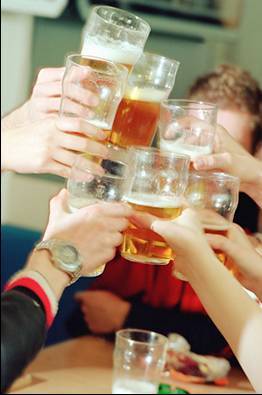
Why do they do it? Why do otherwise smart and savvy college and high school student post photos of themselves drinking and partying on Facebook and MySpace? To the right is just one. There are many more, some of them a lot more, um… revealing than this one.

Facebook/MySpace and the pictures posted on these websites represent a microcosm of social life. It is true that college students drink more often and in higher quantities than any other age group. Their lives include class, work, homework, club meetings…and partying. Many times, pictures of fraternity parties and keggers do not portray college students accurately. In other words, these students choose to portray only certain aspects of their lives on the Internet.

Thus, the pictures posted on Facebook/MySpace only represent some of these activities, specifically partying. For the same reason that website profiles of older adults often feature their wives and children, the profiles of college students feature what they believe is the most interesting, or ‘coolest,’ part of their life – having fun while partying and drinking.

Pictures of drinking and partying are interesting to their peers. The college social scene revolves around attending bars and fraternity parties. Just as the public looks to celebrities for cues on what to wear, where to go, and how to act, young adults look to their peers to see what are the best parties and activities, which are illustrated on Facebook/MySpace. It is unlikely that a college student would post a picture of himself or herself in the library or working at the ice cream shop.

Facebook/MySpace allows for the creation of new or altered identity and the presentation of this identity to others. Individuals can portray themselves as social, attractive, and popular by posting pictures of themselves surrounded by friends at a party. In theory, this makes them more desirable to the other sex and ‘cooler’ to their peers.

Examining the Profiles

In order to take a closer look at the prevalence of alcohol-related pictures in Facebook and MySpace profiles, 25 Facebook profiles and 25 MySpace profiles were randomly selected from a large pool of male and female individuals using a random numbers generator. The users’ ages varied from 17 to 25, essentially the average aged college students. From these profiles, the photo albums were inspected to determine whether they were alcohol or party related. Pictures containing beer cans, bottles, or handles of liquor or those taken in a bar or party setting or other miscellaneous drinking activities counted towards an “alcohol-related” picture or photo album.

Continue reading “Why Do They Do It? Portrayals of Alcohol on Facebook and MySpace”

Student Posts Coming

Just like last year, groups of students from my class Alcohol and Drugs: The Anthropology of Substance Use and Abuse have put together some great posts to share with the world. This year had more of a compulsion and culture theme, looking at “addictions” in areas besides drugs and alcohol as well as the impact of music and the internet on our everyday involvements. I’ll put the first post up later today, and then go more-or-less one a day until I get through all nine.

The posts represent quality work by the students. The students developed their own arguments and ideas, and did the background research themselves. I don’t always agree with them, and that’s good – all part of academic discourse.

Last year’s posts proved very popular. The one on brain imaging is in our Top Ten overall, and another on the genetic and environmental bases of addiction is in the top twenty. All told, the eight posts have been read more than 13,000 times!

The students covered a range of topics last year, from post-conventional outlaws and the drug war to college binge drinking and gender, stress and addiction and inequality and addiction, and finally on denial and disease and on age limits on drinking.

To see all of last’s years posts, check out Why A Final Essay When We Can Do This?

The Insidious, Elusive Becoming: Addiction in Four Steps

bowline_in_four_steps

Trying to describe the process of becoming an alcoholic is like trying to describe air. It’s too big and mysterious and pervasive to be defined… [T]here is no simple reason it happens, no single moment, no physiological event that pushes a heavy drinker across a concrete line into alcoholism. It’s a slow, gradual, insidious, elusive becoming.

-Caroline Knapp

Caroline Knapp wrote those lines near the beginning of her powerful memoir Drinking: A Love Story. Every year I use this book in my class on addiction. Students get drawn into Knapp’s clear and close account of how she began to drink so much, what it is like to be an alcoholic, and how she managed to get to recovery. Every year the book challenges my own thinking as well.

I used that last line—alcoholism as a slow, gradual, insidious, elusive becoming—to end my earlier post on Subjectivity and Addiction: Moving Beyond Just the Disease Model. There I argued that our two views of addiction, a popular one of getting hooked on things and a serious one about tolerance and destructive use, are crucial to understanding what addiction is.

For each category my class stuck up exemplars on the blackboard, from Facebook to hard-core drugs. Then I drew a between the two categories, using a thick two-headed arrow to indicate that the subjective and biological views interact. Both sides matter.

But I’ve realized that is not enough. That double-sided arrow remains woefully inadequate, a place marker that can end being two-faced, saying nothing of consequence, or double-edged, used simply to cut into the other side. That one symbol tells us little about the interactions themselves, about how people and disease mesh. It lends no insight into what Knapp shows us with her book—that addiction is an elusive and terrible becoming.

So how do you become an alcoholic or addict? How do you go from something fun to something all-encompassing? This question matters deeply. One fact, often overlooked in all the moral angst about addiction, is that most people who try alcohol or drugs do not end up addicted to them. They remain on the popular side. But some cross over. In the same passage as the opening quote, Knapp describes the end point: “Alcohol is everywhere in your life, omnipresent, and you’re both aware and unaware of it almost all the time; all you know is you’d die without it, and there is no simple reason why this happens… (8)”

Continue reading “The Insidious, Elusive Becoming: Addiction in Four Steps”

One Day at Kotaku: Understanding Video Games and Other Modern Obsessions

kotakuKotaku is a gaming site, full of news, opinion, and lots of readers’ comments. People hooked on video games go there for a steady stream of stories from around the world. On this particular day, January 12th, a range of pieces captured why the video game phenomenon has so much to tell us about our modern obsessions, from sex to shopping, drugs to drinking. These eight stories show us the powerful convergence of people looking for fun and industries looking for profit. From pleasure to despair, this convergence is the story of our post-modern lives. It’s not commodities anymore, it’s activities.

Why not start off with an aircraft carrier? Golden Tee Joins the Navy, Ships Out on Supercarrier covers how Lieutenant Mike Hall wrote to Incredible Technologies, the manufacturer of the popular arcade golf game, “about his love of the game and his longing to play it while at sea.” Incredible Technologies donated the game, the Navy invited the company to the USS John C Stennis to “see just how important the machine will be to recreational life at sea.” A rather straight-forward feel-good story. It’s where most of us live our lives, including the 5000 crew members who can now golf at sea.

The next one, One Man Zelda Band, shows how video games inspire a cultural genre of creativity, how these activities becomes more than a game and move onto artistry, meaning, and, in this case, some inspired music from the composer and gamer Diwa De Leon. But still, in this video we’re talking about a real obsession. Think of the time and effort that went into this production!

Continue reading “One Day at Kotaku: Understanding Video Games and Other Modern Obsessions”