Top 100 at Online University Reviews

Online University Reviews, a site that tries to sort out which online universities are right for a candidate, has posted a list of its ‘Top 100 Mental Health and Psychology Blogs.’ If it’s a device to get people to visit their site, it worked for me.

There’s lots of old friends and frequent destinations in the list, as well as a few I had never heard of, but Neuroanthropology got picked. We’re glad to be included with some fine company and willing to put up a link (for whatever it’s worth to Open University Reviews).

Thanks to Kelly for passing along the notice.

Girls closing math gap?: Troubles with intelligence #1

In a January 2005 speech, Harvard President Lawrence Summers provoked the proverbial firestorm by suggesting that women lacked the ‘intrinsic aptitude’ of women for math, science and engineering (story in the Boston Globe on the incident). Summers was merely stating out loud what many people believe: that inherent differences between men and women cause significant inequalities in aptitude for math (and presumably also for art history, Coptic studies, or cultural anthropology, but they usually get a lot less attention…).

A recent report in Science by Janet S. Hyde and colleagues, ‘Gender Similarities Characterize Math Performance,’ used a mass of standardized testing data generated under the No Child Left Behind program to compare male and female performance and found that the scores were more similar than different. The gap in average performance on math tests has shrunk significantly since the 1970s, disappearing in most states and grades for which the research team could get good data. According to Marcia C. Linn of the University of California, Berkeley, one of the co-authors of the study: ‘Now that enrollment in advanced math courses is equalized, we don’t see gender differences in test performance. But people are surprised by these findings, which suggests to me that the stereotypes are still there.’

From the way that this report has been discussed, it seems clear that the data has not settled this question in many people’s minds. Tamar Lewin of The New York Time covered the story in (‘Math Scores Show No Gap for Girls, Study Finds‘) provoking comments on a wide range of websites, including some who insisted that the team led by Hyde missed entirely the point being made by Summers or that Lewin had misread the study (some accusing her of feminist bias). In contrast, Keith J. Winstein of The Wall Street Journal focused not on the average scores, but on the results at the top end of the bell curve, writing, Boys’ Math Scores Hit Highs and Lows, which highlights the discussion of variance in boys’ scores.

Although I briefly want to go over the study and the way its being interpreted, I’m more interested in the shift in test scores over time because I think that the movements in these numbers, including gaps that disappear over time (or don’t), point to a basic problem in the tests themselves. Well, not a problem in the tests—they’re very sophisticated instruments for assessing certain kinds of performance on selected tasks—but rather with the common assumption about what these tests actually reveal and the nature of ‘math ability.’ For me, this larger point is more important for neuroanthropology because it applies to far more than just the ‘math gap.’

Continue reading “Girls closing math gap?: Troubles with intelligence #1”

Psychiatry affects human psychology: e.g., ‘bipolar’ children

Prof. Joseph Biederman, MD
Although I really enjoy psychology, like many anthropologists, I feel a deep ambivalence about some contemporary psychological theory and research.

Some of these problems are trivial and tendentious, to be honest, more the effects of pushing our own disciplinary preferences in the way research is presented or semiotic hair-splitting in theoretical terms than substantive concerns. But there are some more profound issues, touched on in recent posts like Daniel’s Neurotosh, Neurodosh and Neurodash and my post, Bench and couch: genetics and psychiatry. Ironically, I was reminded of one of the more serious issues while reading a piece a few weeks ago by psychologist and psychologist-sceptic Bruce Levine on Alternet, The Science of Happiness: Is It All Bullshit?

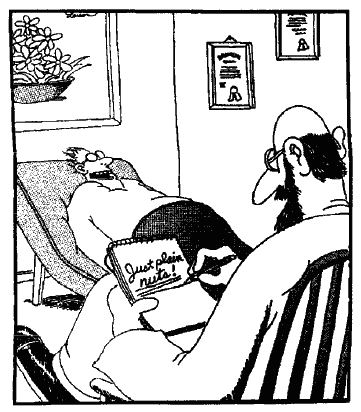
In a meandering way, this post is a reflection on one of anthropology’s consistent criticisms of psychology; the often unacknowledged role of psychiatry in shaping psyches. That is, the difficulty of studying a phenomenon when one is helping to create it and one’s theories influence your subjects’ accounts. When psychology is successful in breaking through into popular awareness, it becomes entangled with its subject, a kind of folk theory operating in the same space that psychologists seek to study. So this post is a kind of neuroanthropological reflection on clinical psychology as both research enterprise and world-making project, and the way the two come into conflict.

Specifically, Daniel’s post on Neurotosh and Levine’s story of John Stewart confronting Harvard happiness researcher, Prof. Tal Ben-Shahar, reminded me of the recent scandal surrounding psychiatrist Prof. Joseph Biederman. Biederman took large unreported consulting fees from pharmaceutical companies who manufactured anti-psychotic medicines while he was simultaneously encouraging psychiatrists to diagnose children with bipolar disorder, and then to prescribe their young patients anti-psychotic medicines. Senator Charles E. Grassley (R-Iowa) held hearings on the financial conflicts of interest as reported in The New York Times in Researchers Fail to Reveal Full Drug Pay, by Gardiner Harris and Benedict Carey. (For an earlier critical article, see the Boston Globe piece, Backlash on bipolar diagnoses in children.)

Continue reading “Psychiatry affects human psychology: e.g., ‘bipolar’ children”

Pharyngula on epigenetics

P. Z. Myers of Pharyngula, when he isn’t driving creationists into paroxysms, can write some great translations of biological concepts for the average reader. He does this in the post, Epigenetics, where he points out some of the problems with textbook definitions of the term. I really recommend checking this post out, but get a cup of coffee and a comfortable seat before you do — the post is not lite fare.

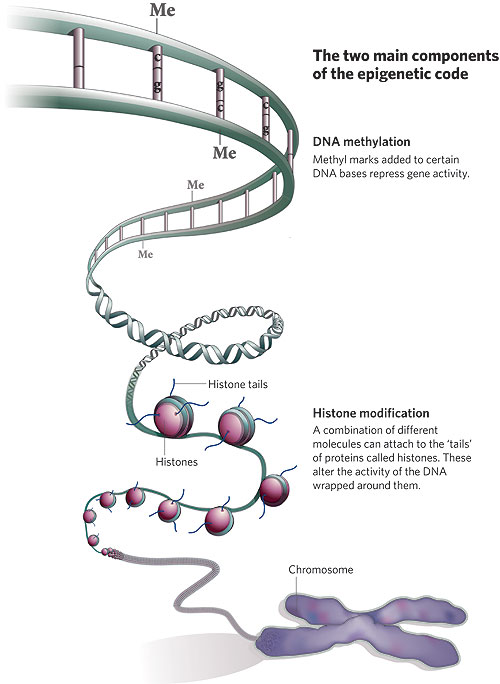
Epigenetics, although devilishly difficult, is absolutely essential for breaking with the common conception of DNA as ‘blueprint’ or marching orders for biological processes. In biological developmental processes, the expression of DNA is quite a bit more interesting than just ‘genes made it happen.’ Myers lays out a host of good examples, such as the variable degree to which histones permit or inhibit DNA transcription, the inactivation of parts of DNA when methylated, how chromosome geometric arrangement might affect gene expression, and other factors. He also discusses X chromosome inactivation in females (because they have two, one has to shut down), genomic imprinting on non-sex chromosomes (Myers discusses chromosome 15 and some of the disorders that can result), and disease changes in genetic expression (such as liver cirrhosis and retroviral insertions, which I touched on in an earlier posts on ‘identical’ twins).

Grunt Doc joked in the last Grand Rounds blog carnival that he hoped our post on psychiatric genetics ‘wouldn’t be on the test’; that goes double for the material Myers is covering. Fascinating, but, wow, tough to wrap the head around. But it’s already making me look at our calico cats in a new light…

Stumble It!

Graphic: Originally from Nature 441, 143-145 (11 May 2006); downloaded from UNSW Embryology, h/t to Pharyngula.

Fall prevention in older people — Stephen Lord at HCSNet

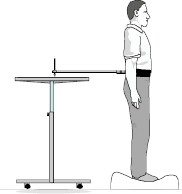
Sway meter, subject on foam
Daniel isn’t the only guy at Neuroanthropology who gets to go to good conferences; last week, while in the throes of a cold brought on by fieldwork with the 15-and-under Sydney city select rugby team, I got to go to the HCSNet Workshop on Speech, Perception and Action held at Western Sydney University.

HCSNet is funded by the Australian Research Council to promote research on human communication. I only got to go to the second day of the two-day conference (because I was cooking meals for 20 hungry rugby hopefuls the first day), but I saw a number of great presentations, including talks by Catherine Best, MARCS Auditory Laboratories, UWS, Beatriz Calvo-Merino, University College London, and Stephen Lord, Prince of Wales Medical Research Institute. I’ll blog soon on Dr. Calvo-Merino, one of the high points of the day, but today I want to make some notes on Prof. Lord’s fascinating research and talk.

Prof. Lord heads the Falls and Balance Research Group. Visit the group’s website for publications and some great information about risk factors for falling. At the conference, Lord discussed the group’s extensive applied research examining different factors that contribute to older people falling and experimental interventions to decrease the contribution of any single factor. The project has created a screening procedure for use by general practitioners to evaluate an older person’s likelihood of falling.

As regular readers know, I’m particularly interested in the way humans maintain equilibrium (see earlier posts, Kids falling down and Equilibrium, modularity, and training the brain-body, and Daniel’s post of some great parkour video, Free Running and Extreme Balance). In the longer of these posts (Equilbrium, modularity…), I specifically discussed how the ‘sense of balance’ is actually a much more complex synthesis of multiple sensory inputs, both exteroception (perception of the world) and interoception (perception of the self).

Continue reading “Fall prevention in older people — Stephen Lord at HCSNet”

Bench and couch: genetics and psychiatry

Vaughn at Mind Hacks has a nice piece on recent research, reported in Nature, on psychiatric genetics: Mental illness: in with the intron crowd. The original article, Psychiatric genetics: The brains of the family, appeared in Nature on 10 July (but it’s behind a subscription wall if you want to see the original — sorry). Daniel linked to Vaughn’s article in the last Wednesday Round Up (#20), but I wanted to make a further brief comment. Vaughn does a really nice job of laying out the key issues, so I’d recommend jumping over there if this brief discussion whets your appetite.

The problem for neuropsychiatry is that genetic links to psychiatric disorders are proving difficult to clearly define. Abbott explains the situation really well:

Finding genes involved in psychiatric conditions is proving to be particularly intractable because it is still unclear whether the various diagnoses are actually separate diseases with distinct underlying genetics or whether… they will dissolve under the genetic spotlight into one biological continuum. Indeed, some researchers suggest that it would be better to abandon conventional clinical definitions and focus instead on ‘intermediate phenotypes’, quantifiable characteristics such as brain structure, wiring and function that are midway between the risk genes involved and the psychopathology displayed.

Continue reading “Bench and couch: genetics and psychiatry”