Girls gone guilty: Evolutionary psych on sex #2

A while back, I posted a piece on recent evolutionary psychology research on human sexuality, specifically Chicks dig jerks?: Evolutionary psych on sex #1. The previous post discussed a couple of research projects that have found a correlation between the ‘dark triad’ of narcissism, psychopathology, and manipulative Machiavelianism at low levels and the number of sexual partners that college-aged men reported having. The conclusion, baldly stated: chicks dig jerks, according to the researchers.

Today, I’m going to discuss a different set of articles, this time on ‘female guilt,’ sparked by research done by Prof. Anne Campbell, a psychologist at Durham University. Prof. Campbell surveyed people online and found that women regretted ‘one-night-stands’ more than men. This has led her to argue that women are ‘ill adapted’ for promiscuity, that the ‘sexual and feminist revolutions’ didn’t work because women couldn’t shake their inherent nature, which is to long for committed relationships and loathe themselves if they act like cheap floozies.

I delayed posting on this because I cannot get to the original article (my university library has a six-month delay on the journal Human Nature; Springer press release here). I hate posting on second-hand versions, but I feel like I don’t want to wait six months to write #2 in my series on ev psych stereotypes…. I mean, ‘perspectives’ on human sexuality or to put in my own two cents worth of opinionation. So I have to base most of my discussion on the press release from Durham University about Prof. Campbell’s recent article.

I can’t imagine that I’m EVER going to persuade the hardened core of evolutionary psychologists that there is not a thing called ‘human nature’; I’m not opposed to the concept for political, feminist reasons but because I don’t think living organisms have ‘essences,’ especially when it comes to behaviour. Nothing I can say, no theoretical point or comparative data from around the world of human variation, will convince the evolutionary psychologists because they know, they just know, that human nature — especially sex — has been shaped by evolution, hardened and set in our genes (or brains or hormones…), to rear it’s head when we do something against our nature (like a woman having sex and not trying to find a mate).

Continue reading “Girls gone guilty: Evolutionary psych on sex #2”
Letter from Ashwin about studying ‘neuroanthropology’

One of our readers, Ashwin, who’s completing his PhD at UCSD posted the following letter on one of our earlier pieces, Where to study neuroanthropology? (it’s response #5), and I thought I should move it up to the front page and make a few comments. It was quite thoughtful and touched on topics that extended beyond merely the issue of where a person might do a PhD in ‘neuroanthropology,’ which really doesn’t exist as a recognized specialization, not only because it is new but also because of certain blind spots in contemporary cultural anthropology. First, I let Ashwin do the talking (and thanks very much for the letter):

My two cents on this query is that as important than what a department looks like on paper/website, past reputation, is to contact faculty to inquire how feasible integrated work will be and will be tolerated.

I am finishing up my PhD in Anthropology and Cognitive Science at UCSD. Ed Hutchins and Tom Csodas (both mentioned above [ed note: see previous post]) are on my committee. Even though I am doing an interdisciplinary degree through an institutionalized mechanism it does not mean that everyone in either department is supportive or even understands what it is I am up to. There is a lot of buzz about interdisciplinary research these days, but persons like me still run up against a lot of traditional disciplinary boundaries/stigmas/epistemological insecurities.
Unfortunately, mainstream (cultural) anthropology still has its head in the sand.
My own experience is that there are still disciplinary dues to be paid, gods to be worshipped, whatever. So it pays to be resilient and fairly clear of intent.
Just something to look out for.

Continue reading “Letter from Ashwin about studying ‘neuroanthropology’”

Mirror neurons: shameless plug redux & publishing regrets

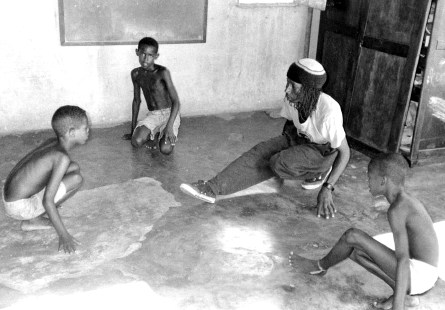
Natinho teaches a capoeira classI’m pleased that a piece I put together on coaching and physical education has appeared in the most recent edition of American Anthropologist. Entitled, Scaffolding Imitation in Capoeira: Physical Education and Enculturation in an Afro-Brazilian Art, it’s behind a subscription wall (sorry about that).

The article is part of my continuing attempt to understand the relation of mirror neurons to actual patterns of imitative cultural learning. The effort is pretty unambitious in comparison to some of the more sweeping declarations about mirror neurons, that they explain all sorts of human capacities. That is, I think some of the discussion of mirror neurons has sped on ahead of both the research and other studies of imitation, including its limitations and odd quirks, to declare that mirror neurons explain all sorts of human abilities. By focusing specifically on a setting where imitation clearly is in play — mimetic learning — I hope to create a model of brain, behaviour, interaction, and even ideology all in interplay to create ability in the individual actor.

Mirror neurons alone do not explain humans’ prodigious abilities in imitative learning; the macaques that first offered evidence of mirror neurons to the University of Parma team do not learn well through imitation. So we can’t just explain enculturation through imitation in humans by reference to mirror neurons. There’s got to be more to the story than mirror neurons. So to think about that, I’m looking specifically at motor learning in capoeira, my original ethnographic study, and am now moving to work on rugby coaching (if I can get some research support).

What I’m thinking is that this careful neuroanthropological modeling of enculturation will likely undermine certain accounts of what culture itself could be. That is, studying how we get encultured will demonstrate limits on what can be learned, how, and under what circumstances.

Continue reading “Mirror neurons: shameless plug redux & publishing regrets”

Culture and Cognition Workshop in Bristol, UK

Francisco Varela (1946-2001)
Francesco Varela (1946-2001)
Fred Cummins of University College Dublin contacted me to give me a head’s up on a workshop that looks pretty good, covering some of the same topics that we look at here at Neuroanthropology.

The workshop is ‘Cognition and Culture: an enactive view,’ and will especially explore the legacy of Humberto Maturana and Francesco Varela. The meeting organizers explain that they seek to ‘develop a robust vocabulary and set of concepts that are capable of sustaining dialogue between researchers in cognitive systems, cognitive science, arts, media, and culture by using the insights and approaches of the enactive approach to cognition.’

Chilean biologists Maturana and Varela wrote a couple of books together, but they are probably best known for the concept of autopoeisis and the book, Tree of Knowledge. Varela also did work on the embodied mind and directly contributed to some of the current neurosciences research on Buddhist monks (such as the Mind and Life Institute, which Varela helped to found); he passed away in 2001, leaving a very rich legacy (see his ‘focus file’ here). Varela, and his mentor Maturana, were both biologists with philosophical inclinations, doing quite a bit to encourage the study of phenomenology in biology and the embodied nature of the brain. Varela did some early brain imaging research, linking observed changes to perceptions. Although there are some parts of his thinking that we at Neuroanthropology might seek to expand and transform, Varela was a giant in the move to create a synthetic brain science that bridged the gap between biological and sociocultural or psychological research.

Continue reading “Culture and Cognition Workshop in Bristol, UK”

Get into trance: Felicitas Goodman

Dr. Felicitas Goodman

Some readers may have thought I was doing my little anthropologist’s quibble with the research on gene expression in meditation in Relax your genes, when I wrote, ‘I’d be surprised if variations in these techniques (such as those that use chanting or movement, for example) had no effect at all on the resulting neural, cellular, and perhaps even genetic processes.’ Some of you might have thought to yourselves, ‘Sure, Greg, you always say stuff like that — you’re paid to say stuff like that as an anthropologist.’ But one of the things I was thinking about was the work of the late anthropologist, Felicitas Goodman, which I hadn’t really discussed at all on Neuroanthorpology.

I stumbled across the webpages for the Felicitas Goodman Institut (the page is in German), and the English discussion of her work, Ritual Body Postures and Ecstatic Trance, by Nana Nauwald, and the webpage for The Cuyamungue Institute, which Goodman founded, this morning. A bit of searching turned up an interview with Prof. Goodman at Conversations for Exploration.

Goodman’s own biography is pretty fascinating; she didn’t do her PhD in anthropology until she was in her 50s, already a veteran German professor at Ohio State where she emigrated after leaving Germany with an American husband (Glenn). She went on to teach anthropology at Denison University (Ohio), and is best known for her contributions to the study of ecstatic states, including trance and glossalalia (speaking in tongues). She wrote a number of works, including Where the Spirits Ride the Wind: Trance Journeys and Other Ecstatic Experiences and Speaking in Tongues: A Cross-Cultural Study of Glossolalia (now out in a new edition, according to Amazon). After falling in love with the area around Santa Fe, Goodman helped to found The Cuyamungue Institute in New Mexico, which, according to the institute’s website, ‘continues her research into altered states of consciousness and holds workshops about the postures which she admits are but one door to alternate reality.’

Continue reading “Get into trance: Felicitas Goodman”

Relax your genes

Image from Good Karma Flags
Relax — it can affect your genes.

A recent article on PLoS One by a research team from the Benson-Henry Institute for Mind/Body Medicine at Massachusetts General Hospital (MGH) and the Genomics Center at Beth Israel Deaconess Medical Center (BIDMC) discusses the genetic effects of the relaxation response, a widespread bodily state induced by different mind-body techniques (such as meditation).

The original piece, Genomic Counter-Stress Changes Induced by the Relaxation Response, was published at PLoS One, and the findings are also discussed on ScienceDaily, Relaxation Response Can Influence Expression Of Stress-related Genes. It’s starting to be a bit of a refrain from genetics research, but it still bears repeating: the team is exploring a way that ‘changing the activity of the mind can alter the way basic genetic instructions are implemented,’ as Dr. Herbert Benson explained (in ScienceDaily).

The relaxation response is a bodily state, found in a variety of contexts, characterized by ‘decreased oxygen consumption, increased exhaled nitric oxide, and reduced psychological distress.’ Long-term effects of relaxation exercises include decreased oxygen intake and carbon dioxide elimination; reductions in blood pressure, heart and respiration rate; prominent low frequency heart rate oscillations; and some changes in cortical and subcortical brain regions, including increased thickness of the cortex (see NeuroReport and here also on the effect of meditation on aging).

For about three decades, dependable clinical studies have shown that relaxation response-producing exercises have a range of positive health benefits. What makes the current research distinctive (at least in my reading) is that the team traced this metabolic process to its genetic effects. As the authors write:

This study provides the first compelling evidence that the RR elicits specific gene expression changes in short-term and long-term practitioners. Our results suggest consistent and constitutive changes in gene expression resulting from RR may relate to long term physiological effects. Our study may stimulate new investigations into applying transcriptional profiling for accurately measuring RR and stress related responses in multiple disease settings.

Continue reading “Relax your genes”