Microsoft induced repetitive brain trauma

Vaughn at Mind Hacks is one of my favourite neuro-bloggers, not only because he once referred to us as the ‘mighty’ Neuroanthropology, but also because he maintains his prolific output while still finding ample opportunities for inducing the unexpected snort-laugh (you know the one — you’ve just scanned his site because you want to sip your coffee and eat a muffin, so you can’t keep typing, and he writes something that causes you to have to clean up your keyboard, cursing him at the same time that you appreciate the barb…).

He writes about the developmental impact of Microsoft Word’s ‘auto-correct’ function (I only say ‘auto-correct’ because that’s what it’s called — sometimes it’s more like ‘obdurately-mangle’). He refers to the disorder as Bell’s Frontal Nomenclature Hypertrophy Syndrome in his post, ‘Computers cause abnormal brain growth – proof!‘ The part that caused my snack-related accident was a line about the growing frequency of the phrase ‘cingulated cortex,’ with the likely culprit being the ubiquity of the ‘auto-mangle’ function on Word.

There are 15 uses of the phrase “cingulated cortex” from 1900 to 2000. There are 1,740 uses from 2000 to now.

There must be a variant of the disorder, however, that’s caused by the auto-hyperlink function (which I know there should be some way to disable, but it would require me to become even more intimate with Word — a man has to draw the line to save his dignity!). And perhaps another one linked to the sometimes unexpected ways that Word decides you’re trying to achieve some formatting trick — like indented, numbered paragraphs. I feel like I have to watch what I’m typing to catch these software ticks, as my document gets auto-corrected, auto-formatted, and auto-linked in various ways that I emphatically reject. It’s certainly changed my visual search behaviour while typing, but it may also be undermining my linearity of narrative thought as I must constantly engage in recursive software checking, rendering my internal narrative a kind of play-and-replay, like a mad scratcher on an out-of-control turntable. But then again, maybe it’s just my midweek sleep deprivation as I try to complete slides on Human Brain Evolution and Dietary Change for tomorrow’s lecture…

Graphic from See One, Do One, Teach One.
Women on tests update: response to stress

A while ago, I posted an overly-long discussion of recent research on the ‘math gap’ between boys and girls on standardized testing (Girls closing math gap?: Troubles with intelligence #1). That posting discussed several studies published in Science that have shown the gap in average math scores between boys and girls is not set in stone. In one paper, an increase in the test pool brought on by the No Child Left Behind program, with mandatory universal tests instead of exams only for those wishing to go to college, caused the gap in average scores to disappear; in the other paper, a decrease in the ‘math gap’ was found to correlate with other measures of greater gender equality in European states.

As I pointed out in the previous post, however, many commentators suggest that it is not the gap in average test scores that really matters; rather, these critics argue that the different variance in boys’ and girls’ scores explains the disproportionate number of boys who produce exceptional scores (as well as exceptionally bad scores), and thus the marked gap of men and women in PhD math programs, in prestigious prizes for physics and related subjects, and in related fields like engineering. In the earlier post, I argued that even if this greater variance showed up reliably across all testing populations, what exactly was being illuminated was still not clear; that is, many other explanations–other than that men had better ‘math modules’ in their brains, or greater ‘innate’ mathematics ability, or something like that–could explain even very stable differences in math performance. At the time I suggested a number of other possibilities, such as sex differences in stress response during testing, as other possible explanations for even a universal ‘math gap’ (which still had to contend with studies like the two in Science which severely undermined the assertion of universality).

As if on cue, I stumbled upon a video and accompanying article in Science Daily on differences in stress responses among men and women: Neuroscientists Find That Men And Women Respond Differently To Stress (but don’t click on that link — keep reading!). Stress is a good candidate to explain a test-taking gap because the observable physiological processes offer abundant evidence that men and women don’t respond to stress in exactly the same way (although there are underlying commonalities). For example, stress causes different diseases in men and women, and some long-term psychological disorders that demonstrate sex-linked disparities seem to emerge from stress.

Unlike the ‘black box’ explanation that boys and simply better at math or evidence greater variability in innate ability, with no observable neural correlate or plausible explanatory mechanism, in variation in stress response we have a clear candidate for male-female difference that plausibly affects their performance and even physiology (for example, in different stress-related diseases).
Continue reading “Women on tests update: response to stress”

Nova: Ghost in Your Genes

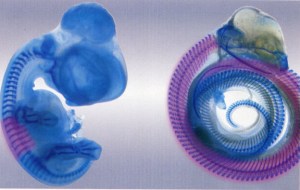
The vertebrae in which hoxc-6 is active (marked purple) in both a chick embryo and garter snake embryo.
Although the title of the special made me think of ‘Party in Your Pants’ (juvenile, I’m well aware), I thought I’d post a link to the website for the Nova special, ‘Ghost in Your Genes.’

The special explores epigenetics and the complex network of regulatory mechanisms that affect gene expression, including a nice little slideshow on Hox genes. We’ve explored the topic before here at Neuroanthropology (see Pharyngula on epigenetics) in part because a better understanding of the molecular mechanisms of organic development tends to undermine the overly simplistic notion that there are two forces shaping any organism — genes and environment or ‘nature’ and ‘nurture.’ With the epigenetic material, it’s painfully obvious that genes are not some kind of organic destiny writ in DNA, as some popular understandings tend to have it (and that popular understanding is often mobilized in simplistic accounts of subjects like behavioural genetics, as we will know).

We’ve already discussed some of the quirks about twins’ genes here (at Identical twins not… err… identical?), and there’s a nice example of genetically identical twin mice looking anything but identical (and having significant differences in health). The story, ‘A Tale of Two Mice,’ has a sobering subtext about the effects on gene expression of BPA (Bisphenol A), an organic chemical known to leach out of plastics (see Wikipedia for a brief overview of the issues). However, I’m still not convinced that calling this complex interaction ‘the epigenome’ or ‘the second genome’ is moving in the right direction. Even with this reservation, the visual aids for thinking about epigenetic processes are excellent.

Thanks to Dr. Jovan Maud (from Macquarie University and Culture Matters) for pointing this piece out to me. Unfortunately, I just gave my lecture on this stuff a week and a half ago — I’m afraid that I confused my audience a lot more than the people at Nova. It’s a nice site though for getting a bit of a feel for the sorts of factors that affect gene expression.

Credits
The brilliant graphic accompanied a reprint of Sean B. Carroll’s article, ‘The Origins of Form: Ancient genes, recycled and repurposed, control embryonic development in organisms of striking diversity,’ originally published in Natural History, November 2005. Carroll’s article can be accessed here, and it’s a great entry-level piece on hox genes and basic ‘evo-devo’ thought, but the author of Endless Forms Most Beautiful.

US Presidential campaign wordpiles

What's on your mind?
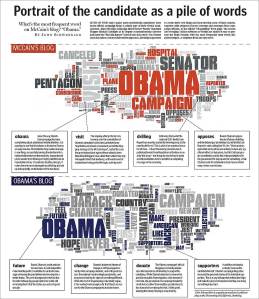
The Boston Globe did a ‘Wordpile’ analysis of both Sen. John McCain and Sen. Barack Obama’s websites and generated some fascinating graphics. Check out the original here. There’s lots one could say about these graphics — the Globe only highlights a few of the fascinating terms, and I’d want to try to chase down the context of a few that show up prominently because they look pretty ambiguous — but some factors stand out clear as day. The most obvious is that ‘Obama’ is the most mentioned word on both blogs. ‘Veeeery inturusting…’

The reason I bring this visual up though is that I found it a fascinating, graphically powerful way to present a basic qualitative-quantitative bit of research. Although I’m intrigued by research tools like nVivo and Atlas.ti, I sometimes wish that there were richer ways to present the data. This ‘Wordpile’ output is rich enough to put on a t-shirt! I’ll have to find some way to integrate it into my seminars on hybrid research methods.

And if anyone knows where I can lay my hands on the software or script to generate this sort of thing, please send along the link. A quick search didn’t give me anything, and I don’t want to sit in my office all Friday obsessing about this.

Human evolution syllabus

I’ve been contributing too little to Neuroanthropology of late. To be honest, I’m exhausted. I’m doing a new class on human evolution and diversity for the anthropology department here at Macquarie University, and it’s kicking my posterior. I have all the usual time devouring requirements of a new class, with the added fun of 130 students, my own high expectations, and my desire to put biocultural and biological anthropology on a bit more solid footing here. I was never trained to do this — although I really enjoyed human evolution, archaeology, and biological anthropology as an undergraduate — but I really felt like it needed to be done, even if I’m not the ideal person to do it.

As recently as 2005 and 2006, a very noisy law professor here at Macquarie, Dr. Andrew Fraser, was advocating a return to the ‘White Australia’ immigration policy (see Wikipedia on him here). As Wikipedia explains (I don’t want to do the legwork on this one to give it a deeper reading): ‘In July, 2005, he received national attention in Australia by opposing non-European immigration, saying that Australia should withdraw from refugee conventions to avoid becoming “a colony of the Third World” and that African immigration increased crime rates.’ His explanation was a hodge-podge of ‘scientific racism’, discredited eugenic theory, and over-heated rhetoric. The timing was ironic; when I was trying to negotiate the terms of my contract, Macquarie was sealing off its campus because of the furor.

I felt that anthropologists needed to respond to Fraser’s ideas (as well as a lot of other things) with a serious biological anthropology unit on evolution and diversity in humanity. But our department has, of late, been offering almost entirely sociocultural anthropology, as many European and Australian departments do. And that’s how I got to offer a unit, ‘Human Evolution and Diversity,’ for Macquarie first-year students. It’s been going well, but it’s draining me.

Continue reading “Human evolution syllabus”

New Four Stone Hearth

So the new Four Stone Hearth, the blog carnival of anthropology, is up at Almost Diamonds. Stephanie may not be an anthropologist, but she puts together a formidable list, including several Olympic-related posts, such as Rex’s (he’s still Alex to me) contribution at Savage Minds, Well I guess we should say something about the Olympics and a fascinating short post by Vaughn at Mind Hacks on cross-cultural studies of the immediate reaction to winning and losing among sighted and blind athletes. There’s a number of good archaeological posts (including Stone Pages pointing to a story about Australia’s less-than-enthusiastic attempts to preserve archaeological sites), a cluster on Neandertal research, and a fascinating piece on artificial language evolution in the laboratory from Anthropology.net (with actual people instead of computers doing the learning).

Lots of good stuff — so why are you still here and not reading it?!