Video Games, Brain and Psychology Round Up

After earlier round-ups on video games (#1 on gaming in itself, as a social form; #2 on social science and game design), I am adding this third round up covering gaming and mind/brain research.

Together all three round ups provide the background for approaching video games through neuroanthropology. Ideally this background would then serve to inform specific research on gaming, which I have addressed previously in discussing avatars, MMORPGs, and Grand Theft Auto, probably my most synthetic piece.

To place that work in context, you can also check out the popular post One Day at Kotaku: Understanding Video Games and Other Modern Obsessions. See also: video games and the neuroanthropology of interaction and gaming and cultural perception.

This round-up draws more on published research than the previous two. At times the best I could provide is a link to an abstract; where possible, I have tracked down pdfs. And if there are other good papers out there that I don’t mention, please leave a comment!

Games and Neuroscience

Shawn Green and Daphne Bavelier, The Cognitive Neuroscience of Video Games
Pdf of a comprehensive chapter that appeared in the book Digital Media: Transformations in Human Communication

Klaus Mathiak & Rene Weber, Toward Brain Correlates of Natural Behavior: fMRI during Violent Video Games
“We propose that virtual environments can be used to study neuronal processes involved in semi-naturalistic behavior as determined by content analysis. Importantly, the activation pattern reflects brain-environment interactions rather than stimulus responses as observed in classical experimental designs.”

Niklas Ravaja et al., Spatial Presence and Emotions during Video Game Playing: Does It Matter with Whom You Play?
Yes it does—playing against another person is different than playing against a computer

CS Green & D. Bavelier, Action-Video-Game Experience Alters the Spatial Resolution of Vision
“Compared with nonplayers, action-video-game players could tolerate smaller target-distractor distances. Thus, the spatial resolution of visual processing is enhanced in this population. Critically, similar effects were observed in non-video-game players who were trained on an action video game; this result verifies a causative relationship between video-game play and augmented spatial resolution.” Gaming can also reduce gender differences in spatial cognition.

Fumiko Hoeft et al., Gender Differences in the Mesocorticolimbic System during Computer Game-play
“males showed greater activation and functional connectivity compared to females in the mesocorticolimbic system. These findings may be attributable to higher motivational states in males, as well as gender differences in reward prediction, learning reward values and cognitive state during computer video games”

MJ Koepp et al., Evidence for Striatal Dopamine Release during a Video Game
Pdf of well-received 1998 Nature paper on reward, dopamine and gaming. Slightly dated now with its view of reward and dopamine, but definitely a foundational piece.

Niklas Ravaja, The Psychophysiology of Video Gaming: Phasic Emotional Responses to Game Events
Ever wonder why it’s fun? Both positive and negative game events when players actively involved in playing elicited “positive emotional responses in terms of facial EMG activity” (pdf)

Games and Embodiment

James Paul Gee, Video Games and Embodiment
Recent article in Games and Culture laying out Gee’s view on gaming and human thinking as both “situated and embodied”.

Continue reading “Video Games, Brain and Psychology Round Up”
Video Game Round Up #2

I did a previous round up on gaming, which covered some basics on gaming, criticisms of the activity, some funny stuff, games as art, some anthropological work, and games and learning.

Here’s another round up, where I have focused on more traditional social science/anthropological themes, as well as related articles and blogging about game design.

Meaning

Sande Chen, Towards More Meaningful Games: A Multidisciplinary Approach
“how to ratchet up emotional intensity – through narrative design, visuals, and music – to create more meaningful games”

The Brainy Gamer, The Elusiveness of Meaning
“Ueda’s process begins with an image and grows from that place, informing the way the game plays, how it feels, and what it means… The meaning of the image is conveyed through a beautiful weave of gameplay and narrative.”

Kyle Stallock, Diablo Fans Petition Against III’s Artistic Direction
New game demo with brighter environments and more color creates a fan backlash: they want a visual style for Diable III “coherent with the universe it belongs to”. See the video report here

The Escapist, The Age of World Builders
“That’s when it really hit me: This wasn’t just some level in a game. This was my vacation home in a digital environment.”

Ian Bogost, The End of Gamers
Gaming matures as a medium, and takes myriad forms

Owen Good, Can a Game Be a Tearjerker?
A journalist asks, and online readers respond about their saddest gaming experiences.

The Brainy Gamer, Narrative Manifesto
Video games and delivering “genuinely interactive narrative experiences to the player”

Language

Brent Ellison, Defining Dialogue Systems
Dialogue as interaction, and how to build that into a game

Continue reading “Video Game Round Up #2”

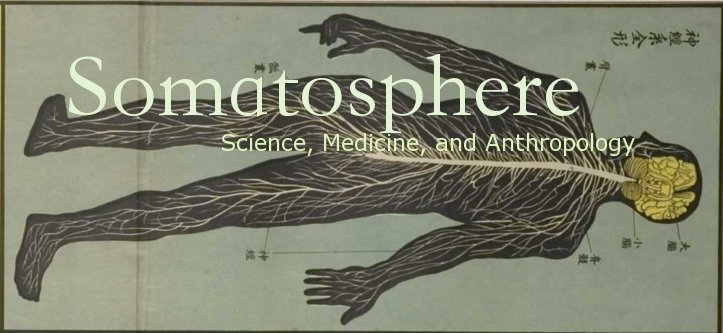
Somatosphere: Science, Medicine and Anthropology


Somatosphere is a new blog focusing on medical anthropology. Eugene Raikhel, a post-doc at McGill, is the primary blogger but there is also a group of contributing anthropologists.

I met Eugene last December at the big annual anthro conference, then again when I was at McGill in July for the critical neuroscience conference. I’ve been waiting to introduce his blog since then, mostly letting him build up an impressive collection of material.

Just yesterday he posted links to some great podcasts with neuroscientists (including Michael Rutter, whom I’ve always wanted to hear) over at the Wellcome Trust Centre for the History of Medicine.

His recent Web Gleanings includes a nice round up of posts and on-line articles ranging over topics like expertise, the limitations of biological psychiatry, antibiotic-resistant bacteria, and the history of treating fatigue.

And if you’re interested in cultural competence, illness narratives, and grandma’s little drug helper, then you’ll find all that and more at Somatosphere.

Michael Wesch and You Tube

Michael Wesch, anthropologist of the digital age, delivers a lengthy lecture at the Library of Congress on the emergence of You Tube and the uses of video in an Internet age. Viral trends in video, global consumption, and the creation of meaning and connections… Lots in this talk, plus some funny clips.

We’ve featured Wesch and his videos before. He also runs a blog/video site entitled Digital Ethnography. His reflection on “context collapse” is quite interesting. Now here’s his talk.

Wednesday Round Up #25

Interactions

Madeline Drexter, How Racism Hurts – Literally
“racism literally hurts the body. More than 100 studies — most published since 2000 — now document the effects of racial discrimination on physical health”

Jamie Davies, Switching Pain Off? Coping with Pain and Pain Experience
Perception and managing pain and even a You Tube Scrubs clip – very funny

Edward Slingerland, Let’s Get Clear about Materialism
A critical take on David Brooks’ Neural Buddhism, and what materialism (e.g., grounding social and psychological phenomena in the brain) really means

P. Pascal Zachary, Digital Designers Rediscover Their Hands
Software designers get hands-on with real world objects to learn to think more creatively and intuitively

Cordelia Fine, Words that Can Change Your Mind
The transformative effects of books

Globalization, Development and Change

Matthew Trevisan, Social Networking for Social Change
Social entrepreneurs aim to bring people together to help educate and create change

Reflection Café, The UC Atlas of Global Inequality
Get your fix on online, downloadable maps on inequality worldwide. Reflection Café provides a nice introduction and overview, but if you want to go directly to mapping, by all means do so.

NextBillion.Net, The Newsroom
Check out recent articles and blog posts on enterprise and development aimed for non-established markets and for people at the bottom of the economic food chain

Continue reading “Wednesday Round Up #25”

Grand Rounds at Six

Six until Me is hosting this week’s Grand Rounds, the carnival of medical-related blogging. This edition features a clever card catalog theme, with each card representing a theme. Topics covered include philosophy and psychology, languages, technology, and even funny stuff.

So we have maggot herders as the next big idea, dying of hunger in America (nice non sequitor, no?), dementia and brain fitness, and reflections on marriage and chronic illness.