Wednesday Round Up #3

Wednesday Round Up #3

“Decolonize Maiz” is art work by Ernesto Yerena. You can purchase it from the Saguaro Gallery.

Black Lives Matter: How the movement that’s changing America was built and where it goes next

And according to Muhammad, we can make these big asks now in large part not merely because of Garza, Cullors, and Tometi, but because of the framework they established. Black Lives Matter was born as an organization with a queer, feminist framework that grasped the importance of intersectionality. “Both Patrisse and I have this experience being queer black women in a movement for black freedom that really isn’t shaped in our image. One of the things that actually connected Patrisse and I very early on is what it meant to try to navigate that space,” Garza says.

That was especially important at a time when the media focused on black death centered on straight black men and boys. Since people are oppressed because of race, gender, and all of the various ways they are identified, if black lives are to truly matter, they all had to matter. It is to the movement’s credit that the deaths of trans people like Tony McDade and Nina Pop haven’t been lost in the shuffle of recent tragedies. But visibility hasn’t been the sole accomplishment.

“This moment crystallizes how important organizing is to movement work and movement building,” Muhammad says. “It’s clear that what they did helped to prepare, city by city, what is emerging as a national network of organizers who have been ready, willing, and able to step into a crisis. We have to see what’s happening here in terms of the nucleus of these massive protests being the outcome of all of that work.”

Explainer: what is decolonisation?

Decolonisation is now used to talk about restorative justice through cultural, psychological and economic freedom.

In most countries where colonisers remain, Indigenous people still don’t hold significant positions of power or self-determination. These nations are termed “settler-colonial” countries – a term made popular in the 1990s by academic Patrick Wolfe, who said “invasion is a structure not an event”.

We Can Protect the Economy From Pandemics. Why Didn’t We?

Now 49, Wolfe had traded the Cameroonian jungle for the conference rooms of Silicon Valley. When I saw him on Zoom, his shoulder-length locks were gone, and his quarantine beard was shot through with gray. But he had the same glow of enthusiasm I remembered. His new preoccupation, he told me, was pandemic insurance.

I’ll confess this didn’t immediately pique my interest. The word insurance evokes in me feelings of tedium and loathing. Like many Americans, my personal interface with the industry has, let’s just say, been less than positive. But then Wolfe began to explain the unexpected direction his career had taken. After years of thinking about epidemics in terms of the symptomatic and the dead, he’d begun considering their economic ramifications. A global pandemic, and the steps we would take to stop it, would mean business closings, layoffs, and mass unemployment. Preparing to face an outbreak, he’d come to believe, required anticipating those impacts.

Tanya Luhrman reflects on writing, books, and the difference between anthropology and ethnography. All built around her own trajectory as a scholar.
Continue reading “Wednesday Round Up #3”

Wednesday Roundup #2

Tyrone B. Hayes on how racism works in the academy. Hayes also was featured in the New Yorker for his groundbreaking work on how manufactured chemicals negatively impact our environment, in particular the herbicide atrazine’s impact on sexual development among amphibians

“Why are you always here?” She asked as we walked up the hill from LSA to Morgan Hall where Immunology was taught. I had walked alongside the professor from LSA to class all semester.

Concerned, I answered, “I’m taking the class, is that ok? I’ve never had a course in immunology.” I assumed the Professor was confused because I was an IB graduate student taking an undergraduate course in MCB.

“I didn’t know they let you guys take classes” she responded.

“What do you mean?” I asked.

“Aren’t you the custodian who takes care of the crickets?” she queried.

“No… I’m a graduate student in IB” I answered.

“Oh.” She said unapologetically. “I always see you on the elevator…I just assumed you were the custodian who takes care of the crickets.”

And that was my introduction to Berkeley as a new graduate student (fall of 1989). It was one thing for campus police to block my car twice during my first week of graduate school and interrogate me because someone called and reported me in the building…but it was a completely different one for one of my professors to treat me this way. I dropped the class.

I thought Berkeley would be better. It reminded me of my first day at Harvard…

The Biggest Psychological Experiment in History Is Running Now

Individual resilience is further complicated by the fact that this pandemic has not affected each person in the same way. For all that is shared–the coronavirus has struck every level of society and left few lives unchanged–there has been tremendous variation in the disruption and devastation experienced. Consider Brooklyn, just one borough in hard-hit New York City. Residents who started the year living or working within a few miles of one another have very different stories of illness, loss and navigating the challenges of social distancing. How quickly and how well individuals, businesses and organizations recover will depend on the jobs, insurance and health they had when this started, on whether they have endured hassle or heartbreak, and on whether they can tap financial resources and social support.

The pandemic has laid bare the inequities in the American health care system and economic safety net. Black and Latino Americans are dying at much higher rates than white Americans. “When we talk about preexisting conditions, it isn’t just if I’m obese, it’s our society’s preexisting condition,” says medical anthropologist Carol Worthman of Emory University, an expert in global mental health.

Fortunately, the unprecedented pandemic is leading to unprecedented science not just in virology but on mental health and resilience. Behavioral scientists are measuring the psychological toll in real time and striving to identify what helps people cope.

This Is What I Want To Tell My White Professors When They Ask, ‘How Are You Today?’

Continue reading “Wednesday Roundup #2”

Wednesday Round Up #1

I’m starting the Wednesday round up back up. I didn’t post yesterday because of #shutdownstem. For more information on that, see shutdownstem.com.

In the wake of the most recent murders of Black people in the US, it is clear that white and other non-Black people have to step up and do the work to eradicate anti-Black racism. As members of the global academic and STEM communities, we have an enormous ethical obligation to stop doing “business as usual.” No matter where we physically live, we impact and are impacted by this moment in history.

Our responsibility starts with our role in society. In academia, our thoughts and words turn into new ways of knowing. Our research papers turn into media releases, books and legislation that reinforce anti-Black narratives. In STEM, we create technologies that affect every part of our society and are routinely weaponized against Black people.

Black academic and Black STEM professionals are hurting because they exist in and are attacked by institutional and systemic racism. Black people have been tirelessly working for change, alongside their Indigenous and People of Color allies. For Black academics and STEM professionals, #ShutDownAcademia and #ShutDownSTEM is a time to prioritize their needs— whether that is to rest, reflect, or to act— without incurring additional cumulative disadvantage.

I encourage people to watch this short video with Ibram X. Kendi. “I’m not racist” is not good enough. We have to strive to actively become anti-racist.

Kendi’s longer talk here is well worth it. He provides more context and depth to his basic framing, and explains the history with keen insight.

I was also struck by this piece from footballer Liam Rosenior: This is just the beginning, I promise you: an open letter to Donald Trump.

Thank you for shining a spotlight to people around the world who have been sadly unaware of your country and the state it has been in for hundreds of years, and for outing the racist, hateful, bigoted and violent people who not only voted for you but have held the cultural key to an unjust, corrupt and fundamentally prejudiced society and system from the conception of the USA, built on the genocide of Native Americans and the slavery and incarceration of millions of black people.

Thank you for giving us a tangible, symbolic enemy (yourself and your Make America Great Again minions) against which people now have fuel to organise, strategise and mobilise a long-lasting movement and process to change our planet for good.

Ezra Klein interviewed Ta-Nehisi Coates.

“I can’t believe I’m gonna say this,” he replied, “but I see hope. I see progress right now” …
Continue reading “Wednesday Round Up #1”

Flattening the Mental Health Curve: Answers Already in Hand

Covid has impacted mental health. So too has police violence. And we still operate from a model where we have to go someplace to access individual care. Many of us fear going out, and our very institutions attack us. Somehow we think that expert care by institutions is what can solve the problem.
In this piece, I want to bring together two different views on this problem. The first comes from clinical psychologists addressing specific concerns about how to promote mental health during covid. The second comes from a cultural psychiatrist who fought for decolonizing psychiatry and recognizing how institutions have long been complicit in creating mental health problems, not just solving them.

June Gruber and Jonathan Rottenberg argue in Flattening the mental health curve is the next big coronavirus challenge:

Our field has accumulated long lists of evidence-based approaches to treat and prevent anxiety, depression and suicide. But these existing tools are inadequate for the task at hand. Our shining examples of successful in-person psychotherapies – such as cognitive behavioral therapy for depression, or dialectical behavioral therapy for suicidal patients – were already underserving the population before the pandemic.

Now, these therapies are largely not available to patients in person, due to physical distancing mandates and continuing anxieties about virus exposure in public places. A further complication: Physical distancing interferes with support networks of friends and family. These networks ordinarily allow people to cope with major shocks. Now they are, if not completely severed, surely diminished.

They argue for four inter-related factors: (1) just as with a switch to online teaching and learning, they see tele-health as one important way to bridge the gap; (2) democratizing mental health care and drawing on peer programs and social support more explicitly (rather than just delivering expert care); (3) promote populational mental health, which includes promoting better sleep, more exercise, and the ability to spend time outdoors; and (4) tracking populational mental health.

#4 will likely require new approaches and measures, as so much of psychology operates with a focus on the individual, rather than having scales and theories to address problems such as deaths of despair. Nancy Krieger’s ecosocial approach offers one place to start.

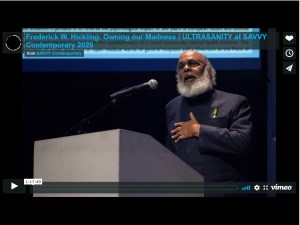
The second piece comes from the Foundation for Psychocultural Research: Owning Our Madness: Honoring Cultural Psychiatrist Frederick Hickling.

Hickling argues that we must own our madness. Own our mental health. And for Hickling this approach requires decolonization:

The mental health challenge for descendants of African people enslaved in Jamaica is to reverse the psychological impact of 500 years of European racism and colonial oppression and create a blueprint for the decolonization of Global Mental Health. The core innovations were the gradual downsizing and dismantling of the colonial mental hospital and the establishment of a novel community mental health initiative. The successful management of acute psychosis in open medical wards of general hospitals and a Diversion at the Point of Arrest Programme (DAPA) resulted in the reduction of stigma and the assimilation of mental health care into medicine in Jamaica. Successful decentralization has led to unmasking underlying social psychopathology and the subsequent development of primary prevention therapeutic programs based on psychohistoriographic cultural therapy and the Dream-A-World Cultural Therapy interventions.

In the video, Hickling tells us, “First we must understand colonialism and what I call the European-American psychosis… A primary delusion that has shaped contemporary psychological experience. Imagine, this small group of white people arriving in a boat after 10 or 12 weeks across the Atlantic, not having enough food and enough water and starving and hungry. And they arrive in this place of paradise, wonderful paradise, and they look at it and they say, This all belongs to me. And you all in here belong to me. And your wife and your husband and your children, you all belong to me. That must be the primary grandiose delusion of Europe.”

Hickling details his specific approach to cultural therapy in his Owning the Madness article in Transcultural Psychiatry.

The unique psychohistoriographic cultural therapy program pioneered in Bellevue Mental Hospital, Jamaica, in 1978 was a novel large group psychotherapy technique aimed at stimulating group insight and catalyzing change (Hickling, 1989, 2007). Created by combining the concept of historiography (Becker, 1938; Goveia,1958) with the oral tradition (Brodber, 1982),psychohistoriography is a method of dialectic analysis of reflective anecdotes to determine a group’s outlook, ideology, and beliefs and to identify dynamics and social forces that compel change.

The article then details (1) the development of community-wide mental health services, (2) short-stay treatement, (3) diversion at point of arrest, (4) reduction of stigma, (5) assimilation of mental health into medical care, (6) unmasking underlying social psychopathology, (7) the development of primary prevention programs, and (8) the development of specific cultural therapies to promote cultural resilience.

Decades of work in Jamaica offers the paths for how we might flatten the curve of mental health.

Maps, Figurative Symbols, and Songlines

When I think of symbols, I default to a rather literal sense of them. In my Introduction to Anthropology class, I put up the symbol for radiation, say there is nothing inherent in that symbol to tell us what it is, rather we put meaning on it – the symbol then tells us, beware of radiation. And thinking about early symbolism is often presented in a similar way. Pigments from Bombos caves, those must have been used to indicate group and individual identity. Radcliffe-Brown’s structural-functional jokes meets Geertz’s system of symbols…

But when I write, I am often trying to feel my way, to find a way to express and configure and connect. Not always – good science writing requires trying to express complicated ideas in a literal way, but that is often helped along by metaphors and comparisons. And when I take a photo, it is not the meaning of the photo that captures me, but the composition and trying to catch a moment that works within larger constellations of happenings in my life and the lives of others.

A graduate student of mine sent me this article, Thinking in maps: from the Lascaux caves to modern knowledge graphs by Anne-Laure Le Cunff over at Ness Labs. It opens:

“What do hieroglyphs, flowcharts, road signs, and knowledge graphs have in common? They’re all thinking maps. Humans have been thinking in maps since the very first symbolic communication systems.

While thinking in maps may first bring to mind the idea of cartography, a map does not need to be geographic—it can be any symbolic depiction of the relationship between elements of some physical or mental space, such as themes, objects, or areas.

In the December 2007 edition of Philosophy of Mind, Professor Elisabeth Camp, whose research has focused on forms of thoughts that do not fit standard models, wrote: “Thinking in maps is substantively different from thinking in sentences.””

And immediately I am struck by how my approach to symbols is one based in “thinking in sentences” – symbols tell me things. Figurative renderings, not so much. But any symbolic relationship between elements could count… That opens a much wider field for how to think about symbols and cognition in the past and the present.

The songlines of indigenous Australians operate more in this figurative realm, as stories and maps and music all together. Nganyinytja, a Pitjantjatjara woman, tells us:

“We have no books, our history was not written by people with pen and paper. It is in the land, the footprints of our Creation Ancestors are on the rocks. The hills and creek beds they created as they dwelled in this land surround us. We learned from our grandmothers and grandfathers as they showed us these sacred sites, told us the stories, sang and danced with us the Tjukurpa (the Dreaming Law). We remember it all; in our minds, our bodies and feet as we dance the stories. We continually recreate the Tjukurpa … ”

These ways of knowing help inform novel ways of thinking about how education can and should work, cultivating this long-existing and robust civilization, and even game design.

This figurative relationship is illustrated so well in this video with Elwyn Henaway demonstrating how the patterning works.

Now back to the original article:
Continue reading “Maps, Figurative Symbols, and Songlines”

Neuronal Systems as Networks

I want to cover two different open-access papers here, both of which represent advances in how we can study and understand how the brain achieves complex outcomes using different levels of interaction, from neurotransmitter systems, to connections among brain areas, to how networks work as systems. The first is a neuroscience-heavy paper, the second more on philosophy of science and complexity. So a good pairing!

Dynamic coupling of whole-brain neuronal and neurotransmitter systems by Morten L. Kringelbach et al.
Abstract:

Remarkable progress has come from whole-brain models linking anatomy and function. Paradoxically, it is not clear how a neuronal dynamical system running in the fixed human anatomical connectome can give rise to the rich changes in the functional repertoire associated with human brain function, which is impossible to explain through long-term plasticity. Neuromodulation evolved to allow for such flexibility by dynamically updating the effectivity of the fixed anatomical connectivity. Here, we introduce a theoretical framework modeling the dynamical mutual coupling between the neuronal and neurotransmitter systems. We demonstrate that this framework is crucial to advance our understanding of whole-brain dynamics by bidirectional coupling of the two systems through combining multimodal neuroimaging data (diffusion magnetic resonance imaging [dMRI], functional magnetic resonance imaging [fMRI], and positron electron tomography [PET]) to explain the functional effects of specific serotoninergic receptor (5-HT2AR) stimulation with psilocybin in healthy humans. This advance provides an understanding of why psilocybin is showing considerable promise as a therapeutic intervention for neuropsychiatric disorders including depression, anxiety, and addiction. Overall, these insights demonstrate that the whole-brain mutual coupling between the neuronal and the neurotransmission systems is essential for understanding the remarkable flexibility of human brain function despite having to rely on fixed anatomical connectivity.

A key section explaining their basic modeling:

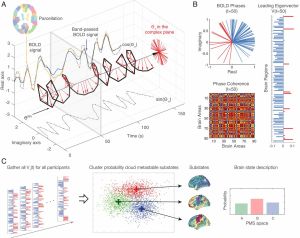
Specifically, the bidirectional coupling of the neuronal and neurotransmitter systems was modeled in the following way: For the placebo condition, we used a standard whole-brain model to simulate the neuronal system, i.e., modeling spontaneous brain activity at the whole-brain level (measured with blood oxygen level-dependent [BOLD] fMRI), where each node represents a brain area and the links between them are represented by white matter connections (measured with dMRI). For the psilocybin condition, we mutually coupled the whole-brain neuronal and neurotransmitter systems by including an explicit description of the neurotransmitter dynamical system and the mutual coupling with the neuronal system. This was done by modeling the dynamics of the neurotransmitter system through simulating the release-and-reuptake dynamics, where the serotonin receptor density of each brain area is measured with PET. The neurotransmitter dynamics are then in turn coupled with the neuronal activity through the firing rate activity of the raphe nucleus, source of the serotonin neurotransmitter.

And how they made that model statistically tractable:

We fitted the mutually coupled whole-brain model using our framework of describing a brain state as an ensemble or probabilistic “cloud” in a given state space (29). This cloud is of course not clustered into discrete states (30), but it has been shown that clustering can nevertheless be useful in providing so-called “metastable substates” that can significantly distinguish between brain states (31, 32). A brain state is determined by a collection of metastable substates, i.e., of time-varying pseudo-states resulting from the clustering process (33⇓–35).

And their conclusion:
Continue reading “Neuronal Systems as Networks”