A softer ‘neo-Whorfianism’

At Neuroanthropology, we’ve had a number of posts about language and the brain (such as here, here, and here); it’s a issue of lasting importance in anthropology, linguistics, cognitive science, and psychology. There’s a really nice piece in The New York Times about it though, and for once, I just want to do a summary and reflection rather than a critique of one of their pieces. The article is When Language Can Hold the Answer by Christine Kenneally.

Daniel recently mentioned this piece in his post, A Times Trifecta, but I wanted to add a comment on it. Daniel relays the quote that the article uses to sum up the debate around the Sapir-Whorf hypothesis: ‘Does language shape what we perceive, a position associated with the late Benjamin Lee Whorf, or are our perceptions pure sensory impressions, immune to the arbitrary ways that language carves up the world?’ He’s just providing a thumbnail sketch, so he doesn’t include the next paragraph, which I think helps to elevate this article above the usual either-or, black-or-white dross that happens in public press about the role of language in thinking:

The latest research changes the framework, perhaps the language of the debate, suggesting that language clearly affects some thinking as a special device added to an ancient mental skill set. Just as adding features to a cellphone or camera can backfire, language is not always helpful. For the most part, it enhances thinking. But it can trip us up, too.

Continue reading “A softer ‘neo-Whorfianism’”

Dying Sooner: The New US Pattern

What the hell is wrong with this country? That is what came to my mind when I read a recent PLoS article “The Reversal of Fortunes: Trends in Country Mortality and Cross-County Mortality Disparities in the United States.” The basic conclusion: life expectancy is going DOWN in parts of the United States. How can that be?!

Here is what the PLoS article tells us: From 1983 to 1999, life expectancy declined significantly in 11 US counties for men and in 180 (!) counties for women. Why? “Life expectancy decline in both sexes was caused by increased mortality from lung cancer, chronic obstructive pulmonary disease, diabetes, and a range of other noncommunicable diseases, which were no longer compensated for by the decline in cardiovascular mortality [driven largely by better drugs and interventions]. Higher HIV/AIDS and homicide deaths also contributed substantially to life expectancy decline for men, but not for women.”

In their conclusions, the authors Majid Ezzati, Ari Friedman, Sandeep Kulkarni, and Christopher Murray single out some specific health problems: “The epidemiological (disease-specific) patterns of female mortality rise are consistent with the geographical patterns of, and trends in, smoking, high blood pressure, and obesity. In particular, the sex and cohort patterns of the increase in lung cancer and chronic respiratory disease mortality point to an important potential role for smoking.” So cigarettes kill.

But before we blame it all on individual behaviors, recall that these data are also geographic, by county. Where did life expectancy go down for 4% of the male population and 19% of the female population? “The majority of these counties were in the Deep South, along the Mississippi River, and in Appalachia, extending into the southern portion of the Midwest and into Texas.” In the worst performing counties, life expectancy dropped SIX years for women and two and a half years for men. In contrast, in the best US counties, life expectancy rose by as much as five years.

Continue reading “Dying Sooner: The New US Pattern”

More on Brainbow

Since I posted Jeff Lichtman’s Brainbows, with all those wonderful images of the fluorescent brain, I’ve gotten questions from people about two basic things: first, how do they get those colors? and second, how do they get those images?

For the colors, genetic recombination techniques are used to insert pigment-expressing genes into the genomes of developing mice. The cool part? Those extra genes come from coral and jellyfish. The red color comes from coral, while the blue and cyan come from modifying a fluorescent green pigment in jellyfish.

For the images, the fluorescent hues only appear under fluorescent light. The Lichtman group has used two techniques, both using confocal microscopy (focused image taking, rather than a normal broad view from a typical microscope). First, brain slices are taken from mice and then examined in the lab. Second, for live shots, the Lichtman group works on the “neuromuscular junctions in a very accessible neck muscle in mice,” which permits taking a series of images over several days.

In the older post I blogged on how Lichtman’s approach to his research is reminiscent of what we try to do here—a naturalist concerned with the processes, mechanisms and connections of life and an understanding of the power of observation. But here I want to point out why these techniques are powerful. First, they permit an understanding of neuronal arrangements and connections through the greater discrimination provided by the many different colors. The image below from the original Nature article shows the differences between neuronal patterns in different parts of the brain.

Second, using computers to create 3-D videos from 2-D images, this research gives us maps that permits us stereoscopic humans to actually see fields of neurons as they are structured in the brain. This too represents a major advance over older images. So enjoy the video!

Finally, for your viewing pleasure, a composite image of brainbow pictures.

Darwin Online

Sue Sheridan, my colleague here at Notre Dame, has a post Darwin in His Own Words on her blog, Life of Wiley. I recreate it below since both the NPR story and the online link to Darwin’s works are great.

Darwin in His Own Words
There was a very interesting piece on NPRs Morning Edition about the new Darwin Online Project. They have made all of his writings, notes, letters, etc. available for free. Including free downloads of his books. Pretty cool. Apparently the site has been swamped with hits. Take that creationists!

As the Darwin Online site says, they got 7 million hits on April 17th. Wow! It should prove to be a great resource.

The New York Times also has an article on Darwin, What Darwin Saw Out Back. It covers the new exhibition at the New York Botanical Garden recreating Darwin’s experimental and observational work with flowers.

Here’s a relevant bit:

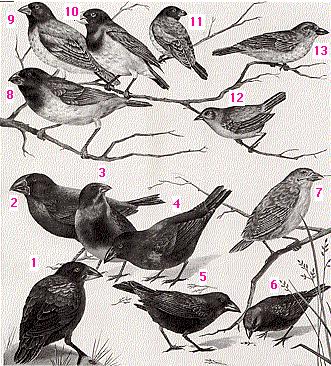
Though most people associate that book and Darwin’s ideas generally with his voyage to the Galápagos and his study of finches there, his work with plants was far more central to his thinking, said David Kohn, a Darwin expert and science historian who is a curator of the exhibition… “He was fascinated by plants,” particularly the way their variation and sexual reproduction challenged the idea that species were stable, a key idea in botany at the time. As Dr. Kohn writes in the exhibition catalogue, “plants were the one group of organisms that he studied with most consistency and depth over the course of a long scientific career” of collecting, observing, experimenting and theorizing. But Darwin studied more than flowers. He was intrigued by what Dr. Kohn calls the “behavior” of plants — how they move, respond to light, consume insects and otherwise act in the world.

Now if they would only do an exhibition on Darwin’s impressive work on molluscs to go along with the flowering plants and the Galapagos finches.

Dopamine and Eating

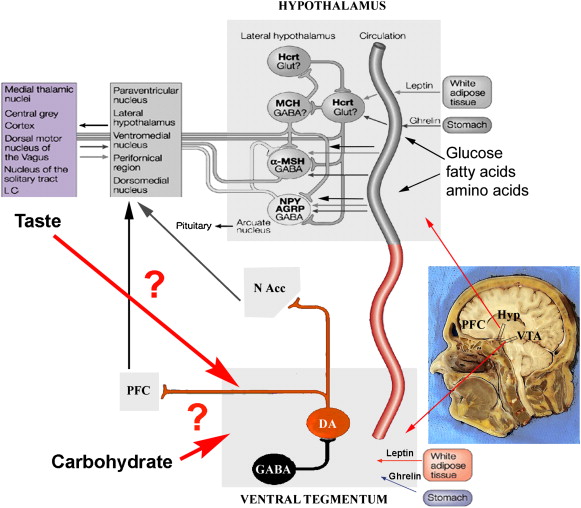
In an earlier post The Sugar Made Me Do It, I covered recent research by de Araujo, Oliveira-Maia et al. on how food, specifically sucrose, can reinforce eating by activating mid-brain dopamine circuitry, even in the absence of taste. In the accompanying editorial essay by Andrews and Horvath, this great graphic appeared, representing what is known about how eating can act on the hypothalamus and on the mesolimbic dopamine system (ventral tegmental area, nucleus accumbens, and prefrontal cortex).

Here is a much more convincing link to how eating can become appetite-driven, which previous posts on Genetics and Obesity and On the Causes of Obesity had raised as an important issue in the obesity problem.

Just one more note on the graphic: in terms of how taste can affect dopamine function, see some thoughts in the post on the neuropeptide orexin.

Figure 1. Schematic Illustration Depicting Some of the Major Findings of de Araujo and Oliveira-Maia et al

Taste alone (noncaloric sweetener), taste with caloric value (sucrose solution), or caloric value only (in the absence of taste receptors) can all equally activate the midbrain reward circuitry. To date, major emphasis has been placed on the hypothalamus and its various circuits, including orexin (ORX/Hcrt)- and melanin concentrating hormone (MCH)-producing neurons in the lateral hypothalamus as well as neuropeptide Y (NPY)/agouti-related protein (AgRP)- and -melanocyte-stimulating hormone (-MSH)-producing neurons in the arcuate nucleus, as a homeostatic center for feeding, responding to various peripheral metabolic hormones and fuels. The mesencephalic dopamine system is also targeted by peripheral hormones that affect and alter behavioral (and potentially endocrine) components of energy homeostasis. The results by de Araujo and Oliveira-Maia et al. highlight, however, that without classical hedonic signaling associated with reward-seeking behavior, the midbrain dopamine system can be entrained by caloric value arising from the periphery. While the precise signaling modality that mediates caloric value on dopamine neuronal activity remains to be deciphered, overall it is reasonable to suggest that distinction between hedonic and homeostatic regulation of feeding is redundant. DA, dopamine; GABA, γ-aminobutyric acid; Glut, glutamate.

Guns and Public Health

The New England Journal of Medicine has an informative podcast of an interview with David Hemenway on “gun violence in the United States and the likely effects of the Supreme Court case D.C. v. Heller.”

Hemenway covers the effect of gun control laws from the public health point of view. He provides a good international perspective, based both on variation in policy and research. One thing I did not know was how the US has become a major supplier of guns to Mexico, Japan and elsewhere–sold here, then imported illegally there. He also describes the impact of major gun control in Australia, where there was a significant reduction in violence post legislation.

The New England Journal of Medicine also provides a full-length editorial, Handgun Violence, Public Health, and the Law, by Gregory Curfman, Stephen Morrissey, and Jeffrey Drazen. Here is the opening: “Firearms were used to kill 30,143 people in the United States in 2005, the most recent year with complete data from the Centers for Disease Control and Prevention. A total of 17,002 of these were suicides, 12,352 homicides, and 789 accidental firearm deaths. Nearly half of these deaths occurred in people under the age of 35. When we consider that there were also nearly 70,000 nonfatal injuries from firearms, we are left with the staggering fact that 100,000 men, women, and children were killed or wounded by firearms in the span of just one year. This translates into one death from firearms every 17 minutes and one death or nonfatal injury every 5 minutes. By any standard, this constitutes a serious public health issue that demands a response not only from law enforcement and the courts, but also from the medical community.”

The same issue of NEJM also has a free-access article on this topic, Guns, Fear, the Constitution, and the Public’s Health, by Garen Wintemute. Focusing specifically on the Washington DC statute being challenged in the Supreme Court, Wintemute writes, “In 1976, Washington, D.C., took action that was consistent with such evidence. Having previously required that guns be registered, the District prohibited further registration of handguns, outlawed the carrying of concealed guns, and required that guns kept at home be unloaded and either disassembled or locked. These laws worked. Careful analysis linked them to reductions of 25% in gun homicide and 23% in gun suicide, with no parallel decrease (or compensatory increase) in homicide and suicide by other methods and no similar changes in nearby Maryland or Virginia.”