Why Neuroanthropology? Why Now?
By Greg Downey and Daniel Lende
Neuroanthropology places the brain and nervous system at the center of discussions about human nature, recognizing that much of what makes us distinctive inheres in the size, specialization, and dynamic openness of the human nervous system. By starting with neural physiology and its variability, neuroanthropology situates itself from the beginning in the interaction of nature and culture, the inextricable interweaving of developmental unfolding and evolutionary endowment.
Our brain and nervous system are our cultural organs. While virtually all parts of the human body—skeleton, muscles, joints, guts—bear the stamp of our behavioral variety, our nervous system is especially immature at birth, our brain disproportionately small in relation to its adult size and disproportionately susceptible to cultural sculpting. Compared to other mammals, our first year of life finds our brain developing as if in utero, immersed in language, social interaction, and the material world when other species are still shielded by their mother’s body from this outside world. This immersion means that our ideas about ourselves and how we want to raise our children affect the environmental niche in which our nervous system unfolds, influencing gene expression and developmental processes to the cellular level.
Increasingly, neuroscientists are finding evidence of functional differences in brain activity and architecture between cultural groups, occupations, and individuals with different skill sets. The implication for neuroanthropology is obvious: forms of enculturation, social norms, training regimens, ritual, and patterns of experience shape how our brains work and are structured. But the predominant reason that culture becomes embodied, even though many anthropologists overlook it, is that neuroanatomy inherently makes experience material. Without material change in the brain, learning, memory, maturation, and even trauma could not happen. Neural systems adapt through long-term refinement and remodeling, which leads to deep enculturation. Through systematic change in the nervous system, the human body learns to orchestrate itself as well as it eventually does. Cultural concepts and meanings become anatomy.
Although every animal’s nervous system is open to the world, the human nervous system is especially adept at projecting mental constructs onto the world, transforming the environment into a sociocognitive niche that scaffolds and extends the brain’s abilities. This niche is constructed through social relationships, physical environments, ritual patterns, and symbolic constructs that shape behavior and ideas, create divisions, and pattern lives. Thus, our brains become encultured through reciprocal processes of externalization and internalization, where we use the material world to think and act even as that world shapes our cognitive capacities, sensory systems, and response patterns.
Our ability to learn and remember, our sophisticated skills, our facility with symbolic systems, and our robust self control all mean that the capacity for culture is, in large part, bought with neurological coin. This dynamic infolding of an encultured nervous system happens over developmental time, through the capacity of individuals to internalize both experience and community-generated tools, and then to share thoughts, meanings and accomplishments. Thus, a central principle of neuroanthropology is that it is a mistake to designate a single cause or to apportion credit for specialized skills (individual or species-wide) to one factor for what is actually a complex set of processes.
Most academic research implicitly or explicitly utilizes a reductive cause-effect approach; in popular understandings of the brain, the tendency to single out causal factors is even more prevalent. Rather than one set of genes or an overarching system of meaning, humans’ capacity for abstract thought emerges equally from social and individual sources, built of public symbol, evolutionary endowment, social scaffolding, and private neurological achievements. In neuroanthropology, the goal is not simply to juxtapose a simplistic critique against a one-side initial account, but to attempt a much more holistic, synthetic exploration of how various elements in these dynamic relations interact to produce cognitive functions.
Neuroanthropology: Areas of Application
Neuroanthropology has four clear roles: (1) understanding the interaction of brain and culture and its implication for our understanding of mind, behavior, and self; (2) examining the role of the nervous system in the creation of social structures; (3) providing empirical and critical inquiry into the interplay of neuroscience and ideologies about the brain; and (4) using neuroanthropology to provide novel syntheses and advances in human science theory.
The interaction of brain and culture is neuroanthropology’s core dynamic, exploring the synthesis of nature and nurture and cutting through idealized views of biological mechanisms and cultural symbols. Using social and cultural neuroscience in combination with psychological anthropology and cultural psychology, neuroanthropology builds in-depth analyses of mind, behavior and self based on an understanding of both neurological function and ethnographic reality. This research creates robust analyses of specific neural-cultural phenomena, recognizing that each may demonstrate a distinctive dynamic; for example, neuroanthropological investigation reworks our understanding of human capacities like balance (often assumed to be something innate), studies how practices like meditation shape and piggyback upon neural functioning, and examines the interactive nature of pathologies like addiction and autism.
Neuroanthropology has profound implications for our understanding of how societies become socially structured. Inequality works through the brain and body, involving mechanisms like stress, learning environments, the loss of neuroplasticity, the impact of toxins, educational opportunities (or their absence) and other factors that negatively shape development. Neuroanthropology can play a fundamental role in documenting these effects and in linking them to the social, political and cultural factors that negatively impact on the brain. At the same time, technological and pharmacological interventions are playing an increasing role in managing behavioral disorders, often with great profit for companies, while cognitive enhancement drugs, brain-computer interfaces, and neuro-engineering will surely be used in ways that create new separations between haves and have-nots. Finally, societal appeals to “hard-wired” differences remain a standard approach by people in positions of power to maintain racial, gender, sexual and other inequalities; a deeper understanding of the complex origins and unfolding of key neural and physiological differences undermines accounts that assume these distinctions are inescapable. At the same time, neuroanthropology points to new ways to think about how people become talented and ways to understand intelligence, resiliency, social relations and other factors that shape success in life.
In societies across the globe, the brain now acts as a central metaphor, a substitute for self, a way to explain mental health, a short-hand for why people are different. In reaction, critical approaches have looked at the interpretation and use of brain imagery, psychoactive pharmaceuticals, public presentations of neuroscience research, and related social phenomena. Meanwhile, the pace of neuroscience research, and innovations in associated technologies, has been breathtaking. One aim for neuroanthropology is to make sense of these three related but often conflicting factors in ways that provide grounded research and critical insight into what the realities of brain and self actually are. Neuroanthropology will play a central role in mediating between the claims of different sides with the expertise gained from empiricism as well as the theoretical and critical framework gained from the combination of neuroscience and anthropology. This aspect of neuroanthropology is an absolute necessity given the convergence of these three recent historical phenomena – accelerating research, social reworkings, and intellectual interrogation of both.
Neuroanthropology makes direct contributions to theory development. At the most basic level, it provides a broad umbrella to integrate concepts across academic fields. Embodiment, for example, is an idea explored from basic neuroscience, psychology and cognitive linguistics to anthropology and philosophy. Neuroanthropology provides the conceptual and methodological tools to work through what we mean by such a broad-ranging idea.
Neuroanthropology also has direct implications for anthropology and neuroscience. It demonstrates the necessity of theorizing culture and human experience in ways that are not ignorant of or wholly inconsistent with discoveries about human cognition from brain sciences. Rather than broad-based concepts like habitus or cognitive structure, neuroanthropology focuses on how social and cultural phenomena actually achieve the impact they have on people in material terms. Rather than assuming structural inequality is basic to all societies, neuroanthropologists ask how inequality differentiates people and what we might do about that.
Similarly, on the neurological side, the principal theories of brain development, neural architecture and function remain tied to a biological view of proximate mechanisms and evolutionary origins. Yet it is abundantly clear that many neurological capacities, such as language or skills, do not appear without immersion in culture. Neuroanthropology highlights how that immersion matters to the brain’s construction and function. For example, neuroanthropology can take a basic idea like Hebbian learning — “what fires together, wires together” — and examine how social and cultural processes shape the timing, exposure, and strength of activity, such that the coordinated action of brain systems emerges through cultural dynamics. Neuroanthropology opens up a vibrant new space for thinking about how and why brains work the ways they do.
Neuroscientists and Anthropologists as Partners
By placing the focus on the individual’s nervous system and its relation to the world, neuroanthropology asks challenging questions of scale and depth for both neuroscientists and anthropologists, demanding both groups stretch beyond accustomed frames. For neuroscientists, seriously considering human diversity may require changes in research methods, in such basic processes as averaging and amalgamating imaging data, removing outlying data points (some of the most interesting individuals), and in finding test subjects. It can help cultural neuroimaging researchers to develop a much more sophisticated understanding about what results of comparative brain scan of Asians and Western Europeans might mean and why seeing doesn’t always translate into cultural believing. Thus, neuroanthropology offers to neuroscientists more sophisticated ways of thinking about neural environment, based upon over a century of debate about the nature of cultural variation and how to conceptualize patterns of behavior.
The same thought and subtlety that goes into understanding the relations among parts of the brain and body can be extended to consider how elements of the cultural and social environment are tied into specific brain functions, illuminating some of the specific ways that mind can become extended through cultural leveraging. That is, simply adding ‘culture’ as a single population variable fails to really illuminate the dynamic, inconsistent processes through which neurological potential is channeled by specific cultural institutions or practices. Because the nervous system is embedded within the world, shot through with the environment down to its cellular structure, integrative models of its development must include interacting elements from both inside and outside of the skin.
Although brain scientists have reached out to other interlocutors, we believe that anthropology is an especially strong potential partner. The influence of culture, social interaction and behavior patterns are immediate and susceptible to direct research, often more so than evolutionary theories about brain architecture origin. In addition, ethnographic research offers concrete evidence of how social and cultural dimensions of the environment might affect cognitive function, and illustrates the range of neuroplasticity in developmental outcomes well beyond what most experimental protocols consider. Anthropologists explore naturally-occurring experiments in which the nervous system is developed over a lifetime in diverging directions.
For anthropologists, neuroanthropology entails a return to integrative research after decades in which many biological and cultural anthropologists have seen each other as the primary opposition. The anthropological study of the nervous system calls on anthropologists to make good on our promises of holism. Psychological anthropologists have called for a greater focus on elements of neuroanthropology — affect, memory, neural-based models of cognition, biocultural integration — but a wholesale shift requires anthropologists to maintain a simultaneous consideration of what may have previously been apportioned to different specialties in the field. The nervous system inherently spans boundaries between specialized knowledge of such areas as evolution, child development, physiology, perception, phenomenology, behavioral research, biology and culture. Although some researchers might pull back from considering biology out of a fear of reductionism, the nervous system resists obstinately any simplistic explanation, throwing up counter-examples such as varying degrees of mental modularity, cognitive heterogeneity, and complex mixtures of neuroplasticity and innate endowments shaped by evolution.
With rare exceptions, anthropologists have not participated extensively in the growing movement toward cultural neuroscience. The time is ripe for this engagement: brain scientists are no longer content to just treat cultural difference as a demographic variable, and anthropologists are no longer so afraid of ‘universalizing’ or ‘psychologizing’ that they cannot get involved in this expanding area of research. Anthropologists offer to brain scientists more robust accounts of enculturation to explain observable differences in brain function, a range of resources for extending neurological accounts beyond the individual human organism. Neuroscience research offers to anthropology a more nuanced way of linking universal human tendencies and cultural particularity, and in grounding one foot of the holistic study of human subjects firmly in biology.
Neuroanthropology is a sustained effort, not to mine brain sciences opportunistically, but to engage continually in interrogating the brain sciences to enrich holistic anthropology, while also contributing to the unfolding of cultural neuroscience. Neuroanthropologists will have to keep abreast of new research techniques and findings, and to be willing to modify, expand, or shed outright our theories if they are unsupported by data. Anthropology has tended to be a theoretically heterodox field, producing more than its fair share of paradigms for understanding human social life, so neuroanthropologists should have abundant resources on which to draw, as long as we are willing to range far and wide for our intellectual frameworks, including into the past paradigms of relevant fields.
Unlike some people working in this area, the organizers of this conference do not believe that only one research method will contribute to neuroanthropology, nor that this emerging field of thought will become dominated by a single account of how the brain functions. The brain itself is baroque, fashioned over evolutionary time out of a host of modules and functional units that are still incompletely integrated. Every type of neurological activity does not obey the same rules, nor are they equally susceptible (or immune) to self-reflection and conscious thought. Some cognitive capacities are characterized by deeply-ingrained stereotypical species-general responses; other functions are remarkably plastic, even susceptible to substantial revision and conscious redirection. No one simple theory can explain how every system works so we should recognize that enculturation will vary even among the regions and networks within the brain. If an account of one system remains consistent with its functioning while defying expectations arising from other systems, this is as likely to be a product of the brain’s heterogeneity as it is a reflection of differences in research methods or approaches.
Enough over-arching theories have foundered on human neural heterogeneity to offer ample warning: neuroanthropological theory will have to be partial and incremental rather than overly generalizing and prematurely sweeping. That is, no single enculturation process affects all brain areas equally, so no single account of the relation between brain and culture is likely to prove compelling in all cases. We propose an evidence-based theoretical eclecticism, recognizing that some of our disagreements are likely to arise from the fact that we theorize from different case studies in neural acculturation.
We also see neuroanthropology’s role as a constructive contributor to integrative brain science, not just policing its borders or offering constant critical scrutiny. Certainly, critique has its place, but without helping to produce better paradigms or suggestions for improvement, critique simply leaves conscientious researchers without positive alternatives to the practices that warrant criticism. Full engagement must include constructive proposals for improving both brain science and anthropological research.
Thinking through Human Problems
Neuroanthropology stakes out a new space for research. In examining the interaction of biology and culture, neuroanthropology considers how activities, contexts, and experiences are crucial to forming what it means to be human and how humans are similar and different around the world. Rather than conceiving of subjectivity as a text to be interpreted and the brain as composed of hard-wired circuits or innate modules beholden to selfish genes and evolutionary algorithms, neuroanthropology posits that subjectivity and the brain meet in the things that people do and say and the ways we interact with one another and the environment. Thus, it does not limit itself to psychology, which has a predominant focus on internal states, often separate from the body, physical activity, and the specifics of interaction with cultural environments. Moreover, neuroanthropology does not limit itself to Western notions of mind, self or consciousness, which can dominate discussions in some academic settings.
The inherent variety among different brain systems means that conscious reflection and experience-based accounts have a crucial relation to many of the phenomena we study. Experience-based ethnographic descriptions can offer valuable insights into brain functioning. At times these descriptions can help illuminate the influence of context and experience; at other times, neuroanthropological accounts may highlight the limits of conscious awareness and demonstrate the self-deceptions inherent in some kinds of neurological functioning. For this reason, neuroanthropology brings an ethnographic sensibility to brain research, including a willingness to take into consideration native theories of thought and individuals’ accounts of their own experience. Thus, careful ethnographic research, in-depth interviews, and the analysis of indigenous worldviews will always be central to the neuroanthropological synthesis
At the same, researchers must explore automization, endocrinology, emotion, perception, and other neural systems that contribute to patterns of variation but are not entirely susceptible to reflection. For example, practices of child rearing and early formative experiences are clearly influenced by cultural ideologies about how children should be nurtured, but many of the organic mechanisms through which these ideologies take hold of individuals and affect their long-term development may be unknown, even invisible to the participants.
For a long time, anthropologists have focused on culture as a system of symbolic associations, public signs, or shared meanings. But from the perspective of the nervous system, patterns of variation among different groups may include significant non-conscious, non-symbolic traits, such as patterns of behavior, automatized response, skills, and perceptual biases. This neuroanthropological framing opens more space for considering why all types of cognition may not operate in identical fashion, and how non-cognitive forms of neural enculturation might influence thought and action. Given this type of functioning, neuroanthropologists will have to return to an older notion of ‘culture,’ one that considers capabilities, habits and other forms of collective action (and not just meaning). While it can prove useful to speak principally of ‘culture’ as shared representations, we also must recognize that ‘cultural variation’ will include other sorts of patterned, shared conditionings of the nervous system.
For this reason subjects’-eye-view accounts are critical to neuroanthropology in a way that they might not be to other cognitive theorists. First, we recognize that theories about how the mind works or what it needs are themselves part of the developmental environment in which the brain is formed. Even if these ideas don’t accurately represent actual neural function, they do influence the brain-culture system, and can have an impact on the way the brain works even if that is in a way utterly unintended by those who hold the ideas. That is, whether indigenous theories of thought are accurate, they are part of the ecology of brain conditioning.
Second, consciousness itself is part of complex neural systems, adding degrees of self-regulation, restraint, learning, monitoring, cuing, and a host of other capacities. How people understand and experience their own thought is part and parcel of neural activities, although not necessarily an all-encompassing awareness or even the most important part of that function. Yet most of our cultural and neural functioning is submerged, only accessible to consciousness with extraordinary effort and special techniques, if it is accessible at all. Thus, research techniques should focus on capturing both our conscious awareness of why we do what we do and the inherent processes that shape the flow and outcome of that doing.
Third, we would point out that cognitive science itself is a hybrid, composed of researchers working in a range of fields from philosophy and psychology to neurophysiology, artificial intelligence and robotics. Different types of neurological functioning are susceptible to different types of research and demand varying degrees of analytical flexibility, including modeling and simulation. Although neuroimaging has made remarkable strides in recent decades, even its practitioners recognize that it must combine with other sorts of fields and data in order to draw robust conclusions beyond the narrow confines of experimental protocols.
Fourth, cultural resources like subtle differences in language may support distinctive phenomenological insights into the human nervous system. That is, other cultures may notice things about the human nervous system that our own communities have not observed, thematized, or codified. For example, the cognitive neuroscience of highly skilled communities or specialists who refine certain brain functions, such as meditation, perceptual skills, or high performance cognitive abilities in areas like mental calculation, recall or spatial navigation, have demonstrated marked empirical differences in brain function in imaging studies. But something similar might happen as well in indigenous folk theories of thinking or other neural functions, and we lose a vital resource if we do not ask ourselves how ethnographic communities come to their own ideas about the mind and experience.
When anthropologists and other ethnographers have engaged with cognitive science, they have made remarkable contributions. Neuroscientists with anthropological inclinations have made similar important advances. But overall the traffic has been too little in both directions, and the contributions made have been piece-meal rather than systemic or sustained. The brain sciences need the research and insights that anthropologists have developed in order to seriously explore the wide variation in human cognitive and neural functioning. Anthropology must move beyond critique and engage with these fields in a constructive mode in order to answer basic questions about culture, inequality, and human difference. Together, we can help construct the frameworks that allow the best of diverse research on the brain and human nature to be shared across disciplinary lines.
The potential gains are enormous: a robust account of brains in the wild, an understanding of how we come to possess our distinctive capacities and the degree to which these might be malleable across our entire species. The applications of this sort of research are myriad in diverse areas such as education, cross-cultural communication, developmental psychology, design, therapy, and information technology, to name just a few. But the first step is the one taken here – by coming together, we can achieve significant advances in understanding how our very humanity relies on the intricate interplay of brain and culture.

Greg Downey is senior lecturer in anthropology at Macquarie University. Daniel Lende is assistant professor of anthropology at the University of Notre Dame.
This essay on Why Neuroanthropology? Why Now? is the conference statement for The Encultured Brain: Building Interdisciplinary Collaborations for the Future of Neuroanthropology.


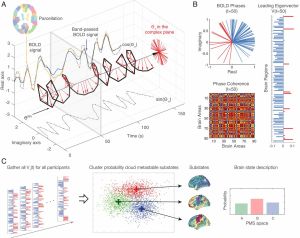 I want to cover two different open-access papers here, both of which represent advances in how we can study and understand how the brain achieves complex outcomes using different levels of interaction, from neurotransmitter systems, to connections among brain areas, to how networks work as systems. The first is a neuroscience-heavy paper, the second more on philosophy of science and complexity. So a good pairing!



 Neuroanthropology