Animal Color

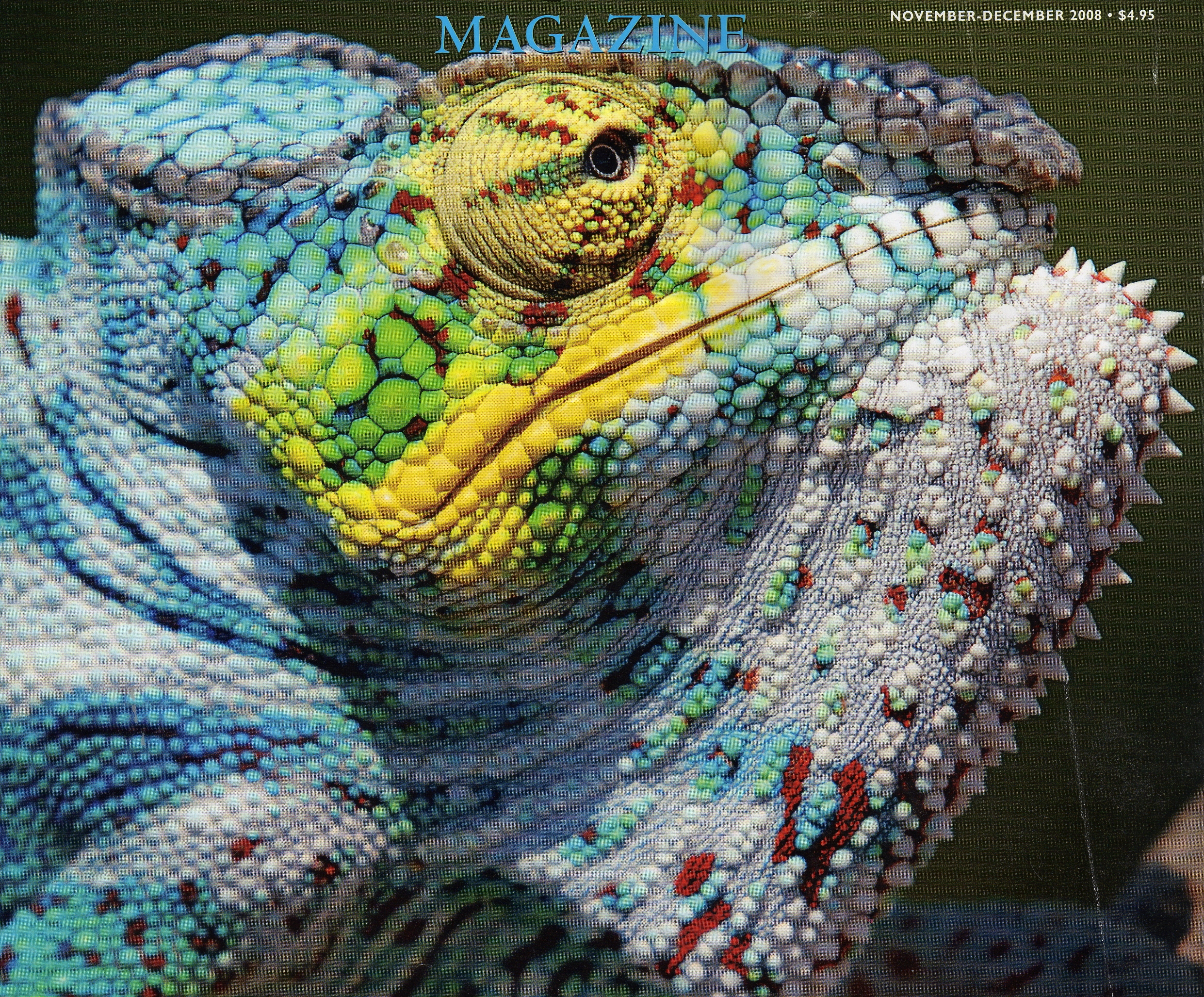
The cover of the November-December Harvard Magazine features this magnificent photo of a panther chameleon from Madagascar (sorry for the slight crease from the scan; the original photo is by Paul Bratescu). That photo introduces us to the feature article Animals Speak Color.

The article is full of striking photos, including this one below of this colorful nudibranch (a type of mollusk). You can go to the website to see them all or download the pdf. If you want the live experience, the article is based on the new exhibit The Language of Color at the Harvard Museum of Natural History. In lieu of that, the magazine gives us a video tour.

In the animal kingdom color serves to warn, camouflage, advertise, and compete. Sex drives a lot of that, showing off for mates, but so does poison, telling predators that this flashy little being is bad to eat.

The Harvard Museum of Natural History is home to the world-famous glass flowers, exquisite life-like reproductions. So it’s not jus the animal world getting in on the color game!

Cartagena Brings Food


Cartagena. The ceviche topped by a twist of plantain is from there. The sunflower-at-dusk building is the restaurant La Vitrola, tucked in beside the Spanish fortifications. Both are part of the NY Times article declaring Cartagena on the map for foodies and gourmets alike.

I’ve eaten at La Vitrola; my financier friend, fascinated by the restaurant, wanted to go there every night. La Escollera, salsa and rum and dancing, is just around the corner. But it’s not the best meal I have ever had in Cartagena. There was a small French restaurant, prix fixe, which produced an extraordinary menu the night my wife and I went there. Even that was no comparison to La Casita Vieja, a small joint in the center, long-closed, where I had one of those experiences I still tell stories about.

On the Caribbean coast the typical meal is sancocho de pescado, fish soup. And La Casita Vieja produced a long-simmered soup full of local fish and plantain and potato and cilantro, an extravagance in its richness and freshness. Trying to lure the tourists in, the soup was served in a large carved calabash with a spoon to match. But it was no tourist trap. The ceiling was low, the windows thrown open, and in the Cartagena heat, the fans thrummed and the smooth Colombian beer was the only thing that hinted at cool. I ate and ate that afternoon.

So if you are ever in Cartagena, sure, La Vitrola is a great place. But el sancocho, that’s the thing memories are made of.

With that introduction, here’s an eclectic foodie round up.

Michael Pollan, Farmer in Chief
What the next president should really do about our food industry; a great essay from the noted writer

Dan Sperber, Tasty Food for Anthropological Thought
Are there four universal tastes? And does anthropology and population thinking have anything to add? A new article in the Brain and Behavioral Sciences

Continue reading “Cartagena Brings Food”

Wednesday Round Up #35

This week we have decision making, the brain and anthropology, plus this week’s top picks.

Top of the List

Eugene Raikhel, The Prevalent Placebo
Anthropology sheds light on the placebo. Somatosphere’s take on the recent report that 50% of US doctors give placebos to patients, with a consideration of both the placebo phenomenon and the literature surrounding it.

Deric Bownds, Arguing for Embodied Consciousness
Deric gives us some of the Harold Fromm Science review of the new book “What Science Offers the Humanities – Integrating Body and Culture” by Edward Slingerland. My Mind on Books give us more on Slingerland and his book.

The Banana Peel Project, Communities of Selves
A riff off Paul Bloom’s recent piece – a community of selves inside each of us, boosted by abundant new technologies of self, from drugs to avatars. Also see Bloom’s piece, First Person Plural

Neil Scheurich, Annals of the Prodigious
The bar-tailed godwit, the longest recorded flight, and a poem from Emily Dickinson

Scicurious, General Stuff I Blog About: Dopamine!
Your Neurotopia guide to dopamine, going from the chemical structure to brain structures. Quite an overview.

Decision Making

Neuronarrative, The Lucifer Effect: An Interview with Dr.Phillip Zimbardo
Making monsters out of decent young men – an interview with the psychologist behind the infamous Stanford Prison Experiment

Wray Herbert, A Recipe for Motivation
Getting people to exercise regularly – and the importance of understandable how-to instructions

Continue reading “Wednesday Round Up #35”

The Colombian Encephalon

Medellin, Colombia
Medellin, Colombia

Mind Hacks has posted the 57th edition of the mind/brain Encephalon carnival. Vaughan Bell is now safely installed in Medellin, Colombia, so is it any surprise that the lead-in piece to this Encephalon is about a Colombian? (Or that I highlight that fact? Colombia is still the best country I’ve ever visited for traveling… And the people. Well, I got married there, didn’t I?)

So Rodolfo Llinas, neuroscientist born in Bogota with an MD degree from the same university my wife attended, is featured over at Channel N. Here’s the video and the transcript. You can also check out the opening to his book I of the Vortex. In the end, along with Patricia Churchland, co-editor of their book The Mind-Brain Continuum, he is a fairly hard-core neuroscientist – as he says in the video, “everything we do is a product of our brain.” But this video is quite revealing about his own genesis as a scholar and person, starting with family in Colombia and a love for science.

As we have come to expect from Mind Hacks and Encephalon more generally, there is a lot of great featured stuff. Gestures to communicate, hypothesis testing, long-term potentiation, the childhood origins of our personality, and more…. So go check out Encephalon #57.

PhD Comics: Piled Higher and Deeper

Meg Towle, a former student of mine and now on a Marshall Scholarship, sent me this link to PhD Comics. Very funny. Here’s one I found that was particularly appropriate for Meg:

Our own Paul Mason just used a PhD comic in his latest post on the travails of field work. If you want to know more about the comics, including the 200 most popular ones, go here. You can even get books collecting the work of Jorge Cham, the cartoonist who has compared me to a ninja.

Coincidentally Meg and I just published an article together entitled “Community Approaches to Preventing Mother-to-Child HIV Transmission: Perspectives from Rural Lesotho .” So kudos to Meg!