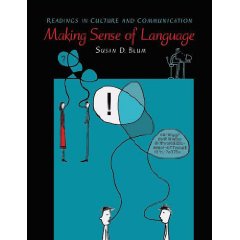
Making Sense of Language: Readings in Culture and Communication

making-sense-of-languageSusan Blum, professor of anthropology at Notre Dame, has brought together an outstanding compendium of linguistic anthropology readings in the new book Making Sense of Language: Readings in Culture and Communication.

Published by Oxford University Press, Making Sense of Language features forty-five readings (table of contents here) that together illuminate the human phenomenon of language.

The volume is divided into six sections: (1) What is language, (2) Language and thought, (3) Multilingualism, (4) Language and identity, (5) Discourse, performance and ritual, and (6) Language and ideology. It’s a preeminent selection of authors, including icons such as de Saussure and Whorf, opposing views such as Pinker vs Lakoff, and anthropologists like Keith Basso and Elinor Ochs. Plus this title, The Whiteness of Nerds!

Susan Blum previously authored the book Lies That Bind: Chinese Truths, Other Truths and has the forthcoming My Word! Plagiarism and College Culture.

You can see Susan in action here, discussing China and the recent Beijing Olympics.

One Day at Kotaku: Understanding Video Games and Other Modern Obsessions

kotakuKotaku is a gaming site, full of news, opinion, and lots of readers’ comments. People hooked on video games go there for a steady stream of stories from around the world. On this particular day, January 12th, a range of pieces captured why the video game phenomenon has so much to tell us about our modern obsessions, from sex to shopping, drugs to drinking. These eight stories show us the powerful convergence of people looking for fun and industries looking for profit. From pleasure to despair, this convergence is the story of our post-modern lives. It’s not commodities anymore, it’s activities.

Why not start off with an aircraft carrier? Golden Tee Joins the Navy, Ships Out on Supercarrier covers how Lieutenant Mike Hall wrote to Incredible Technologies, the manufacturer of the popular arcade golf game, “about his love of the game and his longing to play it while at sea.” Incredible Technologies donated the game, the Navy invited the company to the USS John C Stennis to “see just how important the machine will be to recreational life at sea.” A rather straight-forward feel-good story. It’s where most of us live our lives, including the 5000 crew members who can now golf at sea.

The next one, One Man Zelda Band, shows how video games inspire a cultural genre of creativity, how these activities becomes more than a game and move onto artistry, meaning, and, in this case, some inspired music from the composer and gamer Diwa De Leon. But still, in this video we’re talking about a real obsession. Think of the time and effort that went into this production!

Continue reading “One Day at Kotaku: Understanding Video Games and Other Modern Obsessions”

Get Your Encephalon Dosis

craving-brain
You’ve been craving it – four weeks since the last round up of the best mind and brain blogging on the Internet. And The Mouse Trap and Sandy G give us what we want! Get High on Encephalon #62!

There is a definite addiction theme this time – Neurotopia on whether Prozac is addictive, and on the psychological vs physical concepts of addiction. (Might I suggest that perhaps the notion of “physical” is just as problematic as the psychological in Drug Monkey’s comment – it’s right back to the mind/body dichotomy that is really in question…); Mind Hacks on the abuse of laughing gas (it’s a gas!); and Brain Blogger on deep brain stimulation for pleasure.

There is plenty, plenty more. It’s a great addition. One to highlight is Mouse Trap’s own piece on evolution and altruism – a comprehensive overview and some interesting considerations.

So go check out the latest Encephalon.

Subjectivity and Addiction: Moving Beyond Just the Disease Model

By Daniel Lende

This week when students in my Alcohol and Drugs class spoke of their obessions, of MySpace and gambling and television and text messaging, they easily acknowledged their own subjectivity. Winning big, losing big; getting away from reality; having fun; becoming wrapped up in whatever particular compulsion is their own – they spoke of what it meant to them, why they did it, what sorts of feelings and experiences characterized that activity.

On Thursday I started class by asking them to write down their own definition of addiction. Unlike the descriptions of their own activities, there was a marked move towards a more causal and biological framework: “dependence” was the first word that came out of one small group discussion. Uncontrollable, using to fulfill a need, both physical and psychological, a disease – these were all other ways to characterize addiction.

Obsession did appear as well, the only clear link to a subsequent discussion on the popular sense of addiction, of what people mean whey they say they are addicted to Facebook, to a favorite food, to a friend or lover. “Need” came up too, but more as an afterthought, a recognition that sometimes their popular obsessions get too strong a hold on their everyday lives.

After discussing these two senses of addiction, as a problem and a type of involvement, we turned to looking at how the Diagnostic and Statistical Manual IV (DSM-IV) defines substance abuse and substance dependence. These are the guidelines that health professionals use to diagnose mental health problems.

For abuse, oddly defined as being the lesser problem, some of the main criteria include: “Recurrent substance use resulting in a failure to fulfill major role obligations,” “Recurrent substance-related legal problems,” and “Continued substance use despite having persistent or recurrent social or interpersonal problems.”

Continue reading “Subjectivity and Addiction: Moving Beyond Just the Disease Model”

My genome is not my self

pinker-hairBy Agustin Fuentes

We are not our genes and they are not us. Knowing what copies of genes we carry can tell us a little about getting sick and losing our hair, and maybe even add insight into our ancestry. But that does not tell us about how and why we do the things that we do.

Steven Pinker, in his recent New York Times Magazine article My Genome, My Self, argues that genes do have great influence on our behavior. As an anthropologist, evolutionary theorist, and a researcher of human and other primate behavior I am here to tell you that he is overshooting the mark. Human behavior is simultaneously biology, culture, experience and more.

Natural selection, one of the main drivers in evolutionary change, works on the whole body and behavior complex, not on single genes or even the genome itself. It is the dynamic product of genes, organs, bodies, behaviors, ecologies, and societies that eventually affects evolutionary patterns in humans. No gene or even set of genes can be held in isolation of the systems in which they exist.

Continue reading “My genome is not my self”