Trance Captured on Video

A great discussion on the Medical Anthropology listserve focused on good films for trance. I’ve provided the list below, complete with links to the films, extra notes in brackets, and some YouTube clips.

Joshua Moses asked:

Dear colleagues, I was wondering if people could recommend film footage of trance states of various kinds–rituals, dance, shamanic, church based etc.
The geographical region is not important. I would be grateful for you assistance. Thank you.

The Replies:

Sheila Cosminsky (Rutgers): A classic film on trance is Margaret Mead’s Trance and Dance in Bali, which shows dancers with knives under trance [also recommended by Beverly Bennett of Cultural Ideas].
Also, Jero on Jero, a Balinese Trance Seance Observed [also Balinese Trance Seance, included in the DVD, was recommended by Geraldine Moreno at Oregon].
Other films are: N/um Tchai: the Ceremonial Dance of the !Kung Bushmen, and Macumba, Trance, and Spirit Healing.

Michelle Ramirez (University of the Sciences in Philadelphia): There’s always the classic “Holy Ghost People” by Peter Adair, which shows folks in Appalachia (in what very much looks like trance-like states) handling snakes.
[You can also get this documentary in a series of six YouTube clips starting here; I’ve embedded below another clip that contains some of the most relevant footage]

Continue reading “Trance Captured on Video”

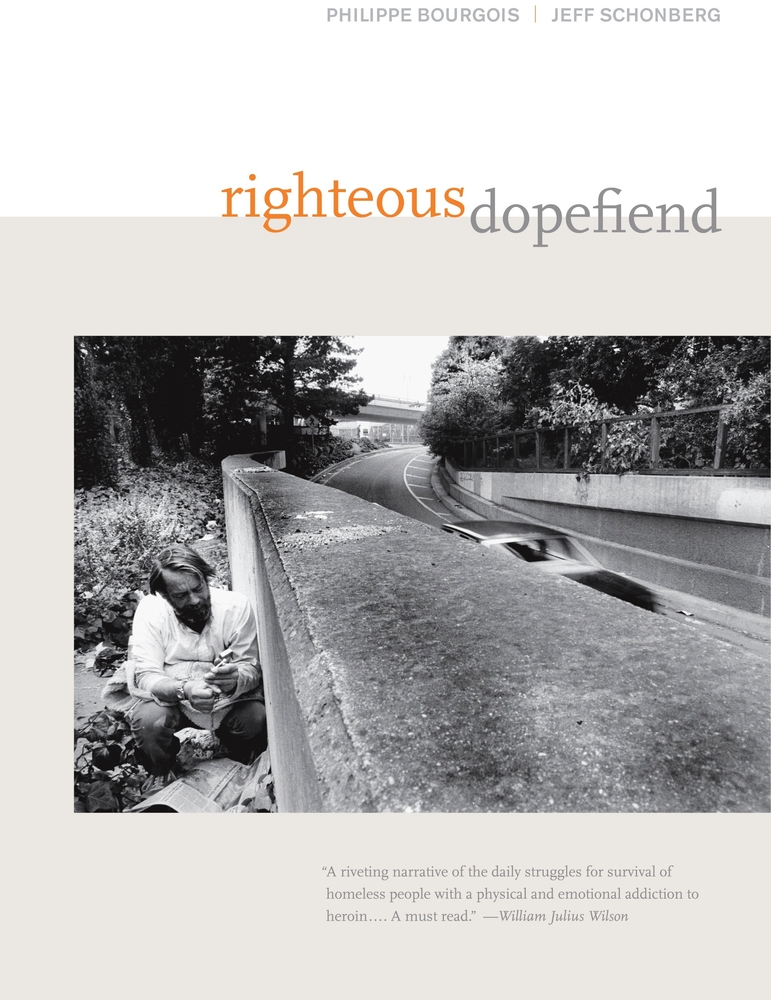
Righteous Dopefiend by Phillippe Bourgois

Righteous Dopefiend
The new book by Phillippe Bourgois, Righteous Dopefiend, has just been published by University of California Press. Righteous Dopefiend covers Bourgois’ long-term ethnographic work with heroin injectors and crack smokers on the streets of San Francisco. Jeff Schonberg provided haunting photographs for the book.

“Calling this book ethnography would be like calling The Wire a cop show: what comes roaring out of its pages is almost as visceral and devastating as spending a night in ‘the hole’ itself.”
-Mike Davis, author of Planet of Slums

“Philippe Bourgois and Jeff Schonberg provide a riveting narrative of the daily struggles for survival of homeless people with a physical and emotional addiction to heroin. The authors’ poignant account of these experiences features sophisticated analytic themes that enable them insightfully to integrate discussions of agency and moral responsibility on the part of homeless addicts with an analysis of the powerful structural forces that shape the addicts’ lives. Righteous Dopefiend is a must-read.”
– William Julius Wilson, author of More than Just Race: Being Black and Poor in the Inner City

Here’s the UC Press description:
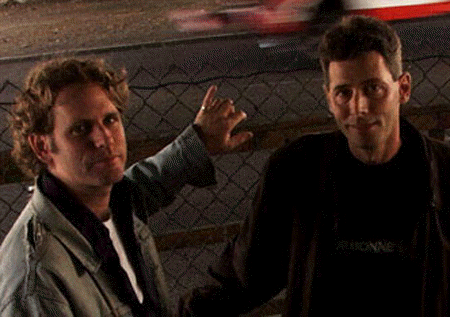
Shonberg & Bourgois

This powerful study immerses the reader in the world of homelessness and drug addiction in the contemporary United States. For over a decade Philippe Bourgois and Jeff Schonberg followed a social network of two dozen heroin injectors and crack smokers on the streets of San Francisco, accompanying them as they scrambled to generate income through burglary, panhandling, recycling, and day labor. Righteous Dopefiend interweaves stunning black-and-white photographs with vivid dialogue, detailed field notes, and critical theoretical analysis. Its gripping narrative develops a cast of characters around the themes of violence, race relations, sexuality, family trauma, embodied suffering, social inequality, and power relations. The result is a dispassionate chronicle of survival, loss, caring, and hope rooted in the addicts’ determination to hang on for one more day and one more “fix” through a “moral economy of sharing” that precariously balances mutual solidarity and interpersonal betrayal.

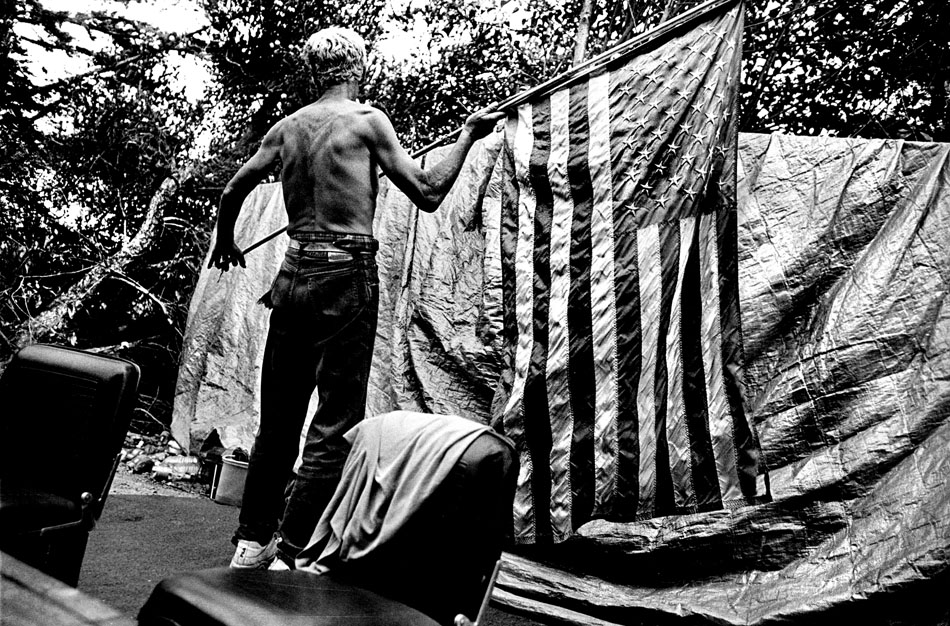
Flag by Jeff Schonberg
And here’s Publisher’s Weekly starred review:

In this gritty ethnography exploring the world of San Francisco’s homeless heroin addicts, Bourgois, anthropology and community medicine professor at the University of Pennsylvania, and Schonberg, a photographer and graduate student in medical anthropology, draw on a decade immersed in this subculture to eloquently elaborate on the survival techniques and intimate lives of black and white addicts who live in self-made communities and work the economic fringes for survival. The authors explore racial boundaries and crossings, love stories, family relations, parenting, histories of childhood abuse, as well as the constant work of navigating hostile police enforcement, exploitative and helpful business owners, overburdened medical services and social service bureaucracies.

The book details the gruesome material toll of addiction, infection and homelessness and the risks of ongoing personal and institutional violence. Bourgois and Schonberg create a deeply nuanced picture of a population that cannot escape social reprobation, but deserves social inclusion. Schonberg’s photographs capture the scars of addiction, the social bonds between romantic pairs and drug-running partners and the concerted efforts at domesticity without a domicile. The collage of case studies, field notes, personal narratives and photography is nothing short of enthralling.

Continue reading “Righteous Dopefiend by Phillippe Bourgois”

Conferences: Cultural and Biological Contexts of Psychiatric Disorder and Cultural Memory

Two great conferences coming up early next year.

The first conference is Cultural and Biological Contexts of Psychiatric Disorder: Implications for Diagnosis and Treatment at UCLA, January 22-24, 2010.

Main Part of the abstract:

Our concept of mental illness in the West is largely shaped by the DSM diagnostic model. The DSM categorization of psychiatric disorders has been useful in driving research, and psychiatric neuroscience has made enormous strides in identifying some of the brain-based factors that contribute to mental disorders such as autism, schizophrenia, and bipolar disorder, as well as suggesting possible drug therapies.

However, both neuroscientists and anthropologists have raised questions about the validity and utility of these categories. Neuroscientists are concerned that the categories obfuscate the key brain-behavior linkages underlying pathological processes. Anthropologists on the other hand argue that the categories are largely social constructions and that the current neurobiological zeitgeist minimally attends to social and cultural processes of mental illness.

Much still remains unknown, particularly how the social and cultural worlds interact with neurobiological processes to produce mental symptoms that we recognize as depression or psychosis in everyday life and what this interaction implies for diagnosis and treatment. The aim of this conference is to improve the quality of psychiatric diagnosis and treatment by giving specific attention to biological and cultural contexts and their interactions.

There is a long list of speakers, from Simon Baron-Cohen to Moshe Szyf, with Byron Good, Eric Kandel, Emily Martin and other notables in the middle. You can already see the schedule here.

The general public can register to attend, and there is also a call for posters, with submissions due October 2, 2009.

The second conference is Transcultural Memory at the University of London, February 5-6, 2010.

Part of the abstract:

The concept of cultural memory has overcome this binary opposition between the individual and the collective, attending to their reciprocal relationship and the cultural grounds on which their mediation takes place (Assman). How, though, does memory work when events are remembered across and between cultures? In an age of globalization, is it still possible to speak of local and national memory, or do the local and national always exist in implicit and explicit dialogue with the transnational?

Main Speakers:
Astrid Erll (University of Wuppertal)
Andrew Hoskins (University of Warwick)
Dirk Moses (University of Sydney)
Michael Rothberg (University of Illinois at Urbana-Champaign)

Abstracts of no more than 500 words to transculturalmemory at gmail dot com by July 21st, 2009.

Main website for Cultural and Biological Contexts of Psychiatric Disorder.

Main website for Transcultural Memory.

Wednesday Round Up #67

Simple this week – top, anthro, neuro

Top

Natalie Angier, Brainy Echidna Proves Looks Aren’t Everything
Did you know they give birth to puggles? And 50% of their brain is neocortex, compared to our measly 30%

Robert Sawyer, All Screens Are Not Created Equal
Yes, the internet and computing are good for you – we shouldn’t cast things in older ideas about attention

Harvey Whitehouse, Anthropology in Crisis – What, Still?
“Imagine a domain of scholarly enquiry that based its theories on multiple and conflicting intuitions about the basic nature of the phenomena under study. It would struggle to get off the ground because of interminable turf wars among competing coalitions with widely differing foundational assumptions about the nature and purpose of scholarly enquiry. Unfortunately, we don’t have to imagine it. That is exactly the problem, or at least has been the problem historically, with social and cultural anthropology.
Since we lack dedicated cognitive machinery for reasoning about social complexity, we are prone to borrowing intuitions proper to alien ontological domains. Consequently social scientists at turns reify institutions, biologize social categories, anthropomorphise offices, and mentalize corporate groups.”

Mike the Mad Biologist, Behavioral Economics: Not Everything Is Irrational
As someone on the irrationality train (I study addiction, after all), it’s refreshing to have a well-considered critique

Anthro

Jean Jackson, Awá Human Rights Report
Indigenous groups in Colombia caught between right-wing paramilitaries, leftist guerillas, and the Colombian army

Continue reading “Wednesday Round Up #67”

WWW: Wake and Robert Sawyer

WWW Wake
Neural plasticity, artificial intelligence, vision, theory of consciousness, the internet, and cross-cultural interactions? Yes, all that and more in Robert Sawyer’s new novel WWW: Wake.

I just finished reading this book, and definitely enjoyed it – more for the ideas than for the writing, but then again, it’s not every day you find such a neuroanthropological tale! As for the story, it moves right along, so it’s a good summer read. As Publisher’s Weekly says, “Wildly thought-provoking.”

Here’s Sawyer’s tag: “The World Wide Web wakes up…” And while much of the story does revolve around artificial intelligence and how the Web might develop into an aware agent, the protagonist of the novel is Caitlin Decter, a blind teenager who is a math prodigy and internet whiz. That combination lets Sawyer explore neural plasticity (her visual cortex has mapped onto her navigation of the web) and Decter’s understanding and interactions with the emergent online being.

As Sawyer writes about Wake, “The World Wide Web will soon have as many connections as does the human brain. And, just as reflective, self-aware consciousness spontaneously emerged in Homo sapiens some 40,000 years ago so too might consciousness emerge in the vast network that is the Web.”

Continue reading “WWW: Wake and Robert Sawyer”

iCephalon!

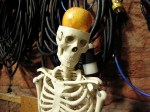
Apple Skull
Cognitive Daily is hosting the 72nd edition of Encephalon, the biweekly round up of mind/brain blogging. This time it’s the i-theme. Yes, Apple is hosting its World Wide Developers conference today, complete with a new iPhone.
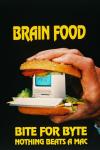
Apple Brain
We’ve got the iPeople app, the iPlant (imPlant…), the iSmoke, the iFit, and much more! I also found some groovy photos to liven up your day…

So go visit the iCephalon 2009 Keynote address!
Brain Food