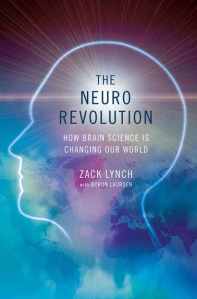
How Bright Might A “Neuro Future” Be?

Neuro Revolution
By Stephan Schleim

Looking for a “Neuro Revolution”? Zack Lynch wants to offer you one in his new book.

With a title like Neuro Revolution: How Brain Science Is Changing Our World and the author celebrated as a leading technology consultant and market researcher in marketing blurbs, readers might expect the author’s opinion to be based on the state of the art of neuroscience. However, frequent mistakes and shortcomings in his presentation of the scientific findings and methodology seriously call into question whether Lynch is the right person to sketch a possible “neuro future” and to address the prospects and limitations of neurotechnology.

The first surprise comes on page 3, where Lynch describes his first experience with a Magnetic Resonance Imaging (MRI) scanner, one of the most frequently-used research tools in contemporary cognitive neuroscience. He explains that “the machine’s computer had recorded and analyzed data about how those loud thumping noises had bounced back from the structures under my skin.” To uninformed people, the noise of high-field MRI scanners will indeed be one of their most salient features. However, it is a mere epiphenomenon subject to the sophisticated technology necessary to change strong magnetic fields in short intervals. The technique itself is based on inaudible electromagnetic waves (like those emitted by a cellphone) to investigate brain structure and function.

Continue reading “How Bright Might A “Neuro Future” Be?”

Institute for General Semantics conference

‘Tis the season for conference announcements! This one was forwarded to me by Joan Jocson at the Metropolitan Museum of Art (thanks, Joan!).

The Institute of General Semantics is now taking registrations for the 57th Alfred Korzybski Memorial Lecture & Dinner and 3-Day International IGS Conference. Anthropologist Mary Catherine Bateson will be giving the keynote lecture: “The Changing Shapes of Lives: Making Meaning Across Time.’

Joan passed along the mission statement of the IGS, which I have to share with our readers:

The Institute of General Semantics (IGS) promotes a scientific approach to understanding human behavior, especially that related to symbol systems and language, and the application of proven principles that guide advancements in critical thinking, rational behavior, and general sanity.

Amen, people! Proven principles to promote GENERAL SANITY — that’s something I can certainly get behind. If only I could persuade all the administrators at my university to get on board with that one!

For more information on the conference and registration, just follow this link over to the IGS website. The jump over to their site is worth it just to check out the silent movie clips of the earlier conferences (gestures from other eras just seem so odd — the past is another country, eh?) and the great quotes on prejudice, communication and other semantic issues running down the left of the page. Personal favourite: ‘The trouble with people is not so much with their ignorance as it is with their knowing so many things that are not so’ (William Alanson White).

Conference: Brain Health Day

SharpBrains and the American Society on Aging are co-producing a Brain Health Day during ASA’s West Coast Conference on Aging. It will happen on Friday, Sept 11th, at the Oakland Marriot City Center, Oakland, California. SharpBrains has all the details on planned activities, talks, registration, and more. Registered participants will even get a complementary copy of the book The SharpBrains Guide to Brain Fitness.

Here is the description:

Since 2006, healthy aging pioneers have been actively evaluating and implementing an expanding menu of stimulating brain health programs. The American Society on Aging and SharpBrains have partnered to introduce aging professionals to the best practices in a variety of community-based and residential settings, discuss emerging trends that will affect your work in years to come, and offer you resources to understand and navigate through the growing array of options.

Brain Health Day details and registration

Conference: “Across the Generations: Legacies of Hope and Meaning”

September 11-13 will see the conference “Across the Generations: Legacies of Hope and Meaning” hosted at Fordham University in New York City. The anthropologist Mary Catherine Bateson will be giving the keynote address, “The Changing Shape of Lives: Making Meaning across Time.” Jerome Bruner will also be part of a panel “Minds and Meanings” the first day. You can access the entire schedule here.

The conference is hosted by The Institute of General Semantics, whose website provides more info about the conference and the institute itself.

Wednesday Round Up #77

Favorites, addiction, anthropology, memes, and mind this week. Enjoy.

Top of the List

Greg Laden, The Falsehoods
Greg lays out common mistakes and bad assumptions about biology, culture and evolution – a fantastic summary

ScienceDaily, Facial Expressions Show Language Barriers, Too
The title doesn’t quite get it; the point is that Ekman’s universal expressions of emotion has just taken a serious data-driven critique: “FACS-coded [Facial Action Coding System] facial expressions are not universal signals of human emotion.”

Melvin Konner, Obesity 2
“Obesity is an evolutionary legacy, which is why it’s so hard to control.” The esteemed anthropologist reflects on our modern obesity epidemic.

Robert Wright, Jerry Coyne and The Evolution of God
The author of The Evolution of God responds vigorously to Coyne’s critique in The New Republic, which I featured a couple round-ups ago.

Dan Myers, Get a Theory – Part II
Some great reflections on what makes for a good conference paper

Christophe Heintz, How Cultural Is Cultural Epidemiology? The Case of Enculturation
An argument for a more robust cultural epidemiology through generative entrenchment and the cultural determination of cognitive tracks

Addiction

Robin Young, Homeless Heroin Addicts
Here and Now NPR interview with Phillippe Bourgois about his new book Righteous Dopefiend. Also has a nice selection of Schonberg’s photos.

Continue reading “Wednesday Round Up #77”

Critique – Making a Difference

Critique is option #1 in our Top Ten Ways for Anthropologists to Make a Difference, and the principal way most anthropologists approach being relevant. Relying only on critique can be problematic – it emphasizes passivity over engagement, promotes an academic idea of change, and can keep us from developing ideas and getting data about other ways of making a difference. But critique also has a real-world impact.

Amidst a wealth of work, I have highlighted two prominent books as well as recent examples of putting critique into action. I also cover how critique is often most useful when used to improve our own efforts.

(1) Critique. Our default position, but sometimes it does work. (Just not as well or as often as we hope.)

Jonathan Marks’ 2003 book What It Means to Be 98% Chimpanzee is an excellent example of critical work in biological anthropology. Marks draws on the breadth of anthropology to produce a trenchant analysis of both science and popular ideas about genetics and human nature. As the American Scientist review says, “A trenchant assault on genetic reductionism and a spirited call for a more critical science, one better informed by the perspectives of anthropology and the humanities.”

James Ferguson’s (1994) The Anti-Politics Machine: “Development,” Depoliticization, and Bureaucratic Power in Lesotho is now a classic in the anthropological critique of development. Ferguson shows how poverty and powerlessness are reduced to technical and bureaucratic problems, even as the state extends its realm of control locally. As the American Political Science review puts it, “He strips the development community of its conceptual attire and leaves it naked for all to see.”

Open Anthropology is Maximilian Forte’s admirable effort to put critical analysis to use, both with respect to the field and to the current state of the world. Open Anthropology aims to “transform anthropology into something that is neither Eurocentric nor elitist,” while also focusing on critical issues such as the wars in Iraq and Afghanistan and how the military is co-opting social science through projects like the Human Terrain System and Minerva. With Open Anthropology, critique is now online.

Continue reading “Critique – Making a Difference”