Wednesday Round Up #98

Enjoy another week, all mashed together once again.

3 Quarks Daily, Michael Moshen Performs the Triangle
An amazing display of skilled performance, integrating timing, music and throwing – definitely one I threw in here for Greg!

Robin Young, Rehab for Terrorists
NPR’s Here and Now speaks with the British journalist Owen Bennett-Jones, who has investigated the Saudi’s rehab program for terrorists. Striking to me both because of the dilemmas of this approach (or any like it) in a probabilistic age that still wants ideal absolutes, and also because of the striking difference in the portrayals of “terrorists” (see the NY Times’ recent piece, The Terrorist Mind) and how young men and women become involved and hence why rehab can work.

Institute of Psychiatry – King’s College, Post Doctoral Research Worker
Looking for a post-doc in neuroanthropology? King’s College in London’s Institute of Psychiatry wants you! The research is on cognitive models of dissociation and the subjective and neural correlates of automatic speech and writing.

Ray Tallis, You Won’t Find Consciousness in the Brain
“My argument is not about technical, probably temporary, limitations. It is about the deep philosophical confusion embedded in the assumption that if you can correlate neural activity with consciousness, then you have demonstrated they are one and the same thing, and that a physical science such as neurophysiology is able to show what consciousness truly is.”

John Cloud, Why Your DNA Isn’t Your Destiny
Epigenetics makes Time magazine! Hunger, abundance, and multi-generational effects in Sweden is the lead case study.

David Dobbs, Neuron Culture’s Top Five from December
Get the links to the posts on David’s Orchid and Dandelion series, which talks about genetic sensitivity and the environment – really looking forward to his book on the subject

Continue reading “Wednesday Round Up #98”

More on Americans exporting mental illness

My previous post, Exporting American mental illness, on Ethan Watters’ New York Times Magazine article, came together pretty quickly, in a few-hours’ rush of thinking, writing, and mistyping. Nevertheless, I’m glad I posted it because I really liked Watters’ original article, even though I took issues with attributing too much causal power to specialists’ knowledge about mental illness. I didn’t consider my original piece to be a ‘critique’ as I fully suspect many of my issues might have been addressed in the book-length version.

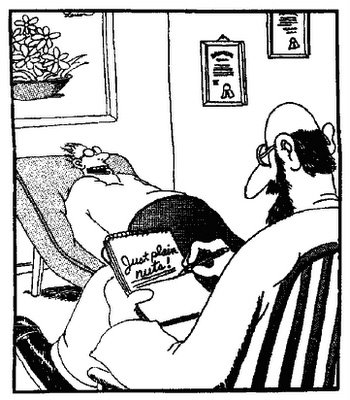
cartoon by Gary Larson

Over at Somatosophere, Eugene Raikhel has a great post on the original article. He’s very generous to my hurried effort but goes on to add in some really good discussion of multi-causal models in psychological anthropology and how difficult it actually is to think about complexity. He agrees with my brief piece (with one caveat that I would concede), but really goes on to take the discussion to a more sophisticated consideration of the question:

“How should anthropologists and cultural psychiatrists deal with this kind of complexity?” Is it enough to gesture toward complexity, calling it a “flow” or an “assemblage” and listing its various elements (as I’ve done above), or should we try to understand the various specific mechanisms through which what we often call macro-processes (like “globalization” or “industrialization”) shape the ways individuals experience and articulate their distress?

Raikhel goes on to discuss three different conceptual and concrete ways to try to link up these scattered forces into local explanations, drawing on Ian Hacking, Laurence Kirmayer and Norman Sartorius, and Tanya Luhrmann. All three are excellent examples of researchers doing the hard yards of making these links between macroscopic and psychological processes, between biology and culture on different levels. I won’t rewrite in less extensive form Raikhel’s excellent piece; just go to the original.

But I also want to point out the Raikhel, like me, really praises Watters’ original effort. Raikhel has a couple of key points of disagreement in the assumptions about modernity and stress and about the psychiatric ‘gray out’ that’s occurring with globalization, but he keeps these in perspective. I’m happy to criticize science journalists when they write stupid dreck, but the discussion of the Americanization of mental illness is quite thorough even though it’s reaching out to an audience that might not have run into this sort of anthropological analysis of psychiatry before; it’s a great piece to alert the public to the subtleties of human brain-culture-belief interactions (which we tend to call ‘neuroanthropology’ around here).

Exporting American mental illness

The New York Times Magazine has a great discussion of the effects of the exportation of American ideas about mental illness, titled appropriately, The Americanization of Mental Illness by Ethan Watters, based on his forthcoming book, Crazy Like Us: The Globalization of the American Psyche, coming out this month from Free Press. The article is quite good, offering some intriguing cases, such as the rise of virulent, American-style anorexia nervosa in Hong Kong, the effect of possession beliefs on communities’ reactions to schizophrenia, and how the narrative of mental illness as ‘brain disease’ might actually lead to great stigma as it spreads and replaces local understandings. The article is well worth a read, and I’m looking forward to the book.

graphic by Alex Trochut, NYTimes

The ethnographic record is full of conditions that didn’t make it into the most recent edition of the DSM — amok, nervios, koro, zar — you can check out Wikipedia or some other source on ‘culture bound syndromes,’ such as Introduction to Culture-Bound Syndromes in Psychiatric Times, to get a fuller discussion of some of these conditions. The Psychiatric Times piece suggests that there are at least 200 culture-bound syndromes.

One thing I really liked about the New York Times Magazine article, however (and by extension, Watters’ book, I suspect), is that the discussion of ‘culture-bound syndromes’ usually tends to treat other people’s syndromes as ‘culture-bound,’ Western psychological illnesses as not ‘culture-bound.’ Watters’ work points out that Western mental illness is both itself culture-bound and that persuading people to believe in Western-style mental illness can affect the way that psychic disorders manifest.

Continue reading “Exporting American mental illness”

Complete this quote: “In a small, dark room at the lab of a large university hospital…”

The first line of Why God Won’t Go Away begins, “In a small, dark room at the lab of a large university hospital…” but how would you finish such a sentence?

This week, we want your ideas on how you will complete this unfinished quote by Andrew Newberg, Eugene D’Aquili and Vince Rause:

“In a small, dark room at the lab of a large university hospital…”


Continue reading “Complete this quote: “In a small, dark room at the lab of a large university hospital…””

Best of the rest 2009

Daniel and I get some help on Neuroanthropology.net, not least of all from Paul Mason, but also from a whole host of other folks, including colleagues, students, long-distance collaborators, and completely innocent bystanders who do absolutely nothing to warrant inclusion. So here’s the most popular posts from 2009 that neither Daniel nor I wrote.

The majority of the posts on this list come from Daniel’s students at the University of Notre Dame. He has been doing award winning community-based research (see posts here and here), and one thing that makes it distinctive is that he gets the students to publish reports of their work online, where people from the community and others can read it. It’s a great use of this sort of virtual platform to promote serious undergraduate research, and to open up the doors of the classroom to let others peer in on what we’re doing. Daniel’s done a workshop at the American Anthropology Association on the subject as well, so I’m hoping he’ll continue to share this sort of work and his reflections on it through Neuroanthropology.net.

1. Cosleeping and Biological Imperatives: Why Human Babies Do Not and Should Not Sleep Alone by James J. McKenna — While technically from the very, very tail end of 2008, this post by our colleague at Notre Dame just keeps generating traffic. It’s a well-written, deeply important consideration of the neuroanthropological dynamics of mother-child co-sleeping (that’s in the same bed or very close by, for those of you non-parents out there). Well worth a look, especially if you’ve got a very little one in the family, or soon will have.

2. What’s the Dope on Music and Drugs? by John Barany, Abby Higgins, Melissa Lechlitner, and Joanna Schultz. Some of Daniel’s students look into the controversy about the effect of references to drugs in the lyrics of popular music. The authors point out the radically different sales figures for ‘cleaned up’ versions of the most explicit popular recordings and whether or not Michael Phelps’ problems with marijuana might have had anything to do with listening to Lil’ Wayne on his headphones before swimming for gold.

3. The Encultured Brain: Why Neuroanthropology? Why Now? by Greg Downey and Daniel Lende — Alright, but technically, it belongs somewhere because it is one of our most widely read posts. The statement we wrote for The Encultured Brain conference as an attempt to try to articulate the Big Picture. We’re still working on it, but it’s already pretty hefty.

Continue reading “Best of the rest 2009”

Wednesday Round Up #97

I hope all of you are having a great New Year! Here’s the mash-up.

Jay Sosa, Savage Minds Rewind: The Best of 2009
A whole slew of great posts from last year from Savage Minds, the leading cultural anthropology site

Ed Yong, Not Exactly Rocket Science Review of 2009
One of my favorite science journalists online covers the best stories of his Not Exactly Rocket Science site

Dave Munger, TV’s Unintended Consequences
It makes us fat, but can benefit women’s equality – are societal benefits at individual costs the new trend?

Scott Christian, The Journalist of the Future
Is Interactive! Web 2.0, building from the ground up (okay, okay, branding), and including the reader (informant?) as the source of stories

Greg Laden, Your Future in Cyberspace: Artificially Intelligent Journalism
The journalist and the consumer still matter – the media are changing…

Continue reading “Wednesday Round Up #97”