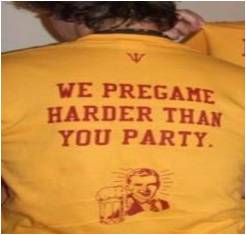
“We Pregame Harder Than You Party!”

By Annette Esquibel, Thomas Mumford, and Jocelyn Rausch

“Why do I pregame?” The third year American History student repeated our question with a bit of sarcasm in his voice. He put down his textbook and then delivered his jovial response:

“Why wouldn’t I pregame?! It makes everything better- bars, parties, dances, football, class, work…”

This is the pregaming mentality expressed by a current undergrad at our mid-Western university. This mentality can be summarized: if you have to go to something, why not be buzzed when you do it?

Across the country, on any given weekend night, college students are often consuming four or five, sometimes even 10 drinks, before they even make it out of their dorm room for a night of partying, the dorm dance, or even the latest sports event.

They consume what many medical professionals construe as dangerous, sometimes lethal, amounts of alcohol in a short period of time. Then students often find themselves passing out, throwing up and even being taken to the hospital. And that’s before they even make it to the party.

From an outsider’s point of view, this may not sound like a lot of fun. For college students, pregaming is often the best part of the night. Our question as student researchers was, Why?

Our Research

Due to the recent emergence of pregaming, little is known about the mentality behind it. Working with the university group in charge of helping to prevent and treat alcohol abuse, we aimed to understand the social and cultural bases for high-risk drinking and pregaming. Previous student research on pregaming focused on gender differences, and can be found in the post “College Drinking: Battle of the Sexes?”

The statistics were already clear for the university office in charge of alcohol education and prevention – almost 80% of students who have gotten in trouble for alcohol-related events were pregaming on the night of the incident. Counselors there feared that the high-risk drinking habit of pregaming has become synonymous with students social lives.

Our project aimed at both understanding students’ general attitude towards pregaming as well as why students stop drinking on a given night. These questions could offer insight and clues to effective handling of the problem of pregaming by students and the university alike.
Continue reading ““We Pregame Harder Than You Party!””

Obesity Meets Family Medicine

By Kelsey Hitchcock, Anna Pavlov, Ryan Shay, John Villecco and Sara Yusko

For several hours we talked about obesity with the resident doctors at the local family clinic. After covering the typical recommendations for losing weight, such as eating healthy and increasing exercise, Dr. B informed us of the most practical treatment method they use. “I usually ask the patient to complete a food journal.”

According to Dr. B and the other residents, a journal can provide concrete evidence of successes and areas in which adolescents could improve their diets. So we asked about the success of such an assignment. Dr. B chuckled and said, “I’ve never had a patient complete a food journal.”

As soon as he said this, two other doctors in the room added their own experiences. One echoed Dr. B’s statements, and the other told his one and only success story:

“The patient was fourteen years old. He didn’t like how big he was becoming and decided to play sports. After he started playing sports he lost thirty pounds.”

As we explored the issue of adolescent obesity within our community, we found that while the recommendations for losing weight may appear simple, successful results were not easily obtained. Our goal was to better understand the prevalence and treatment of adolescent obesity through patient observation and interviews with resident doctors in this mid-Western city.

Continue reading “Obesity Meets Family Medicine”

Wednesday Round Up #106

Basic plus one – top of the list, mind, anthropology, and addiction.

Top of the List

James Fowler and Nicholas Christakis, Cooperative Behavior Cascades in Human Networks
New full-access PNAS paper on social networks and cascades of behavior. For good commentary, see The Frontal Cortex and Not Exactly Rocket Science

Maximilian Forte, Multiplying Human Terrain Dreams of Victory and Fortune
Zero Anthropology examines the non-zero-sum game approach to expanding the use of social science for military ends

Ed Yong, An 60,000-year Old Artistic Movement Recorded in Ostrich Egg Shells
Very cool. Decorative ostrich shells many, many generations ago. Art is old.

John Hawks, Fat Rats
Lab rats come with starting conditions – they are not the representatives of “nature” that scientists have often assumed. In this case, studies on caloric restriction might be flawed because rats started from an unhealthy baseline, and thus any improvement extends their life

Nicholas Wade, Human Culture, An Evolutionary Force
Nice summary of recent research on how culture, broadly conceived, shapes natural selection.

Michael Smith, Blogs Don’t Get No Respect
Good rant about how American Anthropologist’s short piece on cultural anthropology blogs isn’t really all that

Mind

The Neurocritic, Depression’s Cognitive Downside
A critical look at Jonah Lehrer’s recent piece that covered evolutionary proposals about the adaptive benefits of depression; here the impairments come to the fore

Continue reading “Wednesday Round Up #106”

Post-Traumatic Stress Disorder: Getting Help Early to Feeling Welcomed

By Jenny Heil, Brendan Durr, Jon Lopez, Mac Kenzie Nunez, Mark Flanagan

It’s 3:00 AM and you finally decide that it is safe to venture out to the 24-hour Wal-mart. Not totally safe, mind you, but at least almost no one will be there—less potential threats to worry about…

You get home, and sleep in your chair. Sleeping in the bed is too vulnerable…

You wake up, and hear a loud bang. Automatically, you know it’s a bomb, and grab the enemy by the throat…

Veterans may leave the war zone, but they can never escape the war. For those who return from war with post traumatic stress disorder (PTSD), they constantly live as though their minds and bodies are still at war.

Fear of crowds and intense anxiousness around others. An inability to feel safe while sleeping. Flashbacks and nightmares, often triggered by sudden or loud noises. Always feeling like even the people closest to you are the enemy, poised for attack.

Veterans are living in this reality. As many as one in four veterans will experience PTSD, according to Dr. Michael Sheehan, a psychologist specializing in PTSD. PTSD is a disorder that can happen as a result of many kinds of trauma, and is especially prevalent in veterans of war.

People with PTSD may constantly relive the trauma of war (through flashbacks and nightmares), may try to avoid places and events that would cause memories, and may be easily startled and constantly feel on edge.

While PTSD is often not recognized as the same as other battle wounds, the experience of veterans verifies that PTSD is real. We hope that the information that we provide here will help you understand the experience of PTSD.

If you recognize the symptoms of PTSD as ones you experience yourself, please consider seeking help by joining a support group for veterans or talking to a psychologist or physician.

Our Research

We are a group of five Notre Dame undergraduate students who, over the course of a semester, have interacted with a group of veterans with PTSD in an attempt to better understand the experience of PTSD.

Continue reading “Post-Traumatic Stress Disorder: Getting Help Early to Feeling Welcomed”

Complete this quote: “Music and dance are produced by the brain, influenced by culture and depend upon…”

Complete this quote:

“Musik dan tari dibuat oleh otak, dipengaruhi oleh kebudayaan dan tergantung kepada…”

“Music and dance are produced by the brain, influenced by culture and depend upon…”

Continue reading “Complete this quote: “Music and dance are produced by the brain, influenced by culture and depend upon…””

AAA Session on Impulsivity: Call for Submissions

Hal Odden and I are putting together a session on impulsivity at this year’s American Anthropological Association meeting being held in New Orleans. If you are interested in being a participant, please email me at dlende@nd.edu and Hal at oddenh@ipfw.edu as soon as possible. Please indicate your potential topic and/or paper title when you email us.

We want to examine impulsivity broadly, so we are looking for people working on a range of issues related to impulsivity, risk taking behaviors and sensation seeking. Hal plans to look at impulsive suicide in Samoa, and I will look at impulsivity and substance use among adolescents.

We encourage submissions from people working on risk-taking in different sociocultural contexts; maladaptive behaviors associated with impulsivity, including binge eating and bulimia, violence, and unsafe sexual practices; and broader theoretical issues that could be informed by a reconsideration of impulsivity, including embodiment, motivation, and agency.

The session will be broadly oriented by neuroanthropology, using ideas drawn from both psychological anthropology (examining individual-environment interactions) and biocultural anthropology (mixing theory and methods between two disciplines). This session will bring a theoretical and ethnographic sensibility to the role of impulsivity in people’s lives today. This person-centered approach, bridging biology and culture, encourages the circulation of ideas from critical and evolutionary perspectives.

Proposed papers could potentially look at:

-How the neurobiological processes underlying impulsivity develop within specific social and cultural contexts
-How impulsive behaviors are informed by local conceptions of personhood, motivation, and agency
-How ideas on sensation seeking and risk taking in psychology and public health can be fruitfully adopted in psychological and medical anthropology
-How we can build more experience-near and culturally sophisticated accounts of human desire, temptation, and compulsion
-How ideas about impulsivity can inform practice theory, embodiment and other related areas of sociocultural theory.

Please email us your proposed topic and/or title as soon as possible at dlende@nd.edu and oddenh@ipfw.edu. Depending on how many people respond, we might have to limit participation – we’d rather not, of course, but just a warning up front. A single session can have a maximum of seven people.

The AAA meeting will be held from November 17th to 21st, 2010, in New Orleans, and has the meeting theme of “Circulation.” More information can be found at the AAA conference website. We are planning to submit this volunteered session for consideration by the Society for Psychological Anthropology.