Carol Worthman: From Human Development to Habits of the Heart

Carol Worthman, a mentor of mine at Emory University and a real leader in doing neuroanthropological research (even if she might call it “biocultural”), has two recent articles out that I really want to highlight.

The first is The Ecology of Human Development: Evolving Models for Cultural Psychology. Here is the abstract, part of a whole special issue in the Journal of Cross-Cultural Psychology on the work of the husband-wife team John Whiting and Beatrice Whiting:

The Whiting model aimed to provide a blueprint for psychocultural research by generating testable hypotheses about the dynamic relationships of a culture with the psychology and behavior of its members. This analysis identifies reasons why the model was so effective at generating hypotheses borne out in empirical research, including its foundational insight that integrated nature and nurture, its reconceptualization of the significance of early environments, and its attention to biopsychocultural dynamics active in those environments.

Implications and the evolution of the ecological paradigm are tracked through presentations of three current models (developmental niche, ecocultural theory, bioecocultural microniche) and discussion of their related empirical literatures. Findings from these literatures converge to demonstrate the power of a developmental, cultural, ecological framework for explaining within- and between-population variation in cultural psychology.

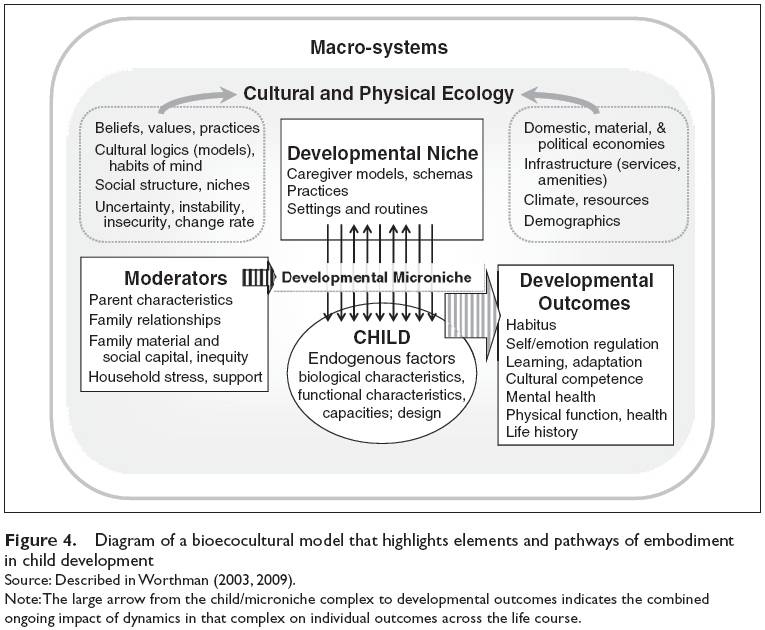
The figure above is from this paper, and represents Carol’s own model for understanding human development. But the real point that Carol wants to make in emphasizing these three models goes as follows:

All of these models share a concern for how the cultural ecology of affect and affect regulation drive psychobehavioral development, competence, and well-being or health. Whoever has looked has found linkages among cultural practices, stress physiology, and emotion regulation. Note that each of these models foregrounds the development of emotion and emotion regulation and de-emphasizes classic knowledge acquisition. Although there are important reasons for this emphasis (Damasio, 2005), a reconsideration of what constitutes “knowledge” and more systematic investigation of the linkages between emotion and knowledge might prove valuable (588).

The second article is Habits of the Heart: Life History and the Developmental Neuroendocrinology of Emotion. This article was part of a special issue on Advances in Evolutionary Endocrinology in the American Journal of Human Biology. Here is Carol’s abstract:

The centrality of emotion in cognition and social intelligence as well as its impact on health has intensified investigation into the causes and consequences of individual variation in emotion regulation. Central processing of experience directly informs regulation of endocrine axes, essentially forming a neuro-endocrine continuum integrating information intake, processing, and physiological and behavioral response. Two major elements of life history—resource allocation and niche partitioning—are served by linking cognitive-affective with physiologic and behavioral processes. Scarce cognitive resources (attention, memory, and time) are allocated under guidance from affective co-processing. Affective-cognitive processing, in turn, regulates physiologic activity through neuro-endocrine outflow and thereby orchestrates energetic resource allocation and trade-offs, both acutely and through time. Reciprocally, peripheral activity (e.g., immunologic, metabolic, or energetic markers) influences affective-cognitive processing.

By guiding attention, memory, and behavior, affective-cognitive processing also informs individual stances toward, patterns of activity in, and relationships with the world. As such, it mediates processes of niche partitioning that adaptively exploit social and material resources. Developmental behavioral neurobiology has identified multiple factors that influence the ontogeny of emotion regulation to form affective and behavioral styles. Evidence is reviewed documenting roles for genetic, epigenetic, and experiential factors in the development of emotion regulation, social cognition, and behavior with important implications for understanding mechanisms that underlie life history construction and the sources of differential health. Overall, this dynamic arena for research promises to link the biological bases of life history theory with the psychobehavioral phenomena that figure so centrally in quotidian experience and adaptation, particularly, for humans.

In this second article, Carol is tying her work back into evolutionary theory. If the first took up more the cultural/psychological side, then here we are grounded in the mechanisms and ideas of biological anthropology. She writes here:

Given the evidence of gene-environment interactions and developmental effects discussed above, combinations of history and circumstance will condition the phenotypes generated from the genetic structure, and thus influence the impact of that structure on corresponding experience, welfare, behavior, and the balance of selective pressures upon genetic diversity. Such gene-environment interactions and their consequences for function and welfare deserve investigation across a wide range of human cultures and conditions. Such study bears exciting possibility for unlocking dynamics among culture, social conditions, the nature and distribution of social niches, and selection pressures operating on allelic variants (779).

Link to citation/abstract for Carol Worthman’s The Ecology of Human Development: Evolving Models for Cultural Psychology.

Link to citation/abstract for Carol Worthman’s Habits of the heart: Life history and the developmental neuroendocrinology of emotion.

Update: You can see Carol lecture on Habits of the heart: Life history and the developmental neuroendocrinology of emotion regulation here.


Glory Days – Anthropologists as Journalists

Brian McKenna, professor of anthropology at the University of Michigan – Dearborn, has a great piece in the August 2010 newsletter of the Society for Applied Anthropology. Starting on p. 11 (the newsletter is a pdf), McKenna has a piece entitled “Doing Anthropology as an Environmental Journalist.”

He uses his 2002 article in City Pulse, Can Glory Days Return to Lake Lansing?, to discuss how he crafted a very effective piece of reporting that was also a very effective piece of public anthropology.

You just have to love how he uses a great hook at the beginning, and then seamlessly transitions to the broader “this is what this piece is about” while still maintaining relevance. Some great writing:

Lake Lansing just wants to be left alone. In the Prohibition Era, bootleggers raised hell in a house on stilts that sat in the belly of the lake – site of a men’s social club – while a lookout warned of an impending sheriff’s raid. By the time the police boat reached the moated fortress, all alcohol had been hurriedly dispatched into the lake through a trap door.

Over the years, the lake has imbibed more than its share of bad whiskey. Septage, arsenic, fertilizer, dog poop, gull dung, mercury and just about everything that people throw on the ground for miles around the 450-acre waterworld winds up in the lake. “If you spit on the sidewalk,” says Pat Lindemann, the Ingham County drain commissioner, “it goes into the lake.”

But what I really want to highlight in McKenna’s SFAA piece is how he demostrates how to connect core anthropological analysis with journalistic writing. He calls it using “The Anthropological Dozen.”

In every journalistic article I write I try to incorporate what I call “The Anthropological Dozen.” These questions help insure a muckracking result.

Very briefly, here they are: 1) holism (how do disparate phenomenon connect?); 2) fieldwork (from lab tests to participant observations); 3) What’s taken for granted (Did the Ojibwa help create this lake?); 4) culture (how is capital behind what’s behind); 5) cross-cultural justaposition (how did Indians and colonialists use the lake?); 6) Getting the native’s point(s) of view (Who are the natives? What are the ways in which the “native points of view” are ignored, omitted, or supressed?); 7) Contradictions and ideologies (Do people say one thing and do another? Are there dialectical tensions in the terrain of inquiry?); 8.) Origins and history (human origins, the origin of the state, the origin of a nation, the origin of a given institution, the origin of a name, the origin of a place. How have things transformed since the origin?); 9) epistemological critique (Begin with a “reification of names” in your analysis. Do names – like “Lake Lansing” in this instance – accurately capture the idea/object represented?); 10) conformity/resistance (what are the modes of resistance that the less powerful play?); 11) privilege the most powerless; and 12) analyze social change.

McKenna goes on in his essay to provide examples of these various techniques in action, and also to describe how he got the necessary information as journalist/anthropologist through interviews, library research, and the like. And all on a four day deadline!

Here is just one example, focusing on the writing part:

The colonialists originally called it Pine Lake for the stand of beautiful white pine trees on the east side of the lake – the largest stand in Ingham County. But the white pines were soon destroyed for their wood resources in the second half of the 19th century. According to Raphael, the biggest logging operation was conducted by a John Saltmarsh, whose name ironically revealed his intent. He “assaulted the ‘marsh’” in the winter one year, sending the logs over the lake ice on sled runners. They were stockpiled for export behind the new train depot. Saltmarsh also owned a picket mill, to make the fences that would set the enclosures around the new form of land division around Lansing: private property.

Notice how I translated academic parlance into civic voice. This is journalism as a public anthropology, a syncretism (McKenna 2010b). Think of it as converting ethnography into a good story. There are villains, dramatic tensions, metaphors and ample use of quotation to enliven the narrative.

Link to the City Pulse article, Can glory days return to Lake Lansing?

Link to the Society for Applied Anthropology August Newsletter

Foodspotting

I just came across a fascinating site worthy of some gourmet exploration. Foodspotting is a site that allows readers to upload photos of food linked to geographic information and also to short descriptions of the food featured in said picture. As they say:

It’s just about the food: It’s not about the place, the price, the surroundings, the crowd or the nutritional value — it’s just about good food and where to find it.

Good food can be found anywhere: We built Foodspotting to work in any city, small town or country from the start. It encourages exploration — trying new things vs. following the crowd.

So here I can find out what dishes people are recommending in Colombia. That mazorca in the photo here is one of my favorite street foods in Colombia – this one came from the Usaquen district in Bogota.

Belgium is there, a place I really enjoy traveling.

Or in my new home city of Tampa.

So go explore food over at Foodspotting

Join the Boob-olution!

Hat-tip to Savage Minds Around the Web

On a complementary note, especially for breast feeding at night, see our popular post: Cosleeping and Biological Imperatives: Why Human Babies Do Not and Should Not Sleep Alone

The Bump: The Inside Scoop of Pregnancy organization created the video. You can find out more about breastfeeding, including “10 Reasons Why Breastfeeding Doesn’t Suck,” over at TheBump’s breastfeeding page, which also has the clip. And they even have BumpTV.

Breastfeeding really does promote brain development and smarter babies! Here’s a very recent article by Elizabeth Isaacs et al. (2010): Impact of Breast Milk on Intelligence Quotient, Brain Size, and White Matter Development. You can get the pdf here; the abstract is below.

Although observational findings linking breast milk to higher scores on cognitive tests may be confounded by factors associated with mothers’ choice to breastfeed, it has been suggested that one or more constituents of breast milk facilitate cognitive development, particularly in preterms. Because cognitive scores are related to head size, we hypothesized that breast milk mediates cognitive effects by affecting brain growth. We used detailed data from a randomized feeding trial to calculate percentage of expressed maternal breast milk (%EBM) in the infant diet of 50 adolescents. MRI scans were obtained (mean age = 15 y 9 mo), allowing volumes of total brain (TBV) and white and gray matter (WMV, GMV) to be calculated.

In the total group, %EBM [amount of breast milk in infant’s diet] correlated significantly with verbal intelligence quotient (VIQ); in boys, with all IQ scores, TBV and WMV. VIQ was, in turn, correlated with WMV and, in boys only, additionally with TBV. No significant relationships were seen in girls or with gray matter. These data support the hypothesis that breast milk promotes brain development, particularly white matter growth. The selective effect in males accords with animal and human evidence regarding gender effects of early diet. Our data have important neurobiological and public health implications and identify areas for future mechanistic study.

Death metal, religion and the socialization of emotion

Photo by George E. Norkus

Over at The Immanent Frame, a website on religion, secularism and society supported by the Social Science Research Council (USA), Jim Robertson reflects on the presence of religion in Death Metal after a trip to Wacken Open Air (in Germany), the world’s largest music festival and ‘loud as hell’ according to its website.

Robertson’s piece, Death metal: A “pipeline to God”?, is well worth the read, if for no other reason that it will be an eye-opener for the non-metalhead to what these guys are screaming through the din. (One personal disclosure: Although I went through a phase of fascination with Canadian power trios with front-man shriekers that sounded like modern castrati — Rush, Triumph — and developed a now-mildly-embarrassing love of Supertramp, Aerosmith, and the Who, I was never really a native metalhead, so I can’t talk about these genres from any deep affection.)

I won’t rehearse all of Robertson’s arguments, but he basically asks why Death Metal and related genres are so obsessed with religion, from Satanic album covers to song lyrics that drip with Apocalyptic motifs to echoes of everything from neo-paganism to blatant anti-Christianism. It’s a great question because not every popular music genre, even iconoclastic subcultural genres, features religious imagery so heavily. One would probably have to move to something like gospel or 1970s reggae to find genres that were more saturated with spiritual symbolism (I have no statistics on this, only my own fleeting engagement with these genres).

Robertson explains:

What is fascinating here is the consistency with which black metal has pursued religious forms. Satanism is replaced, not by a basic materialist atheism but with almost anything else: Occultism, Nietzsche, paganism, mystical nazism. Such religious pluralism begs the question as to whether these are just new and interesting attempts at youth rebellion, or whether something more is playing itself out.

Robertson finds several reasons for the dominance of religious themes in Death Metal:

1) ‘Metal’s rebellious streak’ led to a backlash against attempts to censor or criticize these musical genres, most prominently efforts by the Parents Music Resource Center (PMRC) in the mid-1980s. According to Robertson, the criticism actually hardened the resolves of many musicians to criticize mainstream religion, sparking very explicit anti-religious themes.

2) Extreme lifestyles among the musicians, a character of many Western popular artist communities, but featuring some extraordinary acts of violence, self-destruction and nihilism, especially among proponents of Scandinavian ‘Black Metal’ in the 1990s, Robertson discusses. In this sense, ‘Metal’s obsession with religion is part of its obsession with living at the limit.’ Robertson goes on to explain: ‘This concern with limit experiences explains metal’s obsession with religion. In its aspirations, metal parallels a kind of religious mysticism.’

3) Competition with mainstream religion to provide similar experiences, such as community belonging, emotional transcendence, and mystical experience, what one participant refers to as a ‘pipeline to God.’

4) Shifting philosophical and religious commitments within the community of Metal musicians, including a move away from Satanism toward various forms of paganism, ecological mysticism, and Nietzschean nihilism, reflect a groping to find a language to talk about these profound emotional-mystical experiences: ‘The constant grasping for new ideologies amongst the black metal scene, then, is an attempt to give this transcendental path discursive form.’

Robertson’s discussion is both colourful and insightful, but there are several dimensions I might add just to bring it into the Neuroanthropological fold. Borrowing some ideas from Simon Frith’s piece, ‘Towards an Aesthetics of Popular Music,’ I want to argue that Metal, like many musical genres, has a special role in educating emotion and moods among young people when they are trying to understand social interaction and their own emotions.

Continue reading “Death metal, religion and the socialization of emotion”

Cultural Holes: Bringing Culture and Social Networks Together

In developing my Biocultural Medical Anthropology grad syllabus, I came across an interesting 2010 article in the Annual Review of Sociology: Cultural Holes: Beyond Relationality in Social Networks and Culture. Here is the abstract:

A burgeoning literature spanning sociologies of culture and social network methods has for the past several decades sought to explicate the relationships between culture and connectivity. A number of promising recent moves toward integration are worthy of review, comparison, critique, and synthesis. Network thinking provides powerful techniques for specifying cultural concepts ranging from narrative networks to classification systems, tastes, and cultural repertoires. At the same time, we see theoretical advances by sociologists of culture as providing a corrective to network analysis as it is often portrayed, as a mere collection of methods.

Cultural thinking complements and sets a new agenda for moving beyond predominant forms of structural analysis that ignore action, agency, and intersubjective meaning. The notion of “cultural holes” that we use to organize our review points both to the cultural contingency of network structure and to the increasingly permeable boundary between studies of culture and research on social networks.

Mark Pachucki is the first author, and a recent Ph.D in sociology from Harvard and current Robert Wood Johnson Health & Society Scholar. Ronald Breiger, the second author, is a professor of sociology at Arizona.

The idea of cultural holes builds on Ronald Burt’s idea of “structural holes,” which Pachucki and Breiger summarize:

Burt’s idea refers to strategic bridging ties that may connect otherwise disjoint clumps of social actors; these ties are hypothesized to lead to enhanced information benefits and social capital for those who bridge holes.

Cultural holes fills a gap (yes, I couldn’t resist) by examining “cultural meanings, practices, and discourse” as part of social networks and social structures, basically positing that conceiving social networks as independent phenomena is wrong. Rather, social networks need to be recognized as “culturally contingent” even as we increasingly recognize the powerful impact of networks over the lifespan.

Here is their main justification in their essay:

The time is overdue for a conscientious shift beyond cultural explanations for social structure, and structural explanations for cultural outcomes, toward a more integrated vision of social scientific explanation. Social relations are culturally constituted, and shared cultural meanings also shape social structure…

[We] need to look beyond the structure at both the content of what is being transmitted—such as social norms and the credibility of information—and mechanisms of transmission, and more importantly how culturally meaningful individual action can result in drastic changes in the dynamics of social networks in which individuals are embedded.

I’ll finish off with the ending to their Annual Review article, which provides a good overview of the whole piece.

SUMMARY POINTS

1. Culture and social networks can be usefully seen as mutually constitutive and coevolving, having grown from common sociological roots in relational thinking.

2. Much empirical analysis over the past several decades has tended to treat social networks and culture as discrete realms rather than together. Notable attempts at synthetic engagement are reviewed.

3. A body of recent work shows how culture prods, evokes, and constitutes social networks in ways that may be envisioned and modeled by new analytic methods. Prominent emerging research areas include narrative and textual analysis, the civic sphere, studies of organizing principles such as fields and actor networks, boundaries, and cultural tastes.

4. In dialogue with the influential concept of structural holes, we suggest that cultural holes captures contingencies of meaning, practice, and discourse that enable social structure and structural holes.

5. Four aspects of cultural holes are identified: (1) Bridging social ties often exist because they connect people who both share and reject tastes, as well as those with complementary tastes. (2) Boundaries as well as affinities among genres are productively understood as patterned around absences of ties among cultural forms. (3) The use of structural holes as distinct from other organizing principles may depend on culture at levels ranging from interpersonal, to intraorganizational, to transnational. (4) Incommensurability in institutional logics prods actors to generate new meanings and forms of discourse.

Link to Pachucki & Breiger’s Cultural Holes abstract & citation