Steven Quartz, Brains, and Meaning

I recently came across this post from Edge: The World Question Center, where Steven Quartz, a neuroscientist also interested in anthropology, answers the following question: “What are the pressing scientific issues for the nation and the world, and what is your advice on how I can begin to deal with them?”  

He opens his letter to “the president” with the following summary: “Studies of our biological constitution make it increasingly clear that we are social creatures of meaning, who crave a sense of coherence and purpose. Yet, our modern way of life seems to provide fewer and fewer opportunities to engage in the group life that satisfies these human needs—indeed, many of its structures and institutions stunts these very needs.”  
Continue reading “Steven Quartz, Brains, and Meaning”

Will Power as Mental Muscle

Blogging on Peer-Reviewed ResearchThere’s an interesting blog post here about “How to Boost Your Willpower,” which tells us that “researchers are finding is that willpower is essentially a mental muscle, and certain physical and mental forces can weaken or strengthen our self-control.”

 Well, how about a cultural muscle too?  After all, we’re talking about a cultural trait too!  In my research in Colombia, knowing how to manage limits and having reasons to say no help explain lower rates of illegal drug use there, despite plenty of risk factors and access to drugs. 

Continue reading “Will Power as Mental Muscle”

Rex at Savage Minds – berries, pink things & evolution

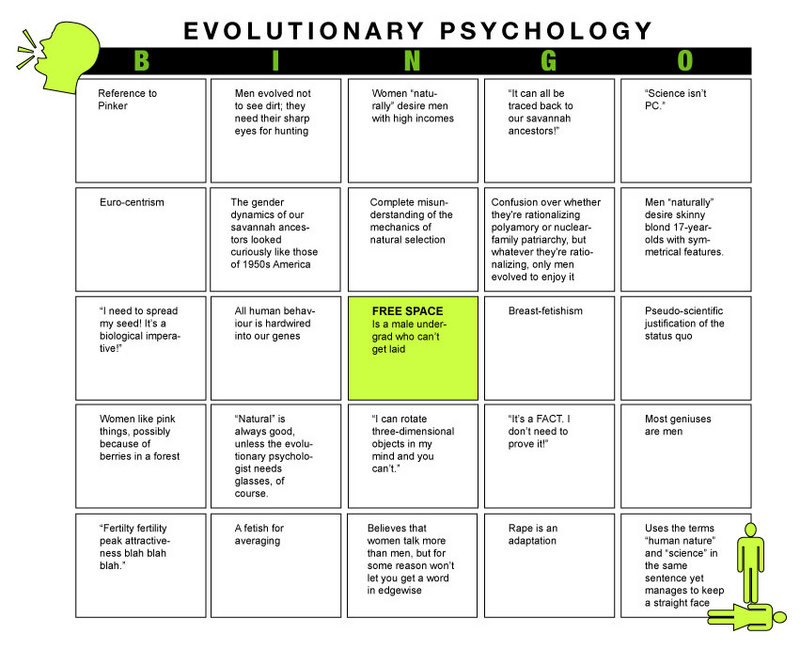
Alex Golub, one of the prime movers at Savage Minds, posted a link to an ‘Evolutionary Psychology’ bingo card that’s worth a chuckle.

Original post here.

I enjoyed the bingo card because it is such a great condensation of the usual hackneyed bits that crop up in conversations involving ‘evolution’ and ‘psychology,’ often with people who have serious interest in and understanding of neither evolutionary theory nor psychology. I’m not surprised that untrained individuals subscribe to evolutionary psychology (‘women like men who are tall because they could see prey farther off in the grasslands…’). After all, people close to me (who will remain unnamed) believe that one must inherit every trait or characteristic, however minor, from some relative, even if they are only related at a distance (‘you must get your love of traveling from your father’s brother…’) and into forms of ethnic personality theory (‘Italians are so expressive; Latins are so passionate…’).

The point of criticizing these trite versions of evolutionary psychology, for me, is not to throw out baby, bath water, and basin, but to really expose when pernicious sloppy thinking is masquerading as ‘science,’ especially under the guise of psychology and evolution. For whatever reason — probably because they have a sheen of ‘naturalness’ and being above criticism — these rubrics have become touchstones for some of the most retrograde thinking about sexuality, gender relations, ‘race,’ and other issues. The only way to truly engage them is to offer better accounts of both evolution and human psychology.

So in the meantime, I’m printing out my bingo card for the next salvo from the evolutionary psychologists.

The Boston Globe on embodied cognition

How often do you read a piece in the newspaper that explicitly makes reference to Maurice Merleau-Ponty? Can’t say that I ever had until I stumbled across this article, ‘Don’t Just Stand There, Think,’ on embodied cognition by science writer Drake Bennett in The Boston Globe. It’s all over the map, making brief references to a host of different research projects, some of them more obviously anti-Cartesian than others. The piece might make an excellent entry point for people wanting to introduce others to the significance of embodiment for human cognition.

In particular, the article discusses a number of examples that highlight the ways in which cognition makes use of motor capacities and perceptual abilities, rather than simply being just some disembodied form, such as logic, signification, or recall. Aside from more obvious cases where embodiment affects thought, Bennett briefly touches on some of the more counter-intuitive cases:

A few [neuroscientists, linguists, and philosophers] argue that human characteristics like empathy, or concepts like time and space, or even the deep structure of language and some of the most profound principles of mathematics, can ultimately be traced to the idiosyncrasies of the human body. If we didn’t walk upright, for example, or weren’t warm-blooded, they argue, we might understand these concepts totally differently. The experience of having a body, they argue, is intimately tied to our intelligence.

Bennett makes references to mirror neurons, research by Sian Beilock and Lauren Holt suggesting that athletes’ perceptions are shaped by their expertise, Susan Goldin-Meadow’s work on gesture and thought, and a number of other intriguing research projects. There’s no links to the original research reports or articles, but the interested reader could easily track them down.

In particular, one quote reminded me of Daniel’s earlier post on cultural differences in puzzle solving. Beilock, after doing research on hockey players’ ability to quickly understand photographs of hockey, came to the conclusion that, ‘People with different types of motor experiences think in different ways.’ This is a consequence of embodied cognition, and it may help to explain certain types of differences in reasoning, perception, or cognition.

The article hardly breaks new ground, but it is a very good quick summary of a lot of relevant research. I’d highly recommend it; and it will be a great one to share with friends and colleagues and anyone else who wonders what you’re on about when you mention embodied cognition.

Political Animals and Anthropological Brains

Today’s New York Times has an article “Political Animals (Yes, Animals),” which recounts the many lines of research on the politics of animal life.  Rhesus monkeys, dolphins, wolves and yes, even humans make their appearance in the article.  Research has increasingly shown that these “nonhuman animals behave like textbook politicians.  In these “highly gregarious and relatively brainy species,” individuals “engage in extraordinarily sophisticated forms of politicking, often across large and far-flung social networks.” 
Continue reading “Political Animals and Anthropological Brains”

Mice brains on stress

Blogging on Peer-Reviewed ResearchIn February 2006, a research team at University of Texas and Tufts University published a piece in Science on how experience could modify the structures in the brain that affect the production of dopamine through brain-derived neurotrophic factor (BDNF) (abstract here). The research team used ‘social defeat’ to explore ‘the neurobiological mechanisms through which psychosocial experience alters the activity of the mesolimbic dopamine pathway’; in other words, the malleable system that can induce structural changes in the brains of mice in response to persistent patterns of social interaction.The abstract, while a little thick, suggests all sorts of intriguing possibilities:

Mice experiencing repeated aggression develop a long-lasting aversion to social contact, which can be normalized by chronic, but not acute, administration of antidepressant. Using viral-mediated, mesolimbic dopamine pathway–specific knockdown of brain-derived neurotrophic factor (BDNF), we showed that BDNF is required for the development of this experience-dependent social aversion. Gene profiling in the nucleus accumbens indicates that local knockdown of BDNF obliterates most of the effects of repeated aggression on gene expression within this circuit, with similar effects being produced by chronic treatment with antidepressant. These results establish an essential role for BDNF in mediating long-term neural and behavioral plasticity in response to aversive social experiences.  

Continue reading “Mice brains on stress”