Red meat, Neandertals were meant to eat it

The Meat and Livestock Association (MLA) of Australia has these great television commercials featuring actor Sam Neill (and by ‘great,’ I don’t mean ‘scientifically accurate’). They’re all about how we humans were ‘meant’ to eat red meat. They’re obviously meant to counteract growing concern about red meat in our diet, in the environmental impact of livestock, and other issues, and they use evolutionary arguments to try to get Australians to ‘beef up’ the amount of red meat in their diet, because of course, Australians don’t eat enough meat (trust me if you’re not in Australia — that’s probably not the biggest health issue here, ‘lack’ of red meat in the Aussie diet). For more information on the campaign, check out the MLA’s webpage, ‘Red Meat. We were meant to eat it.’ (You can download the video of the ads from that site if, like me, you want to incorporate it into your lecture on human evolution and diet.)

Especially interesting is the third ad in the campaign, ‘Evolution.’ The text of that ad is:

‘Evolution’ set the scene for the story of red meat and its role in human evolution. It also highlights the bundle of nutrients in red meat making it a foundation food essential for brain development and function. Red meat. We were meant to eat it.

But an article by M. P. Richards and colleagues soon to appear in the Journal of Human Evolution suggests that the evolutionary prize for red meat-eating should have gone, not to Homo sapiens sapiens but to Homo sapiens neanderthalensis (or H. neanderthalensis). Richards and the research team examined carbon and nitrogen ratios in Neandertal bone collagen to figure out what the Neandertals were eating.

Continue reading “Red meat, Neandertals were meant to eat it”

Eat Hearthy

The new Four Stone Hearth carnival is up, covering some of the best in the four fields of anthropology, over at Hominin Dental Anthropology (say that five times fast, and you’re a real anthropologist). It has a nice chronological theme, starting with a discussion of meat eating among Neanderthals, some pseudo-science on our cousins the Hobbits, ritual and habitation in a Neolithic archaeology site, and other archaeological themes. Then some disease in the Renaissance, the general intelligence vs. social intelligence debate, and finally us.

All worth a look, but given the theme of this blog, the stand-out would be the general vs. social intelligence debate over what accounts for the evolutionary increase in human brain size. So check that out over at Professor Olsen’s.

You can lead a horse to water

I’m not sure what to file this thought under, but I figure I may as well share it. I was holding a couple of my wife’s horses today while our farrier, Chris, shoed them, and we got to talking about horses instincts. I think I was asking about horses hooves in the wild, how they responded to injury or heavy use. He joked that the only reason we really needed to clip their hooves was that we kept them in overly-soft paddocks, fed them high energy feed, and thus they didn’t cover the miles and miles that wild horses would have to in order to get enough to eat. In other words, the ecological niche we created for our horses was so unusual that the whole horse physiology was different.

He also pointed out that most domestic horses, unless they are trained to, will not drink from natural water sources. If they’re accustomed to drinking from troughs or buckets, some will die of thirst before drinking out of a creek or lake. They may recognize that it’s water on some level, but they don’t trust the source unless they’re used to encountering water in this way. Obviously, they might be socialized early in order to become acquainted with water in a wider variety of forms.

I don’t have any information on whether or not a horse has ever died from thirst in the presence of lakes or streams, so I can’t confirm this. (I’ll look it up and report back.) If it is true — and I have no reason to doubt Chris as he’s a deeply knowledgeable guy on the subject of horses — it would be a fascinating case of a very useful ‘instinct’ not being inevitable. It also explains the ‘You can lead a horse to water…’ proverb, which I didn’t really understand until today, in retrospect.

Wednesday Round Up #8

General

Robert Sapolsky, A Natural History of Peace
Foreign Affairs full-text article: humans, like most primates, make their own peace

Michael Gazzaniga, Are Human Brains Unique?
We’ve got big brains. So what?

Michael Wesch, Anti-Teaching: Confronting the Crisis of Significance
Pdf article bringing together Wesch’s work with digital ethnography, blogging, and participatory research with students—highly recommended

Carl Zimmer, The More We Know about Genes, The Less We Understand
The power of robust regulation: gene networks take the day

Nikhil Swaminathan, Can the Brain Be Rebooted to Stop Drug Addiction?
Brain pathways, neural plasticity, and searching for a reset switch

Arthur Caplan, Intelligent Design Film Far Worse Than Stupid
“Ben Stein’s so-called documentary ‘Expelled’ isn’t just bad, it’s immoral”

Happiness

Sue Halpern, Are You Happy?
New York Review of Books piece on the recent batch of happiness pop sci books

Continue reading “Wednesday Round Up #8”

How well do we know our brains?

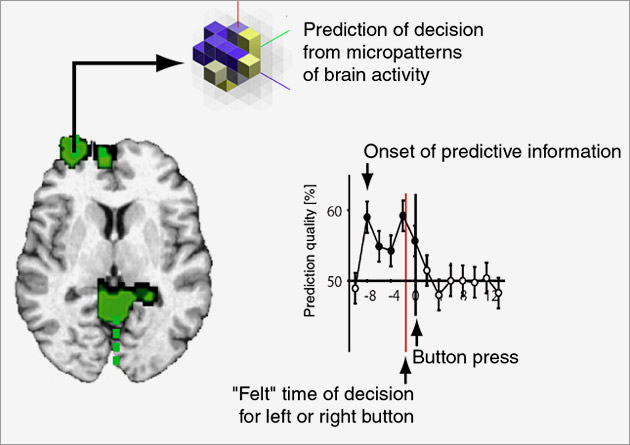
Blogging on Peer-Reviewed ResearchMaking the rounds of neuro-related sites on the web is a recent story from Wired, Brain Scanners Can See Your Decisions Before You Make Them, by Brandon Keim. It’s an interesting short piece on an even more interesting research paper by Chun Siong Soon, Marcel Brass, Hans-Jochen Heinze and John-Dylan Haynes forthcoming in Nature Neuroscience (abstract here). But like so much in the science writing about neurosciences, the piece leaves me feeling like either I don’t get it or science writers really don’t understand the significance of basic brain research. I won’t dwell too much on my issues though with the science writer because I want to really consider the relationship between brain activity and experience, or what role phenomenology might serve in neuroanthropology (besides, I’ve been railing at science writers a bit too much of late…).

Brain areas that predict decisions.  By John-Dylan Haynes.  Wired.
From Keim’s article, we have this explanation of Haynes’ work:

Haynes updated a classic experiment by the late Benjamin Libet, who showed that a brain region involved in coordinating motor activity fired a fraction of a second before test subjects chose to push a button. Later studies supported Libet’s theory that subconscious activity preceded and determined conscious choice [I have a problem with that phrase, especially ‘determined’] — but none found such a vast gap between a decision and the experience of making it as Haynes’ study has….
Taken together, the patterns [in frontopolar cortex and then parietal cortex] consistently predicted whether test subjects eventually pushed a button with their left or right hand — a choice that, to them, felt like the outcome of conscious deliberation. For those accustomed to thinking of themselves as having free will, the implications are far more unsettling than learning about the physiological basis of other brain functions.

The Libet research is a classic piece (I don’t know if it makes any top 100 lists, but it’s especially important to those of us interested in motor action). The problem seems to be forcing Haynes’ data — which confirms Libet’s older research about the subconscious activity that precedes conscious awareness of ‘choice’ — through a folk theory about ‘free will’ being a necessarily conscious activity setting in motion a chain of mind events leading up to action. Folk understandings posit the existence of ‘The Decider’ in the brain, a kind of uncaused cause, the prime neural mover, which is conscious.

Bottom line, as far as I’m concerned: the research can’t be proving whether or not we have ‘free will’ because ‘free will’ is fundamentally about constraints on ‘will’ (itself a fuzzy concept when you’re looking at brain imaging). That is, the research would have to examine not what the brain does when it makes a choice, but whether that brain activity was constrained by something external to the person. After all, if we say that a person’s ‘free will’ is limited by their brain, that doesn’t really make sense now, does it? Presumably, acts of a ‘free will’ would also be determined by the brain, wouldn’t they? For the brain to ‘constrain’ our own ‘free will,’ it would have to be a thing separate from us.

What the research is showing, however, is something fascinating about the relationship of phenomenology and native categories of mind and how they might intersect with brain science research.
Continue reading “How well do we know our brains?”

Jeff Lichtman’s Brainbows

Take a genetically-engineered mouse and add color. That is what Jeffrey Lichtman, Jean Livet, and Joshua Sanes have done. Start by inserting genes that turn neurons fluorescent hues of yellow, red and cyan. Then add some more DNA that randomly expresses those three genes. Presto, rainbow brains.

As a Harvard Science piece reports, “By activating multiple fluorescent proteins in neurons, neuroscientists at Harvard University are imaging the brain and nervous system as never before, rendering their cells in a riotous spray of colors dubbed a ‘Brainbow.’ This technique… allows researchers to tag neurons with roughly 90 distinct colors, a huge leap over the mere handful of shades possible with current fluorescent labeling.”

So many colors in something as complex and elegant as a neuron produces striking images, and I have included many here. These images also permit the study of fields of neurons, from the life course of one neuron to the patterns of connections between neurons. Hence the emerging field of “Connectomics” which “attempts to physically map the tangle of neural circuits that collect, process, and archive information in the nervous system.”

I stumbled across Lichtman’s images in two publications recently. Harvard Magazine features his work, along with five other Harvard scientists, in this month’s feature article, Shedding Light on Life: Advances in Optical Microscopy Reveal Biological Processes as They Unfold. The magazine also provides an online collection of short video clips called Lights! Microscopes! Action! Across the Charles River, MIT’s Technology Review features Lichtman’s work as one of its Ten Emerging Technologies of 2008, complete with an accompanying video featuring Lichtman.

Continue reading “Jeff Lichtman’s Brainbows”