
We at Neuroanthropology are very pleased to be hosting Four Stone Hearth #42, blog carnival of anthropology, especially at our new digs (neuroanthropology.net is now our domain… we like the sound of that, domain). The global anthro-scape has been positively buzzing with excitement: new discoveries, familiar voices, and a few outlandish claims can be worth acres of text in the virtual world. We didn’t get a lot of submissions because we think everyone’s too busy blogging (that, or on summer vacation, we mean, busy with fieldwork). So this is what we’ve come up with. So, go ahead and grab your marshmallows, put a sausage on a stick, and gather round close because the Four Stone Hearth is ready to start cooking.
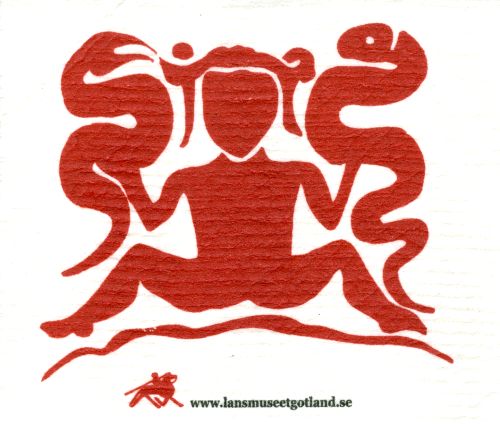 Aardvarchaeology, genitor of the Four Stone Hearth, sounds like he’s pretty busy at a conference on the Orkney Islands, but he does leave us with a piece on medieval archaeology, gender symbolism, and tourist brick-a-brack rolled into a single post. A Swedish county museum prints Iron Age images on dish cloths and sells them in their shop in Sacred Imagery on Dish Rags. Perhaps the most intriguing ‘wrinkle’ in this story of sacred images on kitchen linens is that one of Martin’s colleagues, Howard Williams, came across a Gotlander cloth featuring a ‘snake-witch’ design from a picture stone in När, a symbol interpreted as being of an empowered women ritual specialists for many archaeologists interested in gender. That’s right, a snake-grasping, legs-spread symbol of female strength on a souvenir dish cloth (must. ignore. irony.). The post includes a rollicking discussion of different examples of offensive tourist archaeo-schlock that are so pervasive in gift shops and museum catalogs.
In addition, Martin posts a short piece, Skamby Gaming Pieces on Display, with a really lovely photo of 9th century amber gaming pieces that he helped to exhume that have gone on display at the County Museum in Linköping. If your carbon footprint isn’t big enough to get there, check out the original post he wrote about them here. Congratulations to Martin on getting the artifacts publicly displayed; they’re striking. And condolences if you actually get the haggis you were contemplating eating…
Remote Central has a short piece with good links on recent discoveries of the early traces of human incursions into the Americas, 44,000 Year-old Shell Heaps From Baja California and the Mystery of the 40,000 Year-old Footprints from Valsequillo, Mexico. With a title like this, who needs more summary?
 Hot Cup of Joe brings us a discussion of the sunflower, Big Flower that Looks at Sun God. Remains of sunflowers has cast into doubt whether the plant was first domesticated in Mexico or eastern North America. Carl at HCJ points out the ritual dimensions of sunflower domestication and the likelihood that these played some part in its spread.
Mark Dingemanse, at The Ideophone, has a discussion of Joh. Bernard Schlegel’s assertion, published in 1857, that Ewe wasn’t a fully civilized language because it didn’t have enough adjectives (ironic, because the number of adjectives in a student essay is usually a reliable predictor of just how over-written it is…). Although Schlegel thought that the Bible would have the salutary effect of increasing Ewe adjectival creativity, a century and a half later, the Good Book still hasn’t led to the hoped-for linguistic proliferation. Check it out at Adjectives and the gospel in Ewe.
The extraordinarily prolific Anthropology.net , recently celebrating the one-year anniversary of its move to a new location (neuroanthropology feels your pain; we still can’t find our silverware…) has a great post on the panel, “What it means to be human,” held at this year’s World Science Festival in New York City. Turns out every speaker was wrong — don’t you hate when that happens?
Anthropology.net almost offers too many posts to choose from, so we’ll just highlight 4,000-year-old frozen hair mtDNA sequenced from a Greenlandic Saqqaq settlement (the title pretty much explains it). Turns out that Greenlanders are not closely related to Inuit, other Native Americans, or Europeans. And it also turns out that scholars who study Greenlanders produce very cool cladograms and map projections that pretty much march to their own drummer.
On Culture Matters, Stephen Cox has a short piece, Associated Press – shocked by the value of ethnography, on a recent presentation at the World Editors Forum in Goteborg, Sweden. According to Cox, the report has stirred up his co-workers as it found that, despite low expectations by Context-Based Research Group, the group that conducted the research, ethnography was ‘fun and transformative.’ We were left wondering what ‘context-based research’ was, if not ethnography?
Perhaps it’s hanging out and having some rum. Maximilian Forte at Open Anthropology gives us That’s Just Ole Rum Talk… Ah, field work in Trinidad, where the sweet ambivalent liquor runs from in de morning and then till I die, the names of two popular songs there.
And after fieldwork? How about a theory chaser! Rex at Savage Minds reconsiders the 1970’s through Said and Geertz; Erkan Saka reviews recent statements on culture by George Marcus, Michael Fischer, and Stuart Hall in Erkan’s Field Diary; and here at Neuroanthropology Maurice Bloch gave us the low-down on everyday, relevant anthropology.
Here at Neuroanthropology, we’ve been busy. We’ll just highlight a couple of posts. Daniel’s piece, New Humanities Initiative Proposal has been getting a ton of traffic. Anthropology seems so well poised to benefit from — and to strengthen — any attempt to reintegrate science and the humanities. And we’re also really pleased to have a new poster, Erin Finley, an anthropologist working with Iraq-war veterans, writing Cultural Aspects of Post-Traumatic Stress Disorder: Thinking on Meaning and Risk. A hearty welcome, Erin, both to Neuroanthropology and to Four Stone Hearth!
 Although it’s not strictly anthropological, we couldn’t resist Thadd at Archaeoporn’s great take-down of Dr. Frank’s Joint Relief for Dogs and Cats, in Discovery Channel, Selling Out. Seems that the cable channel is flogging this particular miracle in a bottle, and Thadd carefully analyzes the active ingredients in Dr. Frank’s brew, pointing out the improbability that toxic substances at staggeringly low doses (there’s lots of 0s involved) might have beneficial effects on your pet’s joints.
Finally, on the subject of why anthropologists blog, Lorenz at anthropologi.info brings us, Anthropology blogs more interesting than journals?, based on a class assignment by Owen Wiltshire. The post may be a bit older than our cut-off for FSH #42, but it’s a good read. As Wiltshire writes:
The anthropology blogsphere is a rapidly growing community that has created a new space for all levels of the anthropological hierarchy to express themselves. It has also opened doors to engagement with those outside anthropology.
And on that note, we’ll cut to a bit of a mash-up: dense speedlinking to a host of pages on a single anthro topic. Like speed-dating, only less humiliating… And, as always, please feel free to post comments!
Topical round-up
Since a number of topics have circulated around on a variety of anthro-blogs, we thought we might do a couple of paragraphs of ‘topical round-up,’ pointing to a number of places where particular news was being discussed:
A fascinating story on one of the more famous stone constructions around has been doing the rounds: BBC Stonehenge ‘royal cemetery’ claim and NYTimes Stonehenge Used as Cemetery From the Beginning, inspiring a host of commentary in the anthro-blogosphere: on Remote Central (the comments alone are worth the price of admission), on Early History News (with many links)… There’s even a compilation page on the beta version of Mahalo and a video on National Geographic (VIDEO: New View on Stonehenge Burials).
A number of photos were released by the Brazilian National Foundation of the Indian (FUNAI), passed through Survival International, and wound up with a startling variety of headlines: Isolated tribe spotted in Brazil (BBC), Leave Amazon tribe alone, Brazil says (ABC Australia), Photos Spur Debate On Protecting “Uncontacted” Tribes (Nat Geo), Amazon tribe sighting raises contact dilemma (Reuters)…
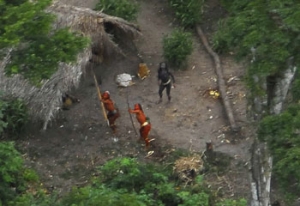 Anthrobloggers took on the issue of ‘uncontacted Indians’ at: John Hawks weblog, Culture Matters (where Greg wrote the piece), Savage Minds (with another posting) antropologi.info (which has a pile of links), Newspaper Rock (pointing out stereotypes of Native Americans)… Even Rush Limbaugh weighed in, offering the kind of incoherent rant that demonstrates why someone living isolated from ‘civilization’ might want to point an arrow at anyone who flew over.
There’s short references on many other sites, but feel free to send links to your own discussion through the comments command. That’s it for Four Stone Hearth #42 — last person to leave, kick some dirt over the embers…
 Neuroanthropology