Jean-Pierre Changeux, Gerald Edelman, and How the Mind Works

The nature of the brain’s “representations”—if there is such a thing—of the world, the self, the past and present, remains puzzling, as the very different approaches we have described suggest: Changeux’s view of “long-lasting global representations”; Edelman and Tononi’s view of memory as constructive recategorizations, and Rizzolatti’s stunning discovery of mirror neurons, suggesting that we know and understand others, to some extent, through neural imitation. And as these differing views show… we are still far from a full understanding of the nature of memory, perception, and meaning.

So Israel Rosenfield, a doctor and historian, and Edward Ziff, a biochemistry professor, conclude their review How The Mind Works: Revelations in a forthcoming New York Review of Books piece. What I liked about this essay is its clear statement on starting points to think about our brains and its insightful summaries and critique of recent work. But in the end I was still left with a “So what?” Their hints at subjective psychology, the acting brain, and relational representation remained the side dishes, rather than the main course. I’ll deal with that main course later this week, and in this post cover Changeux and Edelman.
Rosenfield and Ziff give us a quick historical summary of work on the neuron as a cell that uses electrochemical signaling. Early research by Hermann von Hermholtz and Santiago Ramon y Cajal contributed to defeating the notion that neurons functioned in a similar fashion to the dominate communication technology of that time, the telegraph. Neurons are slow in direct contrast to the speedy telegraph.

Today we still draw on an equally speedy but wrong view, the computer analogy. Jean-Pierre Changeux helped overturn the computer view using both basic research and basic biological theory, evolution by natural selection. (Still, I was left asking myself, why couldn’t we have learned from the failure of the telegraph model in the first place…)

As Rosenfield and Ziff note, Changeux’s research showed that “the human brain therefore does not make optimal use of the resources of the physical world; it makes do instead with components inherited from simpler organisms… that have survived over the course of biological evolution.”

Continue reading “Jean-Pierre Changeux, Gerald Edelman, and How the Mind Works”
Free Running and Extreme Balance

Mostly this is an excuse to link to these great videos of free running and parkour, unusual because they show much of the full sequence rather than mash-ups. But to go all scholarly on you, Cognitive Daily had a recent piece on learning to walk and children’s sense of balance. Leaning with backpack weights was a learned process, not an intuitive one, even with toddlers who knew how to walk.

These videos also give me the chance to plug Greg’s early piece on our sense of balance. Rather than an innate module gifted to us by evolution, “The evidence seems very clear that the sense of balance (again, with all the caveats of calling it ‘a’ single ‘sense’) can be trained to wide range of different challenges and to operate more efficiently or from different sets of information depending upon the task constraints. The variability of equilibrium was driven home to me in my research on capoeira, an Afro-Brazilian martial art and dance.”

Similarly with “l’art de displacement” through mixing balance, jumping, climbing and running. Wow!

Just like elite runners, I bet they stay focused on the task on hand, and not on the pain of a misstep or the fear over a missed jump—dissociation from risk and worry through expert technique. And this focused and skilled activity also relies on significant sensory integration of balance, vision, and touch. In turn, sensory integration, plenty of training and experience, and focus on the task help make free running predictable, understandable and controllable, and thus integrated into the person’s everyday interactive design.

Anyways, here’s a couple popular YouTube videos in the mash-up music video style:

More on the human ‘super-organism’

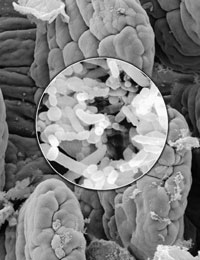
Intestine and gut microbeThere’s a good short piece, Humans Have Ten Times More Bacteria Than Human Cells: How Do Microbial Communities Affect Human Health?, in Science Daily, picks up on some of the themes we discussed in The human ’super-organism.’ The overwhelming majority of cells in human bodies belongs to microbes — the article says 10 bacteria cells for every human body cell (does it make you feel tired to think how much bacteria you’re carrying around?). Recognizing that we are a shambling micro-cosmos of oraganisms (or ‘microbiome’) suggests new understandings of all sorts of things, including disease. The Science Daily article points out that ‘changes in these microbial communities may be responsible for digestive disorders, skin diseases, gum disease and even obesity.’

There’s one passage in particular that I thought was worth posting, even if I don’t have too much to add:

“This could be the basis of a whole new way of looking at disease. In order to understand how changes in normal bacterial populations affect or are affected by disease we first have to establish what normal is or if normal even exists,” says Margaret McFall Ngai of the University of Wisconsin, Madison.

The microbiome research is particularly interesting to us at Neuroanthropology, even though it’s not strictly about the brain or nervous system, because it’s a particular compelling demonstration that the human body is a dynamic system; that is, the body is a system of different forces and processes, at a number of scales, that together continually produce the whole, sometimes in equilibrium and sometimes in ways that produce dysfunction.

Continue reading “More on the human ‘super-organism’”

The Neuroanth Hangover

A Few Too Many? Joan Acocella gives us the low-down on hang-overs, offering us hope (what little there is), science, anthropology, and even some morality! It’s a great article in The New Yorker, a neuroanth mash best enjoyed with a beer or a whiskey.

She covers the theories of why we have hang-overs in the first place, going through withdrawal, dehydration, inflammation (particularly due to cytokines), and congeners (impurities from the fermentation process). To these particularly bodily reactions, Acocella adds the role of genetics. Some people have a greater toxic response, often due to less alcohol dehydrogenase, an enzyme which breaks down alcohol. Others feel less of a withdrawal effect, building up tolerance more quickly.

Beyond the genetics, she also highlights an interesting theory to help explain hangovers. Wayne Jones has proposed that the liver process alcohol in two stages, first the ethanol (the alcohol) and then the methanol (a secondary ingredient in many wines and liquors). Methanol breaks down into formic acid, which is quite toxic. The main recipe to deal with this? Delay the move to methanol (drink some more) or distract yourself, say with spicy foods, to “divert the body’s attention away from coping with alcohol.” Or try comfort foods, again, to deal with the stress, inflammation, and toxins.

Continue reading “The Neuroanth Hangover”

Synesthesia & metaphor — I’m not feeling it

Wired online carried a story recently on a talk by ‘neuroscientist extraordinaire’ V.S. Ramachandran, one of the folks responsible for a lot of creative thinking in the brain sciences. Brandom Keim writes on a recent talk Ramachandran gave at the World Science Festival in a story, Poetry Comes from Our Tree-Climbing Ancestors, Neuroscientist Says. While I typically find his stuff both fascinating and resonant, this particular piece left me unpersuaded.

Normally, I might take issue with the sloppy logic of the title (‘poetry’ coming from ‘tree-climbing ancestors’ being a dangerous conflation between non-proximate contributing factors and eventual effects — you could just as logically say that ‘poetry comes from spinning disk of post-stellar material in proto-solar system’…), but I’ve got bigger fish to fry: synesthesia.

Rmachandran’s work on synesthesia is excellent; for example, his piece with in Neuron on synesthesia is essential reading, and the piece he co-authored on the condition in Scholarpedia is my source for a fair bit of what I will write. The problem is that I don’t think that synesthesia is a good metaphor for, well, metaphor.

Although there may be some ways that metaphor is like synesthesia, when we add up the pros and cons, synesthesia as a metaphor for metaphor may not help us too much to understand the latter, and I seriously doubt that the two are linked in a more profound causal fashion (like a ‘gene’ for both synesthesia and metaphor). Similarly, attention-based failure to perceive something may be like blindness, but using one to try to explain the other is futile. In other words, not all metaphors are equally useful, and I’m concerned that the synesthesia metaphor for metaphor might do more harm than good.

Continue reading “Synesthesia & metaphor — I’m not feeling it”

Cultural Aspects of Post-Traumatic Stress Disorder: Thinking on Meaning and Risk

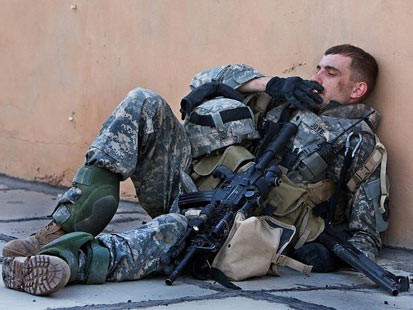
Over the past year and a half, I have been conducting research among male U.S. veterans who have served combat tours in Iraq and Afghanistan, most of whom have been diagnosed with Post-Traumatic Stress Disorder (PTSD). An anthropologist myself, I planned to follow the trail originally blazed by Victor Frankl and Robert Jay Lifton, psychotherapists who wrote a great deal about meaning in their descriptions of trauma and PTSD.

Early on, however, a psychiatrist whose work on trauma I admire opined to me that crises of meaning belong to the realm of depression rather than PTSD. He suggested that combat PTSD was best thought of as the physiological effects of living under conditions of extreme stress, while more meaning-related struggles were best understood as a symptom of depression. Given the frequency of comorbidity between PTSD and depression, I was for some time inclined to go along with his analysis.

Then two things happened. First, I began the work of talking with veterans themselves about their stories of trauma and PTSD, listening to how they describe their own experiences. And second, I began to explore the increasingly dominant Prolonged Exposure model of PTSD, which views the disorder as a pathology that develops when individuals fail to process their traumatic memories in the normal way.

Some background is important here. A recent RAND report suggests that as many as 18.5% of combat troops have gone on to develop PTSD after serving in Iraq or Afghanistan; alarming as that number is, it nonetheless demonstrates that the vast majority of combat-exposed individuals do not develop PTSD. However, most of the veterans I’ve spoken with – even those without a formal PTSD diagnosis – report experiencing some PTSD symptoms for a period of time following their combat deployment. Many of them dealt with such symptoms for a while – a month, three months, a year – before passing through this period of processing their memories and going on with their lives. They may be changed by their experiences in the war zone, but they are not broken by them, and may even describe them as resulting in personal growth and other positive effects.

Continue reading “Cultural Aspects of Post-Traumatic Stress Disorder: Thinking on Meaning and Risk”