Cognitive Daily, The Bloodier the Game, The More Hostile the Gamer
Mortal Kombat settings and a one-game study – the bloodier the game play, the more violent the resulting thoughts. So, are players after that arousal gap? And with the sword, are they looking for that bloody spray? And here context (in game only) helps shape resulting experience.
So, interesting results but various ways to interpret what players are doing and experiencing
Mental Health
Sarah Kershaw, Girl Talk Has Its Limits
Teenage girls and co-rumination – or wallowing in sorrows and anxieties together
Let’s imagine your name is Gaia, you’re a planet and you have a bad case of the humans. For many years you lived in symbiosis with humans, but then they evolved exogenetically, adapted in ways you were unprepared for and started to multiply in extraordinary numbers. Suddenly, the delicate balance of bacteria in your ecological gut got out of whack and now you have a bad case of gas, greenhouse gas! And no Rennie tablet is going to get you out of this one. Continue reading “A bad case of the Humans”
Deep-seated racial misgivings could cost Barack Obama the White House if the election is close, according to an AP-Yahoo News poll that found one-third of white Democrats harbor negative views toward blacks — many calling them “lazy,” “violent,” responsible for their own troubles. The poll, conducted with Stanford University, suggests that the percentage of voters who may turn away from Obama because of his race could easily be larger than the final difference between the candidates in 2004 — about two and one-half percentage points… More than a third of all white Democrats and independents — voters Obama can’t win the White House without — agreed with at least one negative adjective about blacks, according to the survey, and they are significantly less likely to vote for Obama than those who don’t have such views.
In related coverage, Brent Staples writes a NY Times op-ed on Barack Obama, John McCain and the Language of Race. Staples highlights the parallels between “uppity” blacks and the recent use of “uppity” about Obama by a Georgia Republican. He concludes:
Mr. Obama seems to understand that he is always an utterance away from a statement — or a phrase — that could transform him in a campaign ad from the affable, rational and racially ambiguous candidate into the archetypical angry black man who scares off the white vote. His caution is evident from the way he sifts and searches the language as he speaks, stepping around words that might push him into the danger zone. These maneuvers are often painful to watch. The troubling part is that they are necessary.
Nicholas Kristof recently argued that the repeated questioning of Obama’s Christian faith (isn’t he a Muslim?) represent another way to “otherize” Obama:
What is happening, I think, is this: religious prejudice is becoming a proxy for racial prejudice. In public at least, it’s not acceptable to express reservations about a candidate’s skin color, so discomfort about race is sublimated into concerns about whether Mr. Obama is sufficiently Christian. The result is this campaign to “otherize” Mr. Obama. Nobody needs to point out that he is black, but there’s a persistent effort to exaggerate other differences, to de-Americanize him.
As I argued recently in David Brooks and the Social Animal, the Republican party is about “one culture,” portraying itself as the most American, and avoiding the inherent complexity and even relativity that the anthropological notion of culture entails. A lot of that, historically, comes back to race, including the Southern strategy of the Republican party that has proven successful over the last three decades.
I also played the first part of this video to get them to think about how the black vs. white dichotomy doesn’t capture our variation today, and also to think more about the assumptions they make when they see someone. And while I think overall the lecture helped do that, still at the end there were statements being made like “those Asians” or “white kids,” showing just how powerful our “racial” categorization is here in the United States.
Pour les personnes qui aiment la bierre Belge et un Vendange Tardives autant que moi, voici un petit ‘forward’ que j’ai recu cette apres-midi: Continue reading “La théorie du mouton”
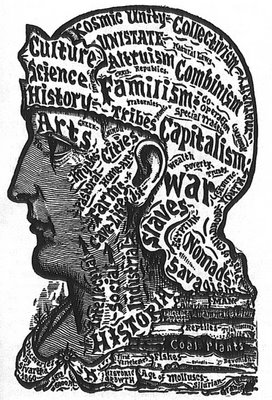
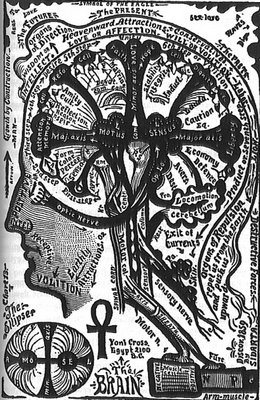
Still, I find Sivartha’s illustrations quite wonderful. Just like early anthropologists trying to cover all the important domains of one culture in one book, so Sivartha tries to jam everything in, to create an impossible representation. It doesn’t work, but the images do provide much to reflect upon.
Silent Raves, where people get together to dance while listening to music on their headphones, came to my attention this week through NPR’s “Silent Ravers Dance ‘Together But Individually’.” Get together in a public place, turn on your music at the appointed time, and start dancing!
This particular Silent Rave took place in Boston’s Copley Square, and was promoted through both Facebook and MySpace. Here’s the MySpace ad:
WHAT IS A SILENT RAVE?? A silent rave is a dance party where everyone listens to their own music. Imagine looking out and seeing hundreds of people dancing, but hearing nothing. Pretty cool, eh?
This Myspace page will keep all you ravers updated on upcoming events. It’ll also help promote this event, and attract more people to the raves.
Basically, what you do at a silent rave is bring your MP3 player and headphones. After the countdown to the start time of the event (typically in the evening, but who knows!), everyone presses play at the same time, listening to their own favorite jams. Everyone then starts dancing (dancing, jumping up and down, flailing arms around wildly, it’s all the same at a rave!).
What’s the point? Well, it’s just an event where a bunch of people can get together to have fun, expend pent-up energy, and meet tons of new people with similar interests. These silent raves are supremely exciting (well, with the right attitude) and fun. Silent raves will normally be short and sweet, but everyone is more than welcome to stay afterwards to party and mingle with fellow ravers.
Simple guidelines:
-please Please PLEASE respect the locations where the silent raves are held, i.e. don’t litter and no violence. We don’t want to be attracting any unwanted attention from local authorities…
-Wait for the countdown to start raving, otherwise it’ll be a mess.
-Have fun.
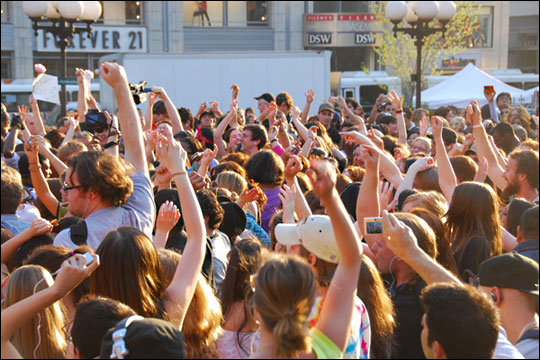
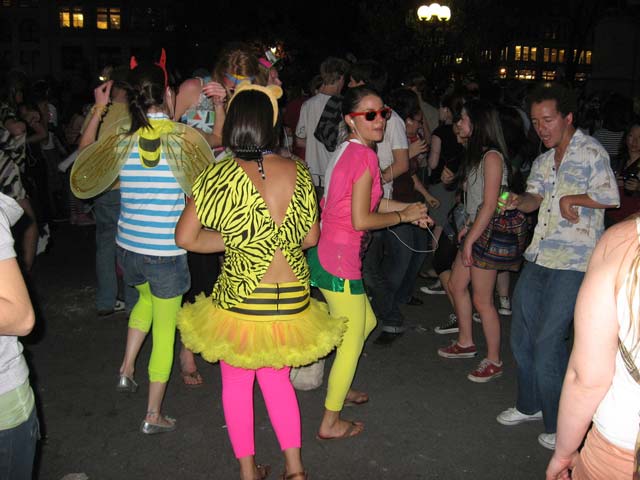
In the States one of the biggest Silent Raves was held last April in NYC’s Union Square. Both the NY Times and ABC News covered it. I’ve included a photo from that rave. For some video go to this You Tube clip.
The odd thing for me was that the You Tube clip included music! I suppose that makes sense for showing off what you were listening to, but as a curious anthropologist (and a guy just out of current style, one of my students commented yesterday) it didn’t help me capture the overall feel of the event. So here’s a video from Calgary. A lot smaller silent rave, but this one gives a better sense of what it looks like to someone on the outside.
And then there was this massive flash mob silent rave in Victoria Station in London!


 Neuroanthropology