Roid Age: steroids in sport and the paradox of pharmacological puritanism

Photo by Pixabay on Pexels.com

The following post is based on a lecture I gave in the course, ‘Drugs Across Cultures,’ on steroids and performance-enhancing drugs. A very-beta version of a Prezi is available for the lecture on my Prezi account, but it still needs updating. I’m eventually hoping to do a webcast version of the lecture, so I’d love to hear your feedback — the lecture isn’t as detailed as this post. The original post is from 9 July 2012 on the PLOS Blogs Neuroanthropology, a site that was closed down (archived: https://web.archive.org/web/20170907050452/http://blogs.plos.org/neuroanthropology/2012/07/09/roid-age-steroids-in-sport-and-the-paradox-of-pharmacological-puritanism/)

Introduction

In 1998, when I was living in New York, my family managed to get tickets to a baseball game between the St. Louis Cardinals and the Chicago Cubs. I had been a Cardinals fan since before I ate solid food, and 1998 was a very good year to catch a Cards-Cubs game. Baseball fans around the US, still demoralized after the 1994 players strike forced the cancellation of the World Series, were thrilled in 1998 by a chase for the record in US Major League Baseball (MLB) for the most home runs in a season by a single player. Fans flocked back to stadiums for a carnival of power hitting that summer.

When I went to the game, Cardinal Mark McGwire and Cub Sammy Sosa were both on pace to break the record of 61 home runs in a season set by Roger Maris, a record that had stood for almost four decades. By the end of the year, both McGwire and Sosa would shatter the previous mark. Sosa finished that season with 66, McGwire with 70. The afternoon that I flew in from New York for the game, both McGwire and Sosa hit home runs, and I had one of my best days watching professional baseball. St. Louis was drunk on the excitement; ‘Big Mac’ jerseys were selling like school uniforms in July, and the hot, humid St. Louis air was crackling with the energy (or maybe we were all just drunk on the insane pollen count). After the sordid spectacle of millionaire players and multi-multi-millionaire owners kicking sand on each other and taking their toys home a few years earlier, it felt good to be a baseball fan again.

Continue reading “Roid Age: steroids in sport and the paradox of pharmacological puritanism”
Proceedings from ASCS 09 Conference online

The Proceedings of the 9th Conference of the Australasian Society for Cognitive Science, held in Sydney last year, are now online for anyone to access. Thanks to the editors, Wayne Christensen, Elizabeth Schier, and John Sutton, for pulling the whole collection together!

I didn’t get to stay for the whole conference because I was running around doing preparation things for the Australian Anthropological Society Conference that we held in December. Nevertheless, I saw some really good papers, and some of the others are especially interesting for those of us interested in neuroanthropology. Please peruse the whole list, but for a discussion of cultural variation in cognition, of special interest might be: Nian Liu’s Tuesday, Threesday, Foursday: Chinese names for the days of the week facilitate Chinese children’s temporal reasoning, Zhengdao Ye’s Eating and drinking in Mandarin and Shanghainese: A lexical-conceptual analysis, Collaborative remembering: When can remembering with others be beneficial? by Celia B. Harris, Paul G. Keil, John Sutton and Amanda J. Barnier, and Expanding expertise: Investigating a musician’s experience of music performance by Andrew Geeves, Doris McIlwain, and John Sutton.

I also like the look of Evaluation of a model of expert decision making in air traffic control, by Stefan Lehmann and colleagues, but I haven’t had the time to really read it (and won’t get time for a few days). Ben Jeffares’ paper was excellent in presentation, but I haven’t yet checked out the written version yet: The evolution of technical competence: strategic and economic thinking.

My paper from the conference, Cultural variation in elite athletes: Does elite cognitive-perceptual skill always converge?, is available as a pdf. I have to admit, it’s a shallower paper than I usually like to present, but I had to cover a LOT of turf, and it’s primarily a proposal for a research program, reviewing the neurological and behavioural places where I expect we might find the clearest evidence of cultural difference in neural dynamics. I’ll take the liberty of reposting the abstract:

Anthropologists have not participated extensively in the cognitive science synthesis for a host of reasons, including internal conflicts in the discipline and profound reservations about the ways that cultural differences have been modeled in psychology, neuroscience, and other contributors to cognitive science. This paper proposes a skills-based model for culture that overcomes some of the problems inherent in the treatment of culture as shared information. Athletes offer excellent cases studies for how skill acquisition, like enculturation, affects the human nervous system. In addition, cultural differences in playing styles of the same sport, such as distinctive ways of playing rugby, demonstrate how varying solution strategies to similar athletic problems produce distinctive skill profiles.

I’d love to hear any responses to the piece. I don’t usually present in cognitive science, as I’m more comfortable in my home discipline of anthropology, working from a pretty solid base of anthropology into the border of brain-culture research, so I’d be interested to learn what scholars situated more confidently in cognitive science think of the piece.

Lose your shoes: Is barefoot better?

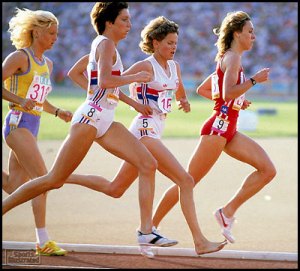
1984 Women's 3000 meter

In 1984 at the Los Angeles Olympics, the women’s 3000-meter final was marred by controversy when American Mary Decker fell after making contact with Zola Budd, a runner from South Africa who represented Britain (due to the boycott of South African sport).

Although Budd had been setting the pace, she faded to seventh in the end and was booed by the partisan LA audience (Decker would later say that she was inexperienced at running in a pack and, as the trailing runner, was responsible for their contact). Maricica Puica of Romania won the event, and Britain’s Wendy Sly took the silver in a final that was seared into my memory by the televised replays of a stricken Mary Decker, hip injured from her fall, shattered and crying on the infield.

In all of the drama, one of the things that left the greatest impression on me as a high school student and sometime athlete was the simple fact that Zola Budd ran without shoes, an almost unimaginable idea to me at the time. Budd was one of a handful of famous barefoot runners, including Abebe Bikila, the Ethiopian marathoner who won his first Olympic gold in 1960 without shoes, Tegla Loroupe, the Kenyan women’s running legend and multiple world record holder, and Ken Bob Saxton, aka ‘Barefoot Ken Bob,’ a marathoner and guru to the shoeless.

I’ve been thinking about barefoot running for a while, oddly enough since I started writing about bare-knuckle punching in no-holds-barred fighting (or ‘mixed martial arts’ like the Ultimate Fighting Championship in its early days). Barefoot running, even more than bare-knuckle boxing, reveals the ways that very simple technologies, if used consistently enough, become part of the developmental niche of the human body, shaping the way that our bones, muscles, tissues, and nervous system develop.

Although this post is not strictly neuroanthropology, I thought I might share some of what I’m working on, in part because I’m interested to hear any feedback people have. In particular, this will focus on how hard it is to sort out what’s ‘natural’ when activity patterns, incredibly variable, are necessary ingredients in the development of biological systems. But also, as it will become clearer in the post, the ways that our nervous system adapt to different situations, such as having heavily padded feet or being barefoot when we run, illustrates well how even unconscious training is a form of phenotypic, non-genetic, adaptation.

Before I go any further, though, if you have anything to say in response to this, I would love to read it. This is my first attempt to put down some thoughts that will be in a chapter of an upcoming book…
Continue reading “Lose your shoes: Is barefoot better?”

Talent: A difference that makes a difference

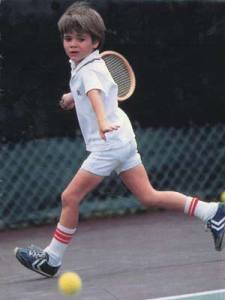
A young Andre Agassi
Studying sports training and skill acquisition, I often run headlong into the concept of ‘talent.’ When I suggest that athletic achievement demonstrates the extraordinary malleability of the human nervous system, the ability of our muscles to remodel, the refinement of athletes’ perceptual acuity, and even how our skeletons can be reconfigured by training, audience members often respond, ‘Yeah, but what about innate talent?’

Or, confronted by the yawning gap between elite athletes’ performances and the ability of the average person, sceptics still want to focus on the slight differences among elites athletes (for example, Jon Entine’s book Taboo), suggesting that this tiny fraction of difference is the ‘innate’ part, the ‘talent.’ I can describe the years of arduous labour that go into producing elite-level achievement, the countless hours of training and sophisticated coaching, and someone will inevitably say, ‘Okay, but some people are just inherently good at sports, aren’t they?’

But as psychologist K. Anders Ericsson said in an interview in Fast Company (cited here by Dan Peterson), ‘The traditional assumption is that people come into a professional domain, have similar experiences, and the only thing that’s different is their innate abilities. There’s little evidence to support this. With the exception of some sports, no characteristic of the brain or body constrains an individual from reaching an expert level.

Obviously, certain dimensions of the body can affect one’s ability to participate in a sport like basketball or sumo at an elite level, or a genetic abnormality may create an unusual wrinkle in a metabolic or even a neural process, but research like Ericsson’s suggests that these sorts of traits are likely the exception rather than the rule. That is, even if there is a genetic trait that helps some Kenyan runners to excel, or gives an individual with photographic memory, or helps a free diver to endure oxygen deprivation, these cases do not confirm the folk idea that talent is innate (and thus likely genetic).

In this post, I want consider the difference that makes a difference. That is, how the concept of talent itself actually affects the unfolding and compounding of developmental variation, helping extreme ability to emerge (and de-motivating those who don’t demonstrate early ‘promise’). Whether or not ‘talent’ exists—and I’m profoundly skeptical—believing that it does is a good foundation for exaggerating variation in skilled ability.

Continue reading “Talent: A difference that makes a difference”

Catching fly balls: taking a step forward

Nolan Catholic High Lady Vikings catcher Martha Thomas zeroes the apparent acceleration of a pop-up
Dan Peterson, probably my favourite blogger on sports science, has a recent piece in Science Daily on How Baseball Players Catch Fly Balls. He usually posts on his excellent blog, Sports Are 80 Percent Mental. His post, as usual, is excellent, but I wanted to take issue with the slightest of details (because that’s just how I am): why do novice outfielders often take a step forward when the crack of a bat and the launch of a ball indicates that a fly ball has just been hit in their direction?

As a former and largely inept outfielder for the Ascension Catholic Church ‘Steamrollers,’ 2nd grade and under team (I was more of a junior soccer player), I well remember our coach, Dr. Wickersham, telling us repeatedly, and to little effect, ‘don’t start running forward until you know the pop-up is going to fall in front of you.’ I also clearly remember the sinking feeling when, after failing to heed his advice, a fly ball flew over my head as I charged toward it, ultimately landing almost precisely where I had been standing the instant that ball was hit.

Peterson discusses a recent paper in the journal, Human Movement Science, ‘Catching fly balls: A simulation study of the Chapman strategy,’ by Dimant Kistemakera and colleagues. Kistemakera and his team set out to test the slight variations between the trajectories fielders took when running to intercept a fly ball, and the trajectories predicted by Seville Chapman’s ‘strategy’ of using the acceleration of the ball in one’s vertical field to control whether one was too close or too far from home plate to make the catch.

Continue reading “Catching fly balls: taking a step forward”

Measuring Process Not Belief: Shane Battier and Stress

The Wrong Box Score
The Wrong Box Score

Besides being a great read about Shane Battier and success in professional basketball, The No-Stats All-Star article by Michael Lewis in last Sunday’s New York Times Magazine carries a larger lesson about how our understanding of the world is shifting. One of its main points is that we are becoming increasingly statistics driven, with sports at the leading edge of this transformation. We can spend lots of money on stars, like the New York Yankees, or we look more closely at what actually leads to success and how we can achieve that with less money. Shane Battier epitomizes this change because his individual stats are rather mediocre, his physical skills rather normal for an NBA player. But he makes his team win.

The key question becomes, how does he do this? That is where Michael Lewis mixes qualitative research (interviews) and ethnographic insight (coming from Battier’s own experience) with an examination of new ways of measuring everything that might count about a basketball game. It’s a powerful mix.

For me it illustrates two important points about how we can develop better measures, ones that are closer to what actually determine outcomes and that don’t fall into so easily into measuring our own beliefs about the world. And yes, by “our own” I mean the researchers who come up with the measures. Here’s a relevant section describing Daryl Morey, the man behind the Houston Rockets new approach to figuring out what works:

What [Morey] will say, however, is that the big challenge on any basketball court is to measure the right things. The five players on any basketball team are far more than the sum of their parts; the Rockets devote a lot of energy to untangling subtle interactions among the team’s elements. To get at this they need something that basketball hasn’t historically supplied: meaningful statistics. For most of its history basketball has measured not so much what is important as what is easy to measure — points, rebounds, assists, steals, blocked shots — and these measurements have warped perceptions of the game. (“Someone created the box score,” Morey says, “and he should be shot.”) How many points a player scores, for example, is no true indication of how much he has helped his team.

Here is how it makes a difference. Battier doesn’t get great traditional stats – points scored, shots blocked, and so forth. But he does things that, on aggregate, make a bigger difference.

Continue reading “Measuring Process Not Belief: Shane Battier and Stress”