American Association for the Advancement of Science

The American Association for the Advancement of Science proudly declares itself the world’s largest scientific organization. As the publisher of Science, they’ve got plenty to be proud about. But for this blog, it’s the online resources they offer that are of interest.

Here are some highlights.

Evolution Resources: One stop shopping from the AAAS on evolution and the public, including education, religion, and intelligent design

The Science Inside: Obesity Comprehensive book on what’s known about obesity (part of Healthy People Library Project)

Healthy People Library Project, Online Books Summaries of science research on seven different health disorders

Brent Garland, Neurosciences and the Law: Brain, Mind and the Scales of Justice Summary of a AAAS meeting, published in 2004

The AAAS also has assorted programs and and activities as well as a number of publications, some free and online, others not.

Open Anthropology

Open Anthropology, a blog run by Maximilian Forte, is dedicated to moving anthropology out of its academic straight-jacket. As Forte describes in About This Project, this project has two aims: one, “to significantly restructure and move anthropology beyond its current confines, beyond the constraints of professionalization and institutionalization;” the other, “to transform anthropology into something that is neither Eurocentric nor elitist” and thus move beyond anthropology’s roots in colonialism. It is about creating new world knowledge.

Open Anthropology has two recent posts which resonate with themes that crop up on Neuroanthropology—an anthropology open to wider influences, an anthropology engaged with a wider public, an anthropology that forgets its own fears, both self-inflicted and institutional.

First, in Towards a More Public Social Science Forte posts the statement by Social Science Research Council president Craig Calhoun. Calhoun outlines four steps for a more engaged social science: (1) Engagement with public constituencies must move beyond a dissemination model. (2) Public social science does not equal applied social science… [T]he opposition of applied to pure is itself part of the problem. It distracts attention from the fundamental issues of quality and originality and misguides as to how both usefulness and scientific advances are achieved. (3) Problem choice is fundamental. What scientists work on and how they formulate their questions shape the likelihood that they will make significant public-or scientific-contributions. (4) A more public social science needs to ask serious questions about the idea of “public” itself… Can ideas of the public be reclaimed from trivialization by those who see all social issues in terms of an aggregation of private interests? What are the social conditions of a vital, effective public sphere and thus of an important role for social science in informing public culture, debate, and decision-making?

Continue reading “Open Anthropology”

Wednesday Round Up #13

Neuroanthropology

David Freedberg, Empathy, Motion & Emotion and Composition & Emotion
Two pdfs on art and the neurosciences by the Columbia art history professor

Sam Harris et al., Functional Neuroimaging of Belief, Disbelief and Uncertainty
Pdf of 2008 article from Annals of Neurology: “truth may be beauty, and beauty truth, in more than a metaphorical sense”

John Horgan, Brain Chips and Other Dreams of the Cyber-Evangelists
Yearning for brain chips, and the problems therein

Literary Trends

Kenneth Goldsmith, In Barry Bonds I See The Future of Poetry
Welcome to our post-human future

Anne Harrington, The Inner Lives of Disordered Brains
The Harvard historian of science’s excellent take on the recent rise in neuro-lit

Jonathan Gottschall, Measure for Measure
Literary criticism needs to embrace science

Henry Bowles, It’s in the Genes: Criticism Devolved
How about criticism of the literary embrace of dubious science?!

Bob Meagher, Socrates on the Campaign Trail
Hope or fear this fall? Socrates will help guide you

Elinore Longobardi, Think Globally, Read Locally
Journalism needs to embrace anthropology

Three-Toed Sloth, Books To Read While Algae Grow In Your Fur
Books recommendations; eclectic from liberalism and math brains to comic books…

Lorenz at Antropologi, Anthropology Blogs More Interesting Than Journals?
For some of us at least… a summary from a quick-and-dirty ethnography of blogging

Language

Liz Danzico, Telling Stories Using Data: An Interview with Jonathan Harris
“Stories should have feeling, to the extent that they want to be human.”

Michael Price, Outside Language Looking In
Children who learn signing at home: language helps organize the mind’s underlying architecture

Continue reading “Wednesday Round Up #13”

Don’t Deep Six Number Forty Six

The 46th Edition of Encephalon is up at Neurocritic. It’s a great edition, really a stand-out.

Here are some favorites. Cognitive Daily has a discussion of the persistence of racism even among the well-intentioned.

Neuroscientifically Challenged writes on The Neuroscience of Distributive Justice.

In My Mascot Only Gave Me Sex Appeal Podblack Cat takes on superstition, luck, and natural disasters, with a focus on toys, Tibet and the earthquake in China.

And the Neurocritic himself has a very nice You’re My Favorite Person… on beauty, relations, dopamine, and immune activity.

Kids falling down

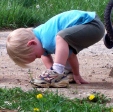
The Appeal of DirtIf, like me, you find the sense of balance and its development fascinating, or if you just want to learn more about toddlers falling over, check out Cognitive Daily’s wonderful piece discussing research on toddlers’ balance. A research team put weighted vests on toddlers to see how they would compensate when they tried to walk, and the poor little folks leaned the wrong way. That is, put a bit of weight on a toddler’s back, and he or she tends to lean backward to try to compensate. Man, little kids are ka-razy!

The piece by Dave Munger is, What backpack-wearing toddlers can tell us about how kids learn to walk. As always, Munger’s discussion is very thorough and gives a great sense for the original research. The work is reminiscent of the research of the late Esther Thelen, one of the psychologists who really opened my eyes to dynamic systems theory and a rethinking of developmental theory.

Back from absence with links on human evolution

I’ve been noticeably silent on Neuroanthropology of late — I didn’t think I could get any busier after January was bad, but it’s been awful around here. I’ve been involved in local politics, if you can believe that, and set up another website (www.berrybypass.com) to try to expose a bit of local corruption and misinformation that was trying to reroute a highway bypass. So I’ve been blogging, just not on Neuroanthropology, putting my knowledge of WordPress to alternative uses.

With the absence, I’ve got a backlog of interesting stuff that I will not be able to write substantial comments on, so I thought I could at least put some links to a couple of pieces:

ABC News has an intriguing short piece on vestigial organs, Five Things Humans No Longer Need, by Laura Spinney. Some of the usual subjects are there (like wisdom teeth and the coccyx), but there’s also some less well-known examples. If I were writing a long piece on this, though, I’m still not persuaded by the notion of ‘vestigial’ organs because it seems to imply that other organs ARE doing what they were selected for, and I doubt that’s the case; too many organs have likely been co-opted into other things over evolutionary time. I worry that the notion of ‘vestigial’ organs singles these out, when in fact the issue is broader, BUT I also love using vesigial organs when I teach.

The other piece I’m not going to get to is Tracing Humanity’s Path, by Michael Balter on ScienceNOW Daily News. The piece is a news story on a longer article available on PLoS Genetics, Inferring Human Colonization History Using a Copying Model, by Garrett Hellenthal, Adam Auton, and Daniel Falush, that uses genome-wide statistical modeling to reconstruct human dispersal patterns that, although not earth-shattering, does produce some interesting wrinkles in the usual account of how humans got all over the globe. And it has cool animated maps linked to it that show the patterns.