Cosleeping and Biological Imperatives: Why Human Babies Do Not and Should Not Sleep Alone

mother-and-childBy James J. McKenna Ph.D.
Edmund P. Joyce C.S.C. Chair in Anthropology
Director, Mother-Baby Behavioral Sleep Laboratory
University of Notre Dame
Author of Sleeping with Your Baby: A Parent’s Guide to Cosleeping

Where a baby sleeps is not as simple as current medical discourse and recommendations against cosleeping in some western societies want it to be. And there is good reason why. I write here to explain why the pediatric recommendations on forms of cosleeping such as bedsharing will and should remain mixed. I will also address why the majority of new parents practice intermittent bedsharing despite governmental and medical warnings against it.

Definitions are important here. The term cosleeping refers to any situation in which a committed adult caregiver, usually the mother, sleeps within close enough proximity to her infant so that each, the mother and infant, can respond to each other’s sensory signals and cues. Room sharing is a form of cosleeping, always considered safe and always considered protective. But it is not the room itself that it is protective. It is what goes on between the mother (or father) and the infant that is. Medical authorities seem to forget this fact. This form of cosleeping is not controversial and is recommended by all.

Unfortunately, the terms cosleeping, bedsharing and a well-known dangerous form of cosleeping, couch or sofa cosleeping, are mostly used interchangeably by medical authorities, even though these terms need to be kept separate. It is absolutely wrong to say, for example, that “cosleeping is dangerous” when roomsharing is a form of cosleeping and this form of cosleeping (as at least three epidemiological studies show) reduce an infant’s chances of dying by one half.

Bedsharing is another form of cosleeping which can be made either safe or unsafe, but it is not intrinsically one nor the other. Couch or sofa cosleeping is, however, intrinsically dangerous as babies can and do all too easily get pushed against the back of the couch by the adult, or flipped face down in the pillows, to suffocate.

Often news stories talk about “another baby dying while cosleeping” but they fail to distinguish between what type of cosleeping was involved and, worse, what specific dangerous factor might have actually been responsible for the baby dying. A specific example is whether the infant was sleeping prone next to their parent, which is an independent risk factor for death regardless of where the infant was sleeping. Such reports inappropriately suggest that all types of cosleeping are the same, dangerous, and all the practices around cosleeping carry the same high risks, and that no cosleeping environment can be made safe.

Nothing can be further from the truth. This is akin to suggesting that because some parents drive drunk with their infants in their cars, unstrapped into car seats, and because some of these babies die in car accidents that nobody can drive with babies in their cars because obviously car transportation for infants is fatal. You see the point.

One of the most important reasons why bedsharing occurs, and the reason why simple declarations against it will not eradicate it, is because sleeping next to one’s baby is biologically appropriate, unlike placing infants prone to sleep or putting an infant in a room to sleep by itself. This is particularly so when bedsharing is associated with breast feeding.

When done safely, mother-infant cosleeping saves infants lives and contributes to infant and maternal health and well being. Merely having an infant sleeping in a room with a committed adult caregiver (cosleeping) reduces the chances of an infant dying from SIDS or from an accident by one half!

Continue reading “Cosleeping and Biological Imperatives: Why Human Babies Do Not and Should Not Sleep Alone”

Balance between cultures: equilibrium training

Way back in January, I posted ‘Equilibrium, modularity, and training the brain-body.‘ At the American Anthropology Association annual meeting, I presented my current version of this research, significantly updating it with ethnographic material from Brazil, a comparative discussion of different techniques for training balance, and a series of graphics that I hope help to make my points. The title of that paper was ‘Balancing Between Cultures: A Comparative Neuroanthropology of Equilibrium in Sports and Dance.’

I’ve decided to post a version of this paper here, with the caveat that it’s still a work-in-progress. I’d be delighted to read any feedback people are willing to offer.

Introduction

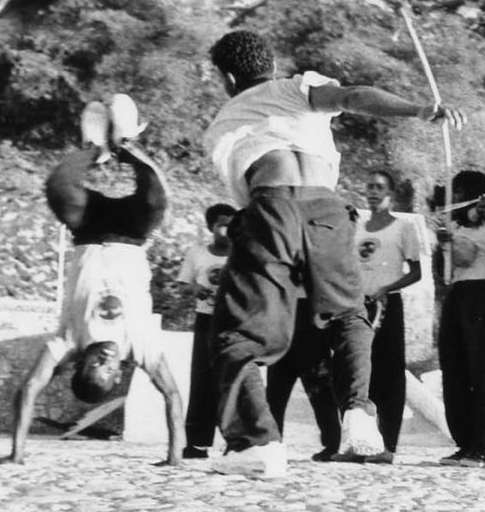
Boca d' Rio does a bananeira
As a cultural anthropologist interested in the effects of physical training and perceptual learning, I see ‘neuroanthropology’ as a continuation of the cognitive anthropology advocated by Claudia Strauss and Naomi Quinn (1997).

The new label, however, reflects engagement with a new generation of brain research, what Andy Clark (1997) refers to as ‘third wave’ cognitive science, or work on embodied cognition.1 Much of the ‘third wave’ does not focus strictly on what we normally refer to as ‘cognition,’ that is, consciousness, memory, or symbolic reasoning. Rather embodied cognition often highlights other brain activities, such as motor, perceptual and regulatory functions, and the influence of embodiment on thought itself; this is the reason I’m thrilled to have endocrinologist Robert Sapolsky as part of this panel, as his work is part of the expanded engagement of neuroanthropology with organic embodiment.2.

My own entry into neuroanthropology results from three influences: a phenomenological interest in cultural variation in human perception, anthropological study of embodiment, and apprenticeship-based ethnographic methods. This method posed an odd question during my field research on the Afro-Brazilian martial art and dance, capoeira. Simply put, as a devoted apprentice-observer, I failed to maintain hermeneutical agnosticism and started to ask, ‘Is what my teachers and peers report — and I too seem to be experiencing — plausible?’

Continue reading “Balance between cultures: equilibrium training”

Andy Clark & Michael Wheeler: Embodied cognition and cultural evolution

The Cognition and Culture website has posted a link to the new edition of the Philosophical Transactions of the Royal Society B on ‘cultural transmission and evolution of human behaviour.’ I wanted to comment on just one piece on embodied cognition and cultural evolution, by philosophers Michael Wheeler and Andy Clark (unfortunately, Philosophical Transactions B is behind a subscription wall, although there’s a one-page ‘free preview’ [ouch] here). The Cognition and Culture website has the table of contents posted here. I was vaguely familiar with Michael Wheeler’s work before this piece, but Andy Clark (it’s not much of a profile) has written some of the work that’s most influenced my thinking about the effects of varied skill acquisition on cognition, especially his remarkable book, Being There: Putting Brain, Body and World Together Again (Amazon listing).

A ream of Clark’s papers can be found here. A review of Michael Wheeler’s book, Reconstructing the cognitive world: The next step, written by Leslie Marsh can be downloaded here. We’ll come back to Andy Clark’s work again in later posts.

I must admit a certain morbid fascination with how one of my favorite streams of thought — embodied cognition — would fare combined with cultural evolution — an area of scholarship that, well, to put it nicely, is uneven (before you get all defensive, let me just stop you with one word: mimetics). It’s sort of like watching one of your good friends get hit on by a sleazy guy at a bar. She looks happy, but you’re sort of cringing at the chance that she might actually take him home. In spite of this instinctual cringe, this special edition of Philosophical Transactions has some really interesting work on cultural evolution, especially because many of the pieces focus tightly on the enormously problematic issue of cultural transmission.

Continue reading “Andy Clark & Michael Wheeler: Embodied cognition and cultural evolution”

Race in the Race

The most recent Associated Press-Yahoo News poll indicates:

Deep-seated racial misgivings could cost Barack Obama the White House if the election is close, according to an AP-Yahoo News poll that found one-third of white Democrats harbor negative views toward blacks — many calling them “lazy,” “violent,” responsible for their own troubles. The poll, conducted with Stanford University, suggests that the percentage of voters who may turn away from Obama because of his race could easily be larger than the final difference between the candidates in 2004 — about two and one-half percentage points… More than a third of all white Democrats and independents — voters Obama can’t win the White House without — agreed with at least one negative adjective about blacks, according to the survey, and they are significantly less likely to vote for Obama than those who don’t have such views.

In related coverage, Brent Staples writes a NY Times op-ed on Barack Obama, John McCain and the Language of Race. Staples highlights the parallels between “uppity” blacks and the recent use of “uppity” about Obama by a Georgia Republican. He concludes:

Mr. Obama seems to understand that he is always an utterance away from a statement — or a phrase — that could transform him in a campaign ad from the affable, rational and racially ambiguous candidate into the archetypical angry black man who scares off the white vote. His caution is evident from the way he sifts and searches the language as he speaks, stepping around words that might push him into the danger zone. These maneuvers are often painful to watch. The troubling part is that they are necessary.

Nicholas Kristof recently argued that the repeated questioning of Obama’s Christian faith (isn’t he a Muslim?) represent another way to “otherize” Obama:

What is happening, I think, is this: religious prejudice is becoming a proxy for racial prejudice. In public at least, it’s not acceptable to express reservations about a candidate’s skin color, so discomfort about race is sublimated into concerns about whether Mr. Obama is sufficiently Christian. The result is this campaign to “otherize” Mr. Obama. Nobody needs to point out that he is black, but there’s a persistent effort to exaggerate other differences, to de-Americanize him.

As I argued recently in David Brooks and the Social Animal, the Republican party is about “one culture,” portraying itself as the most American, and avoiding the inherent complexity and even relativity that the anthropological notion of culture entails. A lot of that, historically, comes back to race, including the Southern strategy of the Republican party that has proven successful over the last three decades.

I lectured on race last week in my Introduction to Anthropology class. In lieu of that, you might check out the American Anthropological Association’s outstanding project Understanding Race. The site focuses on three main areas: (1) history, complete with an online video; (2) human variation, with online graphics and text exploring topics like the human spectrum (a basic intro to thinking about human variation), race and human variation, and the variation in human skin color; and (3) lived experience, exploring topics like sports and beauty.

PBS has a documentary series on Race: The Power of an Illusion. Here’s one clip that I used from it:

I also played the first part of this video to get them to think about how the black vs. white dichotomy doesn’t capture our variation today, and also to think more about the assumptions they make when they see someone. And while I think overall the lecture helped do that, still at the end there were statements being made like “those Asians” or “white kids,” showing just how powerful our “racial” categorization is here in the United States.

Calvin the theologian and Calvin the theoretical neurobiologist

John Calvin, a Theologian from Strasbourg died the day before I was born. He taught an austere form of personal ethics supporting good hospitals, a proper sewage system, protective rails on upper stories to keep children from falling from tall buildings, special care for the poor and infirm, and the introduction of new industries. Continue reading “Calvin the theologian and Calvin the theoretical neurobiologist”

Women on tests update: response to stress

A while ago, I posted an overly-long discussion of recent research on the ‘math gap’ between boys and girls on standardized testing (Girls closing math gap?: Troubles with intelligence #1). That posting discussed several studies published in Science that have shown the gap in average math scores between boys and girls is not set in stone. In one paper, an increase in the test pool brought on by the No Child Left Behind program, with mandatory universal tests instead of exams only for those wishing to go to college, caused the gap in average scores to disappear; in the other paper, a decrease in the ‘math gap’ was found to correlate with other measures of greater gender equality in European states.

As I pointed out in the previous post, however, many commentators suggest that it is not the gap in average test scores that really matters; rather, these critics argue that the different variance in boys’ and girls’ scores explains the disproportionate number of boys who produce exceptional scores (as well as exceptionally bad scores), and thus the marked gap of men and women in PhD math programs, in prestigious prizes for physics and related subjects, and in related fields like engineering. In the earlier post, I argued that even if this greater variance showed up reliably across all testing populations, what exactly was being illuminated was still not clear; that is, many other explanations–other than that men had better ‘math modules’ in their brains, or greater ‘innate’ mathematics ability, or something like that–could explain even very stable differences in math performance. At the time I suggested a number of other possibilities, such as sex differences in stress response during testing, as other possible explanations for even a universal ‘math gap’ (which still had to contend with studies like the two in Science which severely undermined the assertion of universality).

As if on cue, I stumbled upon a video and accompanying article in Science Daily on differences in stress responses among men and women: Neuroscientists Find That Men And Women Respond Differently To Stress (but don’t click on that link — keep reading!). Stress is a good candidate to explain a test-taking gap because the observable physiological processes offer abundant evidence that men and women don’t respond to stress in exactly the same way (although there are underlying commonalities). For example, stress causes different diseases in men and women, and some long-term psychological disorders that demonstrate sex-linked disparities seem to emerge from stress.

Unlike the ‘black box’ explanation that boys and simply better at math or evidence greater variability in innate ability, with no observable neural correlate or plausible explanatory mechanism, in variation in stress response we have a clear candidate for male-female difference that plausibly affects their performance and even physiology (for example, in different stress-related diseases).
Continue reading “Women on tests update: response to stress”