SurveyFail redax: Downey adds to Lende

Daniel did a posting earlier today on Sex, Lies and IRB Tape: Netporn to SurveyFail that explores a research project that self-immolated through bad design, horrible conflict management, and a number of other character flaws. I’m really glad Daniel did this because he’s the more tech-savvy half of this duo. I just saw this yesterday and started to read up on the commentary but quickly realized that I was over my head, having pretty much exhausted my ability to navigate communication technology and resulting subcultural movements with a Twitter-related post a while back.

But I did want to add a couple of points because I’m particularly interested in research design and ethics and because I like kicking researchers when they’re down. No, no, just kidding — because I find the focus of ‘evolutionary’ theorists on the supposed ‘hard wiring’ of sexuality to be one of the more irritating and, well, hard-wired theoretical assumptions, even in the face of OVERWHELMING evidence to the malleability of human sexuality.

I apologize for not putting up some clever graphic, but I spent most of today helping friends build their mud-brick house and then went to a Showground Association meeting, where I was elected president (that’s kind of like the County Fairground in my town). My brain’s fried, but I don’t want to let this post sit for too long or it’s moment will have well and truly passed.

Research ethics

In my brief and incomplete survey of the discussions of this research, it became obvious that slash fans were particularly irritated, not just by the initial bad research design, but also by the seeming inability to apologize, learn from criticism or even simply back off on the part of the researchers.

Continue reading “SurveyFail redax: Downey adds to Lende”

Sex, Lies and IRB Tape: Netporn to SurveyFail

Slash Fail
Neuroscience researchers Ogi Ogas and Sai Gaddam have done a massive FAIL through bad research, failed ethics, and greed. They created an online survey targeted at slash fiction fans that was a debacle start to finish.

Slash fiction takes prominent characters from movies, television, and fiction and explores their relationships in unconventional ways. The founding example is Kirk/Spock, where the slash indicates a story about Kirk and Spock getting it on. The creators and consumers of slash fiction are generally women.

Earlier this year Ogi Ogas and Sai Gaddam signed a deal with Penguin for a popular book with the initial title “Rule 34: What Netporn Teaches Us about the Brain.” Rule 34 is simply that online “If it exists, there is porn on it. No exceptions.”

Slash fiction fans became one of their “netporn” targets. Ogas and Gaddam created and distributed their online survey that aimed to prove their basic premise (well, my take on it): “When in doubt, the brain causes everything. When that’s something we don’t really understand, then it must be the primitive parts of the brain.”

Here’s how I derived that premise. First comes shaggirl’s description of Ogas’ response to criticism (Note: Ogas took down the survey and the livejournal that discussed the project, so I am relying on people who have captured their words):

He defends his comparison of women liking slash to straight men liking transsexuals because “some deep sense of pleasure or satisfaction ultimately rooted in subcortical circuits” compels us to seek out slash/transsexuals despite fearing exposure to society at large.

Continue reading “Sex, Lies and IRB Tape: Netporn to SurveyFail”

Lose your shoes: Is barefoot better?

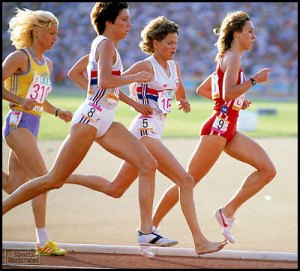
1984 Women's 3000 meter

In 1984 at the Los Angeles Olympics, the women’s 3000-meter final was marred by controversy when American Mary Decker fell after making contact with Zola Budd, a runner from South Africa who represented Britain (due to the boycott of South African sport).

Although Budd had been setting the pace, she faded to seventh in the end and was booed by the partisan LA audience (Decker would later say that she was inexperienced at running in a pack and, as the trailing runner, was responsible for their contact). Maricica Puica of Romania won the event, and Britain’s Wendy Sly took the silver in a final that was seared into my memory by the televised replays of a stricken Mary Decker, hip injured from her fall, shattered and crying on the infield.

In all of the drama, one of the things that left the greatest impression on me as a high school student and sometime athlete was the simple fact that Zola Budd ran without shoes, an almost unimaginable idea to me at the time. Budd was one of a handful of famous barefoot runners, including Abebe Bikila, the Ethiopian marathoner who won his first Olympic gold in 1960 without shoes, Tegla Loroupe, the Kenyan women’s running legend and multiple world record holder, and Ken Bob Saxton, aka ‘Barefoot Ken Bob,’ a marathoner and guru to the shoeless.

I’ve been thinking about barefoot running for a while, oddly enough since I started writing about bare-knuckle punching in no-holds-barred fighting (or ‘mixed martial arts’ like the Ultimate Fighting Championship in its early days). Barefoot running, even more than bare-knuckle boxing, reveals the ways that very simple technologies, if used consistently enough, become part of the developmental niche of the human body, shaping the way that our bones, muscles, tissues, and nervous system develop.

Although this post is not strictly neuroanthropology, I thought I might share some of what I’m working on, in part because I’m interested to hear any feedback people have. In particular, this will focus on how hard it is to sort out what’s ‘natural’ when activity patterns, incredibly variable, are necessary ingredients in the development of biological systems. But also, as it will become clearer in the post, the ways that our nervous system adapt to different situations, such as having heavily padded feet or being barefoot when we run, illustrates well how even unconscious training is a form of phenotypic, non-genetic, adaptation.

Before I go any further, though, if you have anything to say in response to this, I would love to read it. This is my first attempt to put down some thoughts that will be in a chapter of an upcoming book…
Continue reading “Lose your shoes: Is barefoot better?”

Public Anthropology by Biological Anthropologists

Skin A Natural History“Public anthropology” is often presented as primarily an effort of cultural anthropology. For example, the University of California Press Series in Public Anthropology focuses on ethnographies. Yet a broader public anthropology is inherent in its own description:

The California Series in Public Anthropology draws anthropologists to address major issues of our time in ways that readers beyond the discipline, find valuable. Many anthropologists write on narrow subjects in self-contained styles that only coteries of colleagues appreciate. The Series strives, instead, to analyze important public concerns in ways that help non-academic audiences to understand and address them.

Rob Borofsky echoes this broad conception when he writes, “Public anthropology seeks to address broad critical concerns in ways that others beyond the discipline are able to understand what anthropologists can offer to the re-framing and easing–if not necessarily always resolving–of present-day dilemmas.”

Biological anthropologists do public anthropology. They write for broad audiences and address social problems and public concerns. Their books move from the very body we live in to the importance of human variation, the origins of violence to assumptions about human nature and reproduction. Biological anthropologists have provided advice and information on caring for your child, looked at how our present-day environment can shape human health and behavior, and shown how to engage in primate conservation.

Here are those books, the ones that show public anthropology in action. The title links to the Amazon book listing. These books are recent, accessible, competitively priced, and compelling – all useful for increasing their public reach.

Public Anthropology Books by Biological Anthropologists

Sarah Blaffer Hrdy (2000), Mother Nature: Maternal Instincts and How They Shape the Human Species. Ballantine Books.
Hrdy “unblinkingly examines and illuminates such difficult subjects as control of reproductive rights, infanticide, ‘mother love,’ and maternal ambition with its ever-contested companions: child care and the limits of maternal responsibility.”
98% Chimp
Nina Jablonski (2008), Skin: A Natural History. University of California Press.
“This amply illustrated rhapsody to the body’s largest and most visible organ showcases skin’s versatility, importance in human biology and uniqueness… Penn State’s anthropology chair, Jablonski nimbly interprets scientific data for a lay audience, and her geeky love for her discipline is often infectious.”

Jonathan Marks (2005), What it Means to be 98% Chimpanzee: Apes, People, and their Genes. University of California Press.
“So why should one venture through the 307 remaining pages of this book, if the main message is obvious from the start? I can see two good reasons. First of all, because it is fun… The second reason is that the subject of this book is extraordinarily important. Many scientists and physicians deal daily, in one way or another, with human variation and its consequences. However, only seldom do we have the time to reflect on the assumptions underlying many concepts, even apparently simple ones, in this area.”

James J. McKenna (2007), Sleeping with Your Baby: A Parent’s Guide to Cosleeping. Platypus Media.
“Cosleeping is one of the most delicious experiences in parenting, and Dr. McKenna’s carefully researched and thoughtful advice separates the myths from the marvelous reality.”

Dale Peterson & Richard Wrangham (1997), Demonic Males: Apes and the Origins of Human Violence. Mariner Books.
“Contradicting the common belief that chimpanzees in the wild are gentle creatures… they suggest that chimpanzee-like violence preceded and paved the way for human warfare.”

Meredith Small (1999). Our Babies, Ourselves: How Biology and Culture Shape the Way We Parent. Anchor.
“How we raise our children differs greatly from society to society, with many cultures responding differently to such questions as how a parent should respond to a crying child, how often a baby should be nursed, and at what age a child should learn to sleep alone… [This book] will be especially meaningful to those swept up in the wild adventure of parenting.”

E.O. Smith (2002). When Culture and Biology Collide: Why We Are Stressed, Depressed and Self-Obsessed. Rutgers University Press.
“This book will be completely accessible to laypersons, and yet equally thought provoking for scientists.”

Karen Strier (1999), Faces in the Forest: The Endangered Muriqui Monkeys of Brazil. Harvard University Press.
This book “outlines the fight against extinction of the wooly spider monkey. Muriquies remain one of the most endangered primates, but the detailed profile drawn up by the author and her fellow researchers has provided crucial information in their fight for survival. In all areas Strier has carried out impressively thorough and precise research, outlined here in a very readable form, accessible to specialist and laymen alike.”

Other Recent Popular Books by Biological Anthropologists

Why limit ourselves to just eight? After all biological anthropologists have written many popular books. Here is a wider listing, ones that might not hew to a strict definition of “major issues” and “critical concerns” that comes with public anthropology. But these are certainly books that interest a broad public.

Continue reading “Public Anthropology by Biological Anthropologists”

Vidéothèque: Videos on Cross-Cultural Health, Sickness and Healing

The Vidéothèque : Santé, Maladie, Malheur is an absolutely incredible video archive on medical anthropology, with a particular focus on sub-Saharan Africa. I started exploring it when it was mentioned as part of the trance video links, but it’s so rich it deserves its own post – well over 100 video clips that are freely available in Real Media packaging.

Alain Epelboin
Alain Epelboin

The collection has been put together by Alain Epelboin, who has also contributed the lion’s share of footage. Other film makers include Beatriz Soengas, Sylvie Heslot, Susanne Fürniss and Claire Lussiaa-Berdou. The collection is hosted through Réseau Académique Parisien.

Alain Epelboin is a doctor and anthropologist who runs the Labotoire Eco-anthropologie et Ethnobiologie, which is part of the Centre National de la Recherche Scientifique. You can see a video of Alain discussing his work, as well as this informative article – both in French, as are most of the videos.

Some of the videos you can see include Ebola in Congo, this narrated documentary on the Aka of the Central African Republic and the Congo, Traditional Medicine, Culture and AIDS, and Mort et naissance de Masiki.

And here’s the entire list of the Santé, Maladie, Malheur videos.

Trance Captured on Video

A great discussion on the Medical Anthropology listserve focused on good films for trance. I’ve provided the list below, complete with links to the films, extra notes in brackets, and some YouTube clips.

Joshua Moses asked:

Dear colleagues, I was wondering if people could recommend film footage of trance states of various kinds–rituals, dance, shamanic, church based etc.
The geographical region is not important. I would be grateful for you assistance. Thank you.

The Replies:

Sheila Cosminsky (Rutgers): A classic film on trance is Margaret Mead’s Trance and Dance in Bali, which shows dancers with knives under trance [also recommended by Beverly Bennett of Cultural Ideas].
Also, Jero on Jero, a Balinese Trance Seance Observed [also Balinese Trance Seance, included in the DVD, was recommended by Geraldine Moreno at Oregon].
Other films are: N/um Tchai: the Ceremonial Dance of the !Kung Bushmen, and Macumba, Trance, and Spirit Healing.

Michelle Ramirez (University of the Sciences in Philadelphia): There’s always the classic “Holy Ghost People” by Peter Adair, which shows folks in Appalachia (in what very much looks like trance-like states) handling snakes.
[You can also get this documentary in a series of six YouTube clips starting here; I’ve embedded below another clip that contains some of the most relevant footage]

Continue reading “Trance Captured on Video”