Behavioral Economics Is Not All That

An excellent editorial today in the NY Times – Economics Behaving Badly by George Loewenstein and Peter Ubel. The basic gist – behavioral economics, while important, has limits; traditional economics still matters greatly for policy; behavioral economics is being used in politics as an avoidance mechanism (hmm, sounds behavioral?) when traditional economic solutions would be better though politically more difficult.

So to repeat:

[Behavioral economics] has its limits. As policymakers use it to devise programs, it’s becoming clear that behavioral economics is being asked to solve problems it wasn’t meant to address. Indeed, it seems in some cases that behavioral economics is being used as a political expedient, allowing policymakers to avoid painful but more effective solutions rooted in traditional economics.

They use two main examples – obesity and conflicts of interest in medicine, like the drug industry giving lavish gifts to doctors.

Take, for example, our nation’s obesity epidemic. The fashionable response, based on the belief that better information can lead to better behavior, is to influence consumers through things like calorie labeling — for instance, there’s a mandate in the health care reform act requiring restaurant chains to post the number of calories in their dishes.

Calorie labeling is a good thing; dieters should know more about the foods they are eating. But studies of New York City’s attempt at calorie posting have found that it has had little impact on dieters’ choices.

Obesity isn’t a result of a lack of information; instead, economists argue that rising levels of obesity can be traced to falling food prices, especially for unhealthy processed foods.

To combat the epidemic effectively, then, we need to change the relative price of healthful and unhealthful food — for example, we need to stop subsidizing corn, thereby raising the price of high fructose corn syrup used in sodas, and we also need to consider taxes on unhealthful foods. But because we lack the political will to change the price of junk food, we focus on consumer behavior.

As they point out, behavioral economics tries to understand how and why people behave irrationally, using elements from psychology to examine deviations from rational choice. The general prescriptions from this policy approach are to manage how options are presented and to present better information so that people better understand the real costs and benefits. Loewenstein and Ubel don’t go so far as to say that these policy solutions still remain rooted in rational man assumptions – individual choice, better information, costs and benefits – but it is rather obvious. And that’s part of the problem.

Behavioral economics reinforces the individual and rational biases there in psychology and economics, rather than addressing community, institutional, and meaningful aspects of people’s lives. In this sense, it’s not too surprising that the pay-off from behavioral economic solutions is not that great.

Prime Minister David Cameron of Britain recently promoted behavioral economics as a remedy for his country’s over-use of electricity, citing what he claimed were remarkable results from a study that reduced household electricity use by informing consumers of how their use compared to that of their neighbors.

Under closer scrutiny, however, tests of the program found that better information reduced energy use by a mere 1 percent to 2.5 percent — modest relative to the hopes being pinned on it.

Compare that with the likely results of a solution rooted in traditional economics: a carbon tax would instantly bring the price of energy into line with its true cost and would unleash the creative power of the marketplace to generate cleaner energy sources.

Still, it’s quite refreshing to have two such distinguished professors saying that what matters is looking at the true costs of things. Nothing irrational about that!

George Loewenstein is a professor of economics and psychology; here’s his webpage in the Department of Social and Decision Sciences at Carnegie Mellon University. You can access a lot of his publications through the live links in his cv – it downloads as a Word document and the one I clicked one then led to a pdf.

Peter Ubel, a physician and behavioral scientist, looks like he’s just moved to become a professor of business and public policy at Duke (he still has a live listing at Michigan’s Center for Behavioral and Decision Sciences in Medicine). But he does have his own website, peterubel.com.

And finally their editorial – Economics Behaving Badly.

We agree it’s WEIRD, but is it WEIRD enough?

The most recent edition of Behavioral and Brain Sciences carries a remarkable review article by Joseph Henrich, Steven J. Heine and Ara Norenzayan, ‘The weirdest people in the world?’ The article outlines two central propositions; first, that most behavioural science theory is built upon research that examines intensely a narrow sample of human variation (disproportionately US university undergraduates who are, as the authors write, Western, Educated, Industrialized, Rich, and Democratic, or ‘WEIRD’).

More controversially, the authors go on to argue that, where there is robust cross-cultural research, WEIRD subjects tend to be outliers on a range of measurable traits that do vary, including visual perception, sense of fairness, cooperation, spatial reasoning, and a host of other basic psychological traits. They don’t ignore universals – discussing them in several places – but they do highlight human variation and its implications for psychological theory.

As is the custom at BBS, the target article is accompanied by a large number of responses from scholars around the world, and then a synthetic reflection from the original target article authors to the many responses (in this case, 28). The total of the discussion weighs in at a hefty 75 pages, so it will take most readers (like me) a couple of days to digest the whole thing.

It’s my second time encountering the article as I read a pre-print version and contemplated proposing a response, but, sadly, there was just too much I wanted to say, and not enough time in the calendar (conference organizing and the like dominating my life) for me to be able to pull it together. I regret not writing a rejoinder, but I can do so here with no limit on my space and the added advantage of seeing how other scholars responded to the article.

My one word review of the collection of target article and responses: AMEN!

Or maybe that should be, AAAAAAAMEEEEEN! {Sung by angelic voices.}

There’s a short version of the argument in Nature as well, but the longer version is well worth the read.

Of course, I have tons of quibbles with wording or sub-arguments, ways of making points, choices of emblematic cases and the like in the longer BBS article (and I’ll get to a couple of those below the ‘fold’), but I don’t want to lose my over-arching sense that there is so much right in this piece. So before I get into the discussion, I just want to thank all of the authors, not just Henrich, Heine and Norenzayan, but also the authors of the responses, who pulled it together when I didn’t try. The collection is a really remarkable discussion, one that I find gratifying in such a prominent place, and I do hope that the target article has a significant impact on the behavioural sciences.

If you have one blockhead colleague who simply does not get that surveying his or her students in ‘Introduction to Psychology’ fails to provide instant access to ‘human nature,’ this is the article to pass along. If that colleague still doesn’t get it, please stop talking to them. Really. You. Are. Wasting. Your. Breath. If Henrich, Heine and Norenzayan don’t shake their confidence, I’m not sure what can.

The weirdest people in the world?

Continue reading “We agree it’s WEIRD, but is it WEIRD enough?”

Student Websites and the Classroom: Anthropology Online

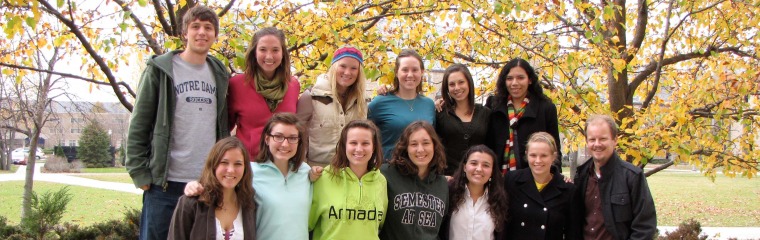
Over the past year, Eric Lindland has guided his students in creating websites as part of their anthropology coursework. Using Weebly, an easy-to-use platform, these Notre Dame students have shown off their learning online.

In Lindland’s Fall 2009 class, Cultural Difference and Social Change, students who had returned from a significant international experience over the summer came together to process what they had learned. The websites proved central in that process, and also let students show what they had done and what it meant to other students and their families and friends.

Each student designed and built a website devoted to sharing stories, photos, links, and other features of their international experience. Each website also represents each student’s perspective on the privileges and challenges of doing intercultural work, and about the strategies of cooperation and service between Western and non-Western peoples that can improve qualities of life for all involved.

Explore these websites to learn more about the practical, on-the-ground aspects of living and working abroad as a student, and about the larger structural factors that condition the lives of those who share their food, shelter, culture, and hopes with those who choose to become intercultural sojourners.

Brianna Muller’s site Paz, Amor y Justicia covers her work at Familias de Esperanza in Guatemala. Shannon Coyne created Opportunity and Inequality about her time in the village of Putubiw in central Ghana, and drew in comparative experiences in post-Katrina New Orleans.

Lindland’s class Ritual, Sport and Play also created their own websites. Each site “explored some example or facet of these three interrelated genres of human behavior.” The in-depth exploration, which included original research and analysis by the student, ranged from Little League to Party Culture to Soccer and even Yoga.

A great example here is Justin Perez and his site Masculinities at Play: Pickup Basketball at Notre Dame.

In Introduction to Anthropology, the student websites “sought to address a question of anthropological interest that is conducive to both biological and sociocultural inquiry, and present a range of informed responses to that question from the perspective of anthropologists and other theorists of human behavior.”

Topics included Pre-Columbian Transoceanic Travel (not Columbus!), Malaria: Perpetuating the Cycle of Poverty, We Make Faces (on facial expressions cross-culturally), and many more.

Link to student websites for Cultural Difference and Social Change

Link to student websites for Ritual, Sport and Play

Link to student websites for Introduction to Anthropology

Community Based Work – Student Posts 2009-2010

I wanted to provide a handy list of the posts that my Notre Dame students wrote based on their community-based research last fall. Much of this work has built on previous efforts, and you can read about my approach to community-based research (including a fun video!) and find links to published articles and earlier student work in the post Community Based Work and the Importance of Being Integrative.

The Posts

Post-Traumatic Stress Disorder: Getting Help Early to Feeling Welcomed

Finding a Voice: Establishing a Support Network for HIV+ Women

“We Pregame Harder Than You Party”

Obesity Meets Family Medicine

I also want to include Brandon Sparks’ post on his ethnographic/CBR research in Africa. This piece drew on his senior thesis, which he finished in 2009.

Funerals and Food Coping in Rural Lesotho

Sin & Sex: Student Posts on Compulsion Spring 2010

My freshmen students in ANTH 13181 “Compulsion” have now wrapped up their nine posts that range over sin and sex. Here’s the full list of what they wrote. Down below I talk more about the class itself.

Augustine’s Original Sin

Be Afraid, America. Be Very Afraid: The Effect of Negative Media

Stealing Pears: We All Want To, But Why?

The Pitfalls and Pratfalls of Criminals

Psychopathy: Is It In You?

Nature vs. Nurture and Sex: Why the Fight?

Inside the Mind of a Pedophile

Love Is A Process

Attraction

There are all nine. For those of you interested in how to integrate blogging into a class, please see my detailed explanation of how I approach this sort of assignment in last year’s post Culture and Compulsion: Student Posts 2009.

All right, onto ANTH 13181 “Compulsion.” This class was one of Notre Dame’s University Seminars. The university seminars are small classes, capped at 18, for freshmen to gain broad exposure to a certain field through focusing on a specific topic of interest (compulsion, in my case). These classes aim to ground freshmen in university-level writing, critical reading, and discussion. I also had two basic goals for the class, to show how anthropology uses a holistic approach to examine human behavior and to read some great works of literature as anthropologists.

The first half of the class focused on sin. We read Alan Jacobs’ Original Sin: A Cultural History, followed by Saint Augustine’s Confessions and Fyodor Dostoevsky’s Crime and Punishment. During the second half we switched to sexuality. We opened with sections from Edward Shorter’s Written in the Flesh: A History of Desire and Anna Clark’s Desire: A History of European Sexuality. Then we read two novels, Lady Chatterley’s Lover by D.H. Lawrence and Lolita by Vladimir Nabokov. I have attached the Lende Seminar Syllabus 2010 for anyone who is interested.

I had eighteen great students, all freshmen, from a wide variety of backgrounds and intellectual interests. Besides everything they learned, I am proud that we created a space of open discussion together. Believe me, it’s not necessarily easy for 18 and 19 year olds to discuss crime and sex in a classroom setting! But we did it, and did so in an honest and intellectually sophisticated manner. Well, most of the time. Sometimes we just had to laugh at the foibles of human nature, including our own.

I really enjoyed this class, and want to finish up by thanking the students. It was a great class!

Attraction

By Chilinh Nguyen and Greta Hurlbut

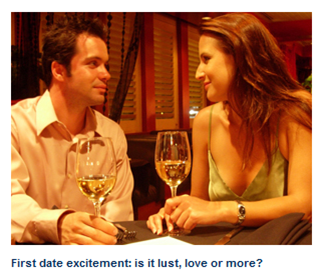
“We just had good chemistry,” is a reason often cited as an explanation for why two people find each other attractive. However, it is usually said without realizing that there is truly a science behind attraction. Chemistry can help guide people in finding their mate. For instance, attraction can be analyzed in terms of physical characteristics like smell and body type and how they can indicate potential reproductive success.

Recent research addressed attraction and the smells of various test subjects. In this research, women were exposed to t-shirts worn by various potential mates. They were asked to rate which smell they found most attractive, and the t-shirt each woman rated the highest belonged to the man that had DNA that was most dissimilar to her own (Sexual Attraction 2006).

This attraction to a mate with dissimilar DNA is important, as can be seen when studying the major histocompatibility complex (MHC), a set of genes that determines immunity to pathogens. Children born to couples with the most different MHC had a broader immunity and were healthier (Sexual Attraction 2006). Therefore, it would be ideal to be attracted to the mate with the most dissimilar DNA because this increases the chances of healthier children.

Another feature that determines attractiveness is the waist-to-hip ratio. Studies have generally shown that a low waist-to-hip ratio is considered attractive, with the ideal being about 0.7 (Berngner 2010). The waist-to-hip ratio itself is important because bigger hips are an indicator of fertility and ability to bear children (Carter 2006).

One study was conducted by Dutch psychologist, Karremans, using two identical mannequins that differed only in their waist-to-hip ratios. One had a ratio of 0.7, while the other had a ratio of 0.84. Men who had been blind from birth were asked to touch these mannequins, focusing on the waists and hips. Because they were blind, they were presumably less influenced by factors such as media and societal ideals. They also decided the more attractive mannequin was the one with the waist-to-hip ratio of 0.7. (Berngner 2010)

Other studies have been conducted around the world where men were shown line drawings of women, and again, the ones that were considered most attractive had a lower waist-to-hip ratio of 0.7 (Bergner 2010). These findings help prove the theory that the attractiveness of a female is based a lot on her capacity to be a good mate.

Continue reading “Attraction”