Wednesday Round Up #5

Food, Drink and Exercise 

Eric Asimov, Can Sips at Home Prevent Binges?
Good discussion of families, teenagers and learning to drink responsibly at home

Nicholas Bakalar, Skipping Cereal and Eggs, and Packing on the Pounds
Breakfast helps keep most adolescents thin (or perhaps less hefty…?)

Ginger Campbell/John Ratey, Exercise and the Brain
Podcast discussion of Ratey’s book, Spark: The Revolutionary New Science of Exercise and the Brain, and how exercise helps the brain

UPenn Press Release, Images of Desire: Food and Drug Cravings….
Cravings, habits and memories…

UFlorida Press Release, Imaging Disorders of Desire: Opiates, Brownies, Sex and Cocaine
Interview with Anna Rose Childress

Race 

Adam Geller, Where Should Conversation on Race Start?
In our mixed reactions to Obama’s speech, and much more

Eduardo Porter, Race and the Social Contract
Diversity and investment in public infrastructure

Mireya Navarro, Who Are We? New Dialogue on Mixed Race
Navigating the tight space between racial divides

General 

Sue Sheridan, Random Bytes
Sue has her own round-up, including make-up wearing Neanderthals and the evolution of complexity
Continue reading “Wednesday Round Up #5”

Visiting Colombia

Colombia is one of the most amazing countries I know for travelers.  Everything a traveler might want—geographical regions from deserts to tropical rain forest, plains to high-mountain glaciers; human diversity from world-class art to world-class archaeology to colonial history, indigenous groups, and the most modern of metropolises.  And the people are warm, and the food plentiful and delicious. So it’s a pleasure to point to several recent articles that highlight the reactivation of tourism in Colombia. 

Today the New York Times covers Bogotá, the capital city of eight million located at 8200 feet, in its piece A Cultural Heart Beats Anew. 

Travel and Leisure covers the magnificent fortified colonial city, home of Gabriel Garcia Marquez, this month in Cartagena, A Hidden Retreat. 

And last November the New York Times covered visiting the incredible Tayrona Park, on Colombia’s Caribbean coast, in its piece In Colombia A War Zone Reclaims Its Past.  Tayrona, with neighboring Santa Marta, the hacienda of Simon Bolivar, the Guajira, and the Kogi indigenous group which lives in the mountains above, holds some wonderful memories.

Wednesday Round Up #4

Books

Dr. Ginger Campell and her Brain Science Store
Ginger provides a handy Amazon collection of the books covered in her podcasts

Greg Mortensen and David Oliver Relin, Three Cups of Tea: One Man’s Mission to Promote Peace… One School at a Time
Building schools amid the Taliban, Americans and more…  Recently covered in the Diane Rehm show.  800+ reviews on Amazon, averaging in at the max 5 stars
 

Brian Fagan, The Great Warming: Climate Change and the Rise and Fall of Civilizations
Drought is our great historical enemy, especially in dense populations… Recently reviewed in the NY Times
 

Sandra Blakeslee & Matthew Blakeslee, The Body Has a Mind of Its Own: How Body Maps in Your Brain Help You Do (Almost) Everything Better
One reviewer: “The brain and the body are not separate entities, but are intertwined, interdependent, and interfunctional. Understanding this fact is essential to understanding how and why body maps work. This book explains that lucidly.”
 

Stephen Kern, A Cultural History of Causality: Science, Murder Novels, and Systems of Thought
Literary murder and social history—how we view the causes of ourselves

Melody Petersen, Our Daily Meds: How the Pharmaceutical Companies Transformed Themselves into Slick Marketing Machines and Hooked the Nation on Prescription Drugs
Pharmaceuticals killing people, and companies marketing them more.  See an illuminating review here
  

Vision 

Cognitive Daily, Fun With Point-Light Displays—And What That Says About The Visual System
Creating order out of dots… includes some good QuickTime videos

Mixing Memory, Language, Neuroscientific Evidence for the Influence of Language on Color Perception
Critique of imaging, importance of evidence, and our visual system

General 

Cordelia Fine, Will Working Mothers’ Brains Explode? The Popular New Genre of Neurosexism
Critique of the at times popular view that gender differences are “hard wired”

Brandon Keim, Brain Scanner Can Tell You What You’re Looking At
Functional imaging and a good computational program can “decode” the different photographs people see, reconstructing the content.   Worth a look!

Continue reading “Wednesday Round Up #4”

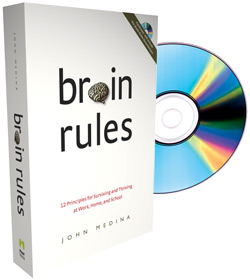
Blatant plug: new book, Brain Rules, by John Medina

book_dvd.jpgThe publisher of John Medina’s new book, Brain Rules: 12 Principles for Surviving and Thriving at Work, Home, and School, sent me an email saying that the book might be appropriate for Neuroanthropology. Normally, I wouldn’t plug something I haven’t yet read (and you can be confident that the publisher didn’t bribe me with a review copy, as I don’t have a copy… yet…), but I thought that the website in support of the book itself was worth a look.

The website contains a wealth of Flash-based audio-visual elements from the book, bibliography, graphics, and a host of other resources. I’m struck by several things about it; first, Medina is very savvy — he’s pitched this book brilliantly for a general audience. I don’t mean that as a backhanded compliment; in fact, it’s something that I aspire to in my own writing, and it’s educational to see such a good practitioner. Second, he’s done a great job of distilling some complicated ideas into bullet-point amenable, succinct statements. This sort of nested complexity (because there is more when one scratches the surface) is going to be a hallmark of neuroanthropological work, as we’re going to have to be able to write on several levels at once if we’re to persuade both specialists in the areas we’re writing about and other, non-specialists. For example, if I’m going to discuss brain modularity and it’s relationship to cultural theory, I’m going to have to be able to come up with compelling glosses for very complex research (to appeal to those more interested in cultural theory than modularity, but also vice versa), and deeper explanation so that I don’t get off-sides with the specialists.

Finally, I’m just amazed at the media support for the book — it’s excellent. As a former design ‘consultant,’ I just dig deeply the richness of the website and accompanying material. For example, there’s clever little bits of Medina giving audio versions of some of the book’s main points, but they’re much slicker and better produced than the usual head-on or 45-degree-to-the-side, video-camera-on-tripod, wide-angle-to-catch-powerpoints-and-speaker footage. He comes across as profoundly and engaging and funny. Frankly, he’s providing a really accessible counter-point to some of the simplistic ‘public intellectual’ versions of the brain sciences that we rail against frequently. For those of you with better access to well-stocked bookstores, you might want to check it out.

Obama and Race

The importance of history, the role of our own personal lives, a recognition of the power of our ideas and the stains of our faults, the emphasis on the strength of both inequality and hope.  Barack Obama’s speech on race in the United States, on the terrible patterns of the past and the foundational hopes and ideas of this nation, embodies much that I have found in trying to understand people’s lives on their own terms, those lives as both driving the same repeating patterns and offering the possibility of change. 

It was luck that I had decided to post a series on race today, and Obama’s speech, and the array of reactions today, were more than worthy inclusions—they were necessary.  Obama captures the movement towards a new way of managing our problems, of integration and reconciliation, of the best ideas presented clearly rather than as decisions hidden behind the doors of power.  Oh, he is a hard-core democrat, and I have as much cynicism about the possibility of our government working towards change.  History provides both lessons, of tragedy and triumph, and always at a cost.  And yet… 

Obama is reflexive, he sees the limits of knowledge, he sees the value of emotion as well as reason, he can judge vociferous ideas and statements but still cherish a person, he draws on his own experience to think about the larger lessons.  He is, as he says, against our continued tendency to “simplify and stereotype and amplify the negative to the point that it distorts reality.”  We simplify politics, we simplify brain biology, we simplify anthropology—and thus distort our engagement with our own larger reality.

Race is about that distortion, and using that distortion to justify the discrimination Obama so eloquently argues against.  It is an old theme in anthropology, the theme that really founded the field in the United States.  There is no manifest destiny in our biology; we forge it, for ourselves and too often against others.  It is time to turn the page, both back to our foundational moments and forward to what we can now do. 

Wednesday Round Up #3

Race 

The New York Times, How Race Is Lived In America
Series of articles focused on how race relations are defined by “daily experience, in schools, in sports arenas, in pop culture and at worship, and especially in the workplace”

American Anthropological Association, RACE: Are We So Different?
“Looking through the eyes of history, science and lived experience, the RACE Project explains differences among people and reveals the reality – and unreality – of race.”

The New York African Burial Ground
“Return to the past to build the future”

Also check out the lead researcher’s report, “An Examination of Enslaved Lives, A Construction of Ancestral Ties

Jennifer Eberhardt, Imaging Race (pdf)
American Psychologist article on brain imaging and the “social psychological responses associated with race”

Barack Obama’s Speech on Race
Full transcript here; Video, with comments across the spectrum, here

And for those people coming here, seeking more commentary on Obama’s speech, I now have a post on Obama and Race.

Embodiment & Sense Making

20/20, Blind People Who Interact with the World like Dolphins & Bats
Humans can echolocate!  Absolutely amazing.

Mind Matters, Thinking With The Body
Reading
, Movement, and Embodied Cognition

CF Kurtz & DJ Snowden, The New Dynamics of Strategy: Sense-making in a Complex and Complicated World
Challenging three basic assumptions—order, rational choice, and intent—in decision making

Continue reading “Wednesday Round Up #3”