Round Up of Wednesday Round Ups

The first twenty Wednesday round-ups quickly evolved into a format of summarizing different links by themes. So here are the past twenty weeks with the covered themes indicated next to the link. Have fun exploring. I have.

Wednesday Round Up #20 Brain Health & Illness, Addiction, PLoS One Papers, General, Evolution

Wednesday Round Up #19 Education, Health, Anthropology, Mental Health, Language

Wednesday Round Up #18 Experimental Philosophy, Morality, The Brain, Addiction, Nature/Nurture, Evolution, Animals

Wednesday Round Up #17 Inequality, Anorexia, Decision Making, Politics, General, Evolution, The Brain

Wednesday Round Up #16 Biocultural Synergies, Psychiatry, Brain Stuff, Marriage, Genetics

Wednesday Round Up #15 Anthropology, Elitism in the US, Decision Making, Gender in the US, Everyday Life, General

Wednesday Round Up #14 Memory, Prefrontal Cortex, Consumer Life, More on the Brain, Education

Continue reading “Round Up of Wednesday Round Ups”

Colombia, Peace and Progress

On Sunday the 20th of July, millions of Colombians gathered to march for peace around the world. The streets of Bogotá were packed.

In Paris Juanes, Ingrid Betancourt and others held the concert Paz Sin Fronteras

After the dramatic rescue of fifteen hostages, including Ingrid Betancourt, Colombians look to the future. Juan Manuel Santos, the minister of defense, has co-written an editorial in today’s New York Times. NPR covered the march for peace. And El Tiempo, Colombia’s leading newspaper, celebrates the 20 de Julio through extensive coverage and even photos and videos that readers have uploaded from around the world

Pharyngula on epigenetics

P. Z. Myers of Pharyngula, when he isn’t driving creationists into paroxysms, can write some great translations of biological concepts for the average reader. He does this in the post, Epigenetics, where he points out some of the problems with textbook definitions of the term. I really recommend checking this post out, but get a cup of coffee and a comfortable seat before you do — the post is not lite fare.

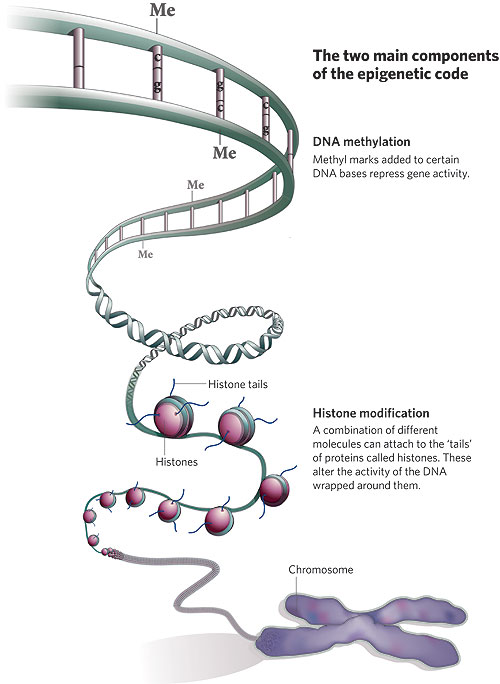
Epigenetics, although devilishly difficult, is absolutely essential for breaking with the common conception of DNA as ‘blueprint’ or marching orders for biological processes. In biological developmental processes, the expression of DNA is quite a bit more interesting than just ‘genes made it happen.’ Myers lays out a host of good examples, such as the variable degree to which histones permit or inhibit DNA transcription, the inactivation of parts of DNA when methylated, how chromosome geometric arrangement might affect gene expression, and other factors. He also discusses X chromosome inactivation in females (because they have two, one has to shut down), genomic imprinting on non-sex chromosomes (Myers discusses chromosome 15 and some of the disorders that can result), and disease changes in genetic expression (such as liver cirrhosis and retroviral insertions, which I touched on in an earlier posts on ‘identical’ twins).

Grunt Doc joked in the last Grand Rounds blog carnival that he hoped our post on psychiatric genetics ‘wouldn’t be on the test’; that goes double for the material Myers is covering. Fascinating, but, wow, tough to wrap the head around. But it’s already making me look at our calico cats in a new light…

Stumble It!

Graphic: Originally from Nature 441, 143-145 (11 May 2006); downloaded from UNSW Embryology, h/t to Pharyngula.

Fall prevention in older people — Stephen Lord at HCSNet

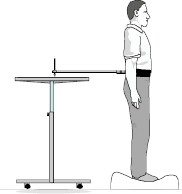
Sway meter, subject on foam
Daniel isn’t the only guy at Neuroanthropology who gets to go to good conferences; last week, while in the throes of a cold brought on by fieldwork with the 15-and-under Sydney city select rugby team, I got to go to the HCSNet Workshop on Speech, Perception and Action held at Western Sydney University.

HCSNet is funded by the Australian Research Council to promote research on human communication. I only got to go to the second day of the two-day conference (because I was cooking meals for 20 hungry rugby hopefuls the first day), but I saw a number of great presentations, including talks by Catherine Best, MARCS Auditory Laboratories, UWS, Beatriz Calvo-Merino, University College London, and Stephen Lord, Prince of Wales Medical Research Institute. I’ll blog soon on Dr. Calvo-Merino, one of the high points of the day, but today I want to make some notes on Prof. Lord’s fascinating research and talk.

Prof. Lord heads the Falls and Balance Research Group. Visit the group’s website for publications and some great information about risk factors for falling. At the conference, Lord discussed the group’s extensive applied research examining different factors that contribute to older people falling and experimental interventions to decrease the contribution of any single factor. The project has created a screening procedure for use by general practitioners to evaluate an older person’s likelihood of falling.

As regular readers know, I’m particularly interested in the way humans maintain equilibrium (see earlier posts, Kids falling down and Equilibrium, modularity, and training the brain-body, and Daniel’s post of some great parkour video, Free Running and Extreme Balance). In the longer of these posts (Equilbrium, modularity…), I specifically discussed how the ‘sense of balance’ is actually a much more complex synthesis of multiple sensory inputs, both exteroception (perception of the world) and interoception (perception of the self).

Continue reading “Fall prevention in older people — Stephen Lord at HCSNet”

Pop Goes the Media

At the Critical Neurosciences meeting in Montreal, Laurence Kirmayer brought up a great example of how research gets transformed and bastardized by the popular media. Here we have sociological research on the complex dynamics behind delinquency becoming the “biology-causes-everything” story.
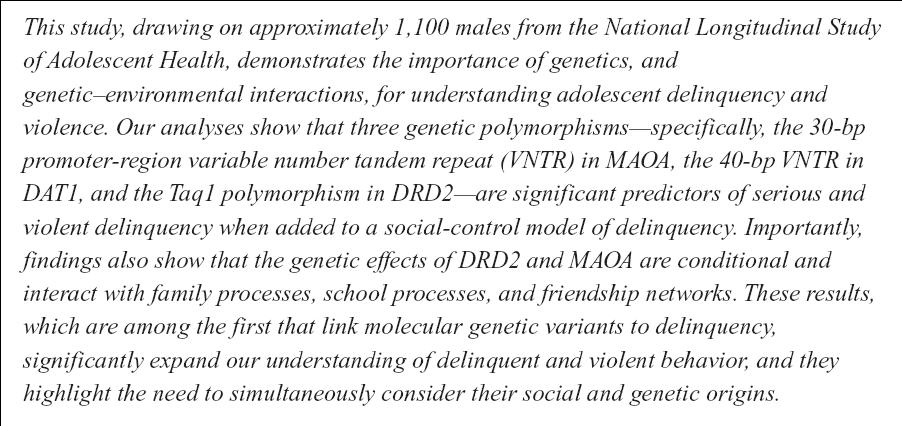
The original article is entitled “The Integration of Genetic Propensities into Social-Control Models of Delinquency and Violence among Male Youths” (big pdf; supplementary methods materials here) by Guang Guo, Michael Roettger and Tianji Chi at the University of North Carolina – Chapel Hill.

As a featured article in the American Sociological Review, the flagship journal of the American Sociological Association, this article had both a press release and an abstract prepared specially for the media. In other words, there were already digested materials ready for the media! No “misreading” of the original paper allowed.

The press release reads “Sociological Research Shows Combined Impact of Genetics, Social Factors on Delinquency,” with a minor highlight that indicates “Study is among first to tie molecular genetic variants to male delinquency.” The first sentence goes: “[this] sociological research… identifies three genetic predictors—of serious and violent delinquency—that gain predictive precision when considered together with social influences, such as family, friends and school processes.”

The media abstract is even clearer: “[The] genetic effects are conditional and interact with family processes, school processes, and friendship networks. ‘A stronger social-control influence of family, school, or social networks,’ the authors explain, ‘reduces the delinquency-increasing effect of a genetic variant, whereas a weaker social-control influence of family, school, and social networks amplifies the delinquency-increasing effect of a genetic variant’.”

Guang Guo goes on in the ASA media release: “Positive social influences appear to reduce the delinquency-increasing effect of a genetic variant, whereas the effect of these genetic variants is amplified in the absence of social controls. Our research confirms that genetic effects are not deterministic. Gene expression may depend heavily on the environment.”

So how does Reuters, one of the premier reporting services in the world, present the article? “Study finds genetic link to violence, delinquency” reads the title. I’ve included the accompanying photo that comes directly below the title. The Reuters piece got posted at Scientific American, Yahoo and other places, while an even worse photo appears at a “European descent” site.

Continue reading “Pop Goes the Media”