Daniel interviewed at Scientific American

Daniel should flag it, but he might not out of a fear of self-promotion (I have no such qualms), so I’m going to post a link to an interview that our own Daniel Lende did with Jonah Lehrer, the editor of Mind Matters at Scientific American: Getting Hooked on Sin. Daniel discusses some of the general principles, but he also gives an accessible introduction to the work he’s been doing on addiction (see his recent postings here, Wanting to Craving: Understanding Compulsive Involvement with Drugs and Craving and Compulsive Involvement Scales, for more on that subject). As the subtitle describes: ‘A neuroanthropologist explains what Colombian teenagers can teach neuroscientists about addiction.’ Well worth checking out in the original, even if some of the comments get WAAAAY off the point with a discussion of ‘sin.’

It’s interesting: anthropologists have little problem switching between indigenous (emic) concepts used by our informants, and our own analytical constructs. Perhaps because we’re not overly attached to either, we don’t really feel a strong need to defend any particular set of theoretical constructs (well, some of us don’t, at least). For example, when I taught ‘anthropological theory’ to majors, one of the crucial points was that, depending on one’s analytical perspective, a different set of theoretical constructs made sense — outside that framework, the theoretical terms often lost a lot of their usefulness. So I have no trouble when Daniel switches to talking about ‘sin’; in fact, as a (mostly) recovered Catholic, it’s like a welcome switch to my native tongue. But clearly, not everyone reading Scientific American is quite as willing to work in a sort of agnostic discussion space…

Great to see Daniel getting his ideas out there in all sorts of places — I’ve always liked Scientific American’s Mind & Brain site. Hopefully, he’ll continue to fill out more of his thinking on the neuroanthropological dimensions of addiction. Looking forward to San Francisco for the American Anthropology Association.

Drew Westen and Political Messages

The NY Times highlighed the Emory psychologist Drew Westen this week in the article “A Psychologist Helps Repackage Democrats’ Message.” Westen is the author of the 2007 book The Political Brain, which argued for the role of emotion in political decision making and advocated appealing to “the gut” (particularly for Democrats) rather than the usual wonkish rationales. The Progressive offers us a short and informative review here.

The Times highlights Westen’s Message Handbook for Progressives From Left to Center. Basically Westen is saying that in an emotional or values argument, appeals to reason do not persuade most voters. You have to hit back, not talk back. Here’s a long excerpt on what Westen advocates in the Handbook:

Its mission is to assist progressives by developing language and narratives that connect with voters on a personal, emotional level in the short-term, as well as help the progressive movement brand themselves effectively in the long-term.

The goal of the VFP is to develop and test principled stands on issues—emotionally compelling values statements and narratives about where we stand—so that progressive leaders, elected officials, and others do not need to practice the politics of avoidance (trying to change the subject instead of addressing issues head-on), resort to off-putting or euphemistic language, offer defensive hedges without clear underlying principles (particularly on wedge issues, e.g., “I believe we should register new handguns but not old ones”), or adopt “conservative-lite” positions designed to avoid offending certain constituent groups perceived to be opposed to a progressive position. Embedded in these narratives should be readily remembered phrases or sentences that evoke the broader principles underlying them.

The goal of this project is not to develop “talking points.” Progressives are by definition free thinking, and their values range from center-to-left progressive. Rather, the goal is to develop a menu of well-tested principled stands, from center to left, which progressive organizations and individuals advancing progressive causes can use if they find them helpful and consistent with their own values and goals, so that they are not constantly reinventing the wheel or speaking to the public in ways that do not resonate emotionally. The evidence is clear that the language on the left needs an “extreme makeover” so that we stop recycling the tired, poor, and huddled phrases of the left (e.g., “the environment,” “reproductive health,” “I’ll fight for people”) that lost their appeal decades ago and have little appeal in the political center.

What I find interesting is the connection of a short-term orientation (votes are made in the near future and are often about present circumstances) and emotion and values as guiding choices about leadership with an emphasis on categorization (or framing) and narrative. As one politician says in the Times, “Dr. Westen’s advice had given him the confidence to speak his mind even on conservative talk radio. ‘If we communicate it through our stories and our real-life examples, if they don’t agree with you then they can at least understand where you come from’.”

In one sense, it’s about common sense communication. “The idea,” Dr. Westen said, “is to start to rebrand progressives using language that’s as evocative as the language of the other side, and stop using phrases that just turn people off.”

Here’s one example: “Instead of using euphemisms like “pro-choice” and “reproductive health,” his handbook suggests, liberal candidates might insist that it is un-American for the government to tell men and women when to start a family or what religious beliefs to follow, arguments that test well in focus groups with conservatives and independents.”

I am not sure if you need “the brain” to justify all this. Telling stories and creating emotional appeals are as old as dirt. But there is a prominent discourse of rights and policy and reason that can also get stuck in people’s head. So maybe Westen has just invented a way of talking to politicians and reminding them of how to communicate effectively.

If you’re interested in more from Westen, he runs a blog where you can find some of his own thoughts about the presidential race.

The Other Side of Colombia

So I just spoke about great food in Cartagena; featured videos of the massive march for peace back in July; have discussed the proposed free trade agreement; and highlighted some great places to visit in the spring. But Colombia does have a dark side – violence, drug trafficking, an ongoing war with guerrillas.

On Wednesday Simon Romero wrote the disturbing piece “Colombia Lists Civilian Killings in Guerrilla Toll” in the New York Times. The accusations are horrific – the army taking young men, mostly poor and down-and-out, and transporting them to guerrilla war zones. The army then kills them and dresses them in guerilla gear, thus upping the tally for enemy combatants killed. Getting “kills” earns promotions, time-off, and extra pay.

Prosecutors and human rights researchers are investigating hundreds of such deaths and disappearances, contending that Colombia’s security forces are increasingly murdering civilians and making it look as if they were killed in combat, often by planting weapons by the bodies or dressing them in guerrilla fatigues.

Besides the incentives from the side of the army, this new effort appears like a resurgence of social cleansing techniques used by vigilante groups in the cities and paramilitaries in rural regions. These are the poor, disabled, the mentally ill, often seen as morally degenerate and as criminals, and thus less than human and a danger to the better parts of society. I knew boys targeted by such groups in Bogota; thieves, addicts, gang members who saw themselves in a shadow war with unknown, powerful groups who wanted to get rid of them.

But this effort by the army is more directly coordinated and more sinister. It has caught up people who have done no wrong at all. The highlighted case is Julian Oveido, a 19 year old construction worker who disappeared March 2 after he told his mother he was going to talk with a man about work. A day later he turned up dead 350 miles to the north and was classified as a “subversive” by the army.

Faced with this crisis, President Alvaro Uribe is purging army generals and making renewed calls for the protection of human rights. But Uribe is the one pursuing the war and has old ties to paramilitary groups who carried on an extra-judicial and savage war in his home state of Antioquia.

Amnesty International has released a report (full report available here) on this sudden resurgence of social cleansing and the murder of civilians in the midst of a generally improving human rights picture in Colombia. The Colombian Commision of Jurists reports that “civilian killings rose to 287 from mid-2006 to mid-2007, up from 267 in the same period a year earlier and 218 the year before that.”

El Tiempo has a video report from CityTV on the capture of the recruiters that were working in Bogota (not a direct link, but the video is there as I post this). El Espectador relates that there are “more and more” denunciations, this time in the city of Huila, for what people in Colombia are calling “false positives,” innocents taken and killed as guerrillas.

Anthropologies

In today’s New York Times Mark Leibovich writes on the contrasts between Republican and Democratic events in “At Rallies of Faithful, Contrasts in Red and Blue.” Differences in dress, behavior, language, music and more are highlighted, with some recognition of the similarities too. But it was really this line from Leibovich that got my attention:

What can we learn from a close-in view of Democratic and Republican events at the end of a bitter, exhilarating campaign? It has become a cliché to say that the country is “divided,” but the anthropologies displayed at 11 campaign stops in recent days offer glimpses of partisan America.

I have never seen “anthropologies” used in that way, as a noun to capture what generally anthropologists try to gloss under the rubric of “culture.” For US anthropologists, “anthropologies” might mean the four or five different fields we say fall under the discipline of anthropology – biological and sociocultural, linguistic and archaeology, with applied often thrown in for good measure.

I really like this use of “anthropologies,” and the fact that it got past the copy editors at the Times must mean that they assume it has enough common meaning for people to grasp some general concept behind it.

“Culture” has been a contested concept in anthropology for several decades now, but we haven’t really been able to settle on a better term for a holistic understanding of a way of life. Anthropologies seems a lot closer, especially when we can then evoke all the different fields to understand the lived anthropology of a place and time and people. No longer is it the -ology receiving emphasis, it is the anthro-.

With anthropologies, we can talk about ways of life and practices and embodiment and meaning, and not keep assuming that somehow a symbolic structure or an inequality or a set of genetics is the thing to use to understand that way of life. Rather, it demands the sort of interdisciplinary engagement already seen in the word itself – anthropologies.

Animal Color

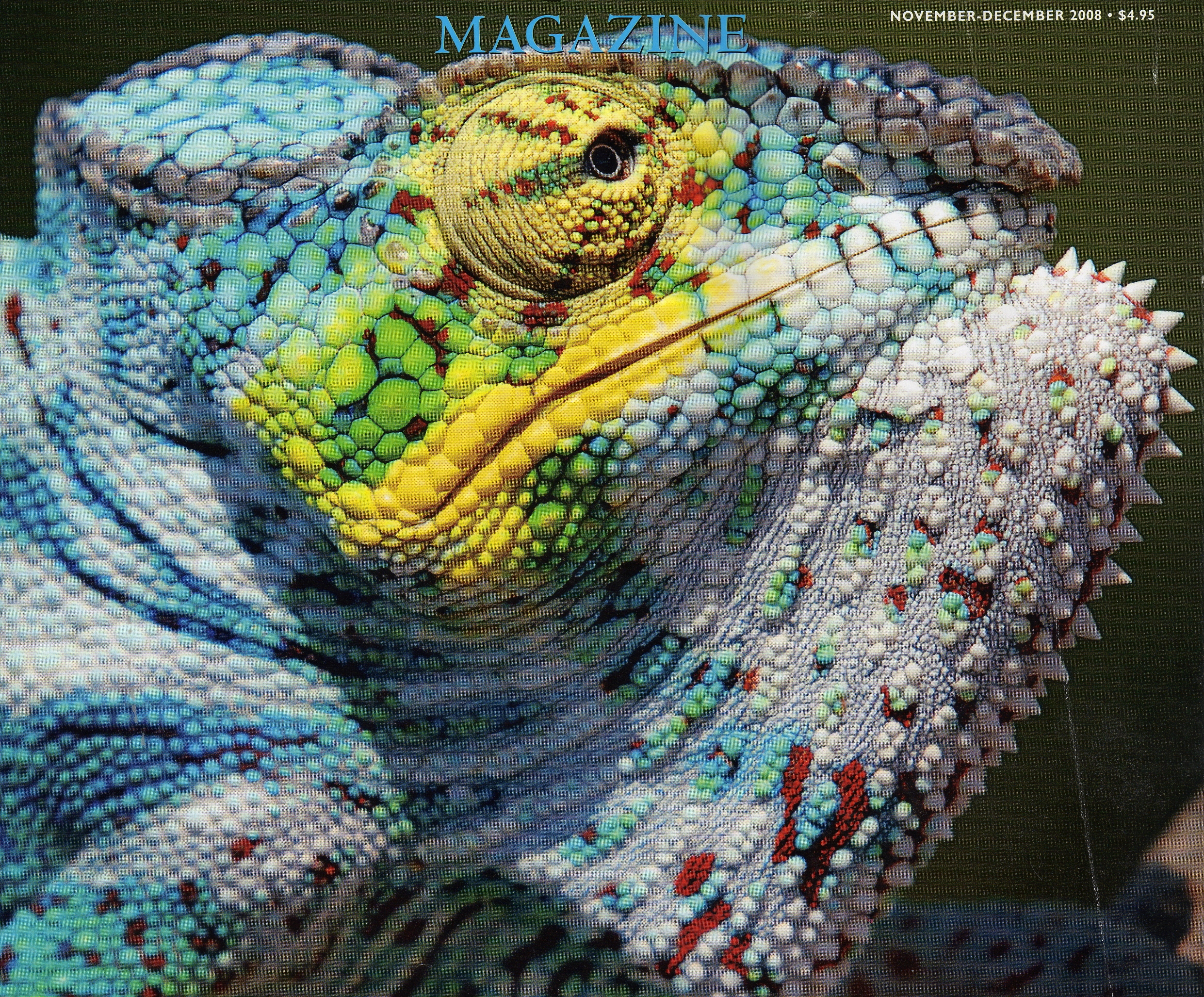
The cover of the November-December Harvard Magazine features this magnificent photo of a panther chameleon from Madagascar (sorry for the slight crease from the scan; the original photo is by Paul Bratescu). That photo introduces us to the feature article Animals Speak Color.

The article is full of striking photos, including this one below of this colorful nudibranch (a type of mollusk). You can go to the website to see them all or download the pdf. If you want the live experience, the article is based on the new exhibit The Language of Color at the Harvard Museum of Natural History. In lieu of that, the magazine gives us a video tour.

In the animal kingdom color serves to warn, camouflage, advertise, and compete. Sex drives a lot of that, showing off for mates, but so does poison, telling predators that this flashy little being is bad to eat.

The Harvard Museum of Natural History is home to the world-famous glass flowers, exquisite life-like reproductions. So it’s not jus the animal world getting in on the color game!