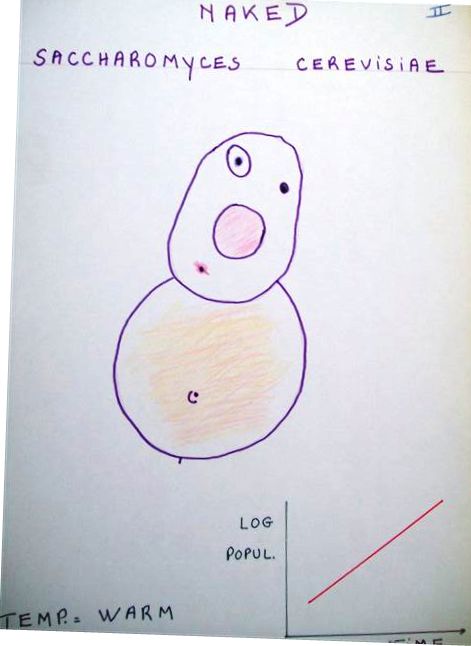
The Adventures of Little Sacc

Little Sacc was a happy little dude who liked to eat sugar and liked to make beer,

He was always polite and never rude, he liked to smile and he would never sneer.

But the story of Little Sacc isn’t so happy it’s true, his plight is somewhat tragic let me make that clear.

In all the happiness of making a drink, His real future just went down the sink.

But is his destiny so different from our very own?
Should we really smile on this fella whose death we condone?
Dying in his own excrement is no heroic fate,
But who are we to judge? Let me explain, just wait;


Continue reading “The Adventures of Little Sacc”

Colour, is it in the brain?

Colour is a perceptual interaction arising from our ability to discriminate between different wavelengths of light from within a narrow band of electromagnetic radiation. Light itself has no colour. The colour of a specific wavelength can change according to context. For example, in the above picture, despite having the same spectral reflectance, the ‘X’ appears to be different when set against the two different backgrounds (Albers J. 1975). Continue reading “Colour, is it in the brain?”

Edelman, Evolution and Encephalisation

The brain exhibits all of the properties of an evolutionary system. In the developing brain, there is an initial oversupply of neurons. The combinatorial possibilities that exist within and between neuronal groups is a source of variation that is selected from. The brain, which is only approx. 25% formed at birth, matures through processes of degeneracy and associativity. The dynamic interplay between the variation and selection of neuronal groups is a source of self-organisation. The brain has the capacity to store patterns of activation and to recreate acts separated in time from the original events. Memory biases the processes of organisation towards increased complexity. (For a more extensive explanation of the brain as an evolutionary system see Edelman 1987; 1993; 2004).

To be honest, I have not met many people who truly understand every aspect of Edelman’s theory of neuronal group selection (TNGS). In fact, if I have gone some way to understanding some part of his theory, then it has been largely through my reading of secondary literature material, returning frequently to his new books and then discussing his work with some of my friends Continue reading “Edelman, Evolution and Encephalisation”

Calvin the theologian and Calvin the theoretical neurobiologist

John Calvin, a Theologian from Strasbourg died the day before I was born. He taught an austere form of personal ethics supporting good hospitals, a proper sewage system, protective rails on upper stories to keep children from falling from tall buildings, special care for the poor and infirm, and the introduction of new industries. Continue reading “Calvin the theologian and Calvin the theoretical neurobiologist”

Foxy Evolution

Here’s a great video that shows how selection can work its effects–in this case artificial selection, demonstrated through the work of the Russian Dmitri Belyaev and his tame silver foxes. Still, what I find most striking about this video is the analogy to ourselves.

Jim Rilling, a neuroanthropologist at Emory, once commented to me that humans are wired to cooperate (in his latest work, he’s doing neuro-imaging on what happens when people don’t reciprocate, having researched the neural bases of cooperation earlier). The example Jim used has stuck with me ever since. Imagine 50 chimpanzees trying to sit down and watch an introductory lecture together. Pandemonium with those chimps. For us, it’s the most mundane sort of thing. People do it everyday around the world.

Continue reading “Foxy Evolution”