What Is The Value of Neuroscience?

Jonah Lehrer has a great post, The Value of Neuroscience, over at The Frontal Cortex. He writes about struggling with a common question he got during his recent tour for his new book, How We Decide.

The question is, “What practical knowledge have we gained by looking at decision-making in the brain that we didn’t already have, either through introspection or behavioral studies?”

His answer is, “The best answer, I think, is that learning about the brain can help constrain our theories. We haven’t decoded the cortex or solved human nature – we’re not even close – but we can begin to narrow the space of possible theories.”

That is both an elegant and a practical answer – it claims neither too much nor too little for neuroscience, and provides a way to think about neuroscience. Ways of thinking are often much harder to grasp than what to think, where neuroscience churns out an enormous quantity of information but not necessarily an enormous range of hypotheses about people as people.

Lehrer’s answer echoes my own view of evolutionary theory, that its greatest utility is in limiting the range of possibilities when confronting the diversity and commonality of people’s behavior lives today and in the recent past. People are often aghast when I say this – but what about all the predictions, the selective forces, Darwin’s genius? But there is evolution’s strength – certain possibilities are more likely, and others are often not on the table. Combine that with the mechanistic understandings from neurobiology–the outcomes of evolutionary adaptations and present function–and suddenly the range of possibilities is constrained further.

Continue reading “What Is The Value of Neuroscience?”

David Attenborough on the Tree of Life

There’s a beautiful, albeit animal-centric, video on the evolutionary ‘tree of life’ narrated by David Attenborough and produced by the BBC. I’ll embed the HD version below, but you can also go to the ‘Tree of Life’ website to find more.


According to the site’s blog, they’ve attempted to address the absence of discussions of plants in the interactive version of the tree:

We’ve already had some feedback about the lack of plants in the interactive tree. The key point is that what we’ve put up for now is pretty much the interactive version of the film. We used the same tools and data structures to build both. Obviously the film has its own narrative structure and logic, but the choice of species might make less sense when on its own in the interactive. This is the situation at launch but it will not be the case in the future.

The irony of a ‘tree’ without sufficient mention of plants is a bit rich, but it’s well worth a look. It’s a beautiful little animation and Attenborough’s voice makes me want to drink port and sit by the fireside, even though it’s about 90 degrees here and we haven’t seen rain in what feels like months…

Paleofantasies of the perfect diet – Marlene Zuk in NYTimes

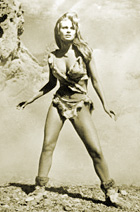
Prof. Marlene Zuk (University of California Riverside), author of Riddled with Life: Friendly Worms, Ladybug Sex and the Parasites That Make Us Who We Are (Amazon, Google books), has a very nice short essay in The New York Times on the recent discussion of whether or not our dietary problems stem from our bodies being ‘out of step’ evolutionarily with things like Mars bars and Big Macs: The Evolutionary Search for Our Perfect Past. We’ve seen these sorts of arguments all over the place, that a ‘Paleolithic diet’ can make you healthy and banish bulges from inopportune places, after all, just look at Raquel Welch in 10,000 BC!

Paleolithic dieter?  Not exactly...
Paleolithic dieter? Not exactly...

When I talk about diet and human evolution in my freshman class, I have to point out that there are a tremendous number of complications, including the fact that the vast majority of us do not have the cultural knowledge to get ANY nutritional resources out of the environment around us (see my earlier post with my slides from that lecture, if you like). It’s all well and good to say, ‘Eat meat, roots and berries,’ but that just means spending our time in the grocery store aisles a bit differently for most of us, not actually transforming the ways that we get food, how we relate to our environment, or even the quality of the meat, roots and berries we’re getting (after all, even the meat we get is from the animal world’s equivalent of couch potatoes, not the wild stuff on the hoof– or for that matter, dead on the ground where we can scavenge it).

Zuk draws on Leslie Aiello’s concept of ‘paleofantasies,’ stories about our past spun from thin evidence, to label the nostalgia some people seem to express for prehistoric conditions that they see as somehow healthier. In my research on sports and masculinity, I frequently see paleofantasies come up around fight sports, the idea that, before civilization hemmed us in and blunted our instincts, we would just punch each other if we got angry, and somehow this was healthier, freer and more natural (the problems with this view being so many that I refuse to even begin to enumerate them). It’s an odd inversion on the usual Myth of Progress, the idea that things always get better and better; instead, paleofantasies are a kind of long range projection of Grumpy Old Man Syndrome (‘Things were so much better in MY day…’), spinning fantasies of ‘life before’ everything we have built up around us.

Continue reading “Paleofantasies of the perfect diet – Marlene Zuk in NYTimes”

My genome is not my self

pinker-hairBy Agustin Fuentes

We are not our genes and they are not us. Knowing what copies of genes we carry can tell us a little about getting sick and losing our hair, and maybe even add insight into our ancestry. But that does not tell us about how and why we do the things that we do.

Steven Pinker, in his recent New York Times Magazine article My Genome, My Self, argues that genes do have great influence on our behavior. As an anthropologist, evolutionary theorist, and a researcher of human and other primate behavior I am here to tell you that he is overshooting the mark. Human behavior is simultaneously biology, culture, experience and more.

Natural selection, one of the main drivers in evolutionary change, works on the whole body and behavior complex, not on single genes or even the genome itself. It is the dynamic product of genes, organs, bodies, behaviors, ecologies, and societies that eventually affects evolutionary patterns in humans. No gene or even set of genes can be held in isolation of the systems in which they exist.

Continue reading “My genome is not my self”

Myth Busting on Human Nature

agustin-fuentes
Agustin Fuentes has a short interview on the myths about human nature that prevail in popular discourse and even in anthropology. The three big ones are race, sex, and aggression.

Here’s the excerpt for race and racism:

Myth: Humans are divided into races that differ in some biological and behavioral patterns.
Fuentes: “There is no separate gene for black or white. Our concept of race is not biological, it is social. While there is only one biological race in humans (Homo sapiens) it still matters whether you are black or white in the U.S. Differences between ‘races’ in this country are the outcomes of social, historical, economic, and experiential contexts, not biological entities . . . so what do we do about it?”

For more on sex, relationships, monogamy, violence and morality, you can go check out Agustin’s answers.

Agustin was part of our Encultured Brain session, and we featured a profile of him then, including some discussion of his work on niche construction. Agustin included ideas about the myths of human nature, niche construction and more in his new textbook The Evolution of Human Behavior

Catherine Panter-Brick and Agustin Fuentes co-edited the recent collection Health, Risk and Adversity. Stephen McGarvey reviews the book, “[The] contribution lies in reminding and refining how human health and biology are produced, perceived, and communicated in a deep social context that includes history, politics, economics, and current global culture, especially modern media.”

Here’s the Amazon blurb for Health, Risk and Adversity:

Research on health involves evaluating the disparities that are systematically associated with the experience of risk, including genetic and physiological variation, environmental exposure to poor nutrition and disease, and social marginalization. This volume provides a unique perspective a comparative approach to the analysis of health disparities and human adaptability and specifically focuses on the pathways that lead to unequal health outcomes. From an explicitly anthropological perspective situated in the practice and theory of biosocial studies, this book combines theoretical rigor with more applied and practice-oriented approaches and critically examines infectious and chronic diseases, reproduction, and nutrition.

Cosleeping and Biological Imperatives: Why Human Babies Do Not and Should Not Sleep Alone

mother-and-childBy James J. McKenna Ph.D.
Edmund P. Joyce C.S.C. Chair in Anthropology
Director, Mother-Baby Behavioral Sleep Laboratory
University of Notre Dame
Author of Sleeping with Your Baby: A Parent’s Guide to Cosleeping

Where a baby sleeps is not as simple as current medical discourse and recommendations against cosleeping in some western societies want it to be. And there is good reason why. I write here to explain why the pediatric recommendations on forms of cosleeping such as bedsharing will and should remain mixed. I will also address why the majority of new parents practice intermittent bedsharing despite governmental and medical warnings against it.

Definitions are important here. The term cosleeping refers to any situation in which a committed adult caregiver, usually the mother, sleeps within close enough proximity to her infant so that each, the mother and infant, can respond to each other’s sensory signals and cues. Room sharing is a form of cosleeping, always considered safe and always considered protective. But it is not the room itself that it is protective. It is what goes on between the mother (or father) and the infant that is. Medical authorities seem to forget this fact. This form of cosleeping is not controversial and is recommended by all.

Unfortunately, the terms cosleeping, bedsharing and a well-known dangerous form of cosleeping, couch or sofa cosleeping, are mostly used interchangeably by medical authorities, even though these terms need to be kept separate. It is absolutely wrong to say, for example, that “cosleeping is dangerous” when roomsharing is a form of cosleeping and this form of cosleeping (as at least three epidemiological studies show) reduce an infant’s chances of dying by one half.

Bedsharing is another form of cosleeping which can be made either safe or unsafe, but it is not intrinsically one nor the other. Couch or sofa cosleeping is, however, intrinsically dangerous as babies can and do all too easily get pushed against the back of the couch by the adult, or flipped face down in the pillows, to suffocate.

Often news stories talk about “another baby dying while cosleeping” but they fail to distinguish between what type of cosleeping was involved and, worse, what specific dangerous factor might have actually been responsible for the baby dying. A specific example is whether the infant was sleeping prone next to their parent, which is an independent risk factor for death regardless of where the infant was sleeping. Such reports inappropriately suggest that all types of cosleeping are the same, dangerous, and all the practices around cosleeping carry the same high risks, and that no cosleeping environment can be made safe.

Nothing can be further from the truth. This is akin to suggesting that because some parents drive drunk with their infants in their cars, unstrapped into car seats, and because some of these babies die in car accidents that nobody can drive with babies in their cars because obviously car transportation for infants is fatal. You see the point.

One of the most important reasons why bedsharing occurs, and the reason why simple declarations against it will not eradicate it, is because sleeping next to one’s baby is biologically appropriate, unlike placing infants prone to sleep or putting an infant in a room to sleep by itself. This is particularly so when bedsharing is associated with breast feeding.

When done safely, mother-infant cosleeping saves infants lives and contributes to infant and maternal health and well being. Merely having an infant sleeping in a room with a committed adult caregiver (cosleeping) reduces the chances of an infant dying from SIDS or from an accident by one half!

Continue reading “Cosleeping and Biological Imperatives: Why Human Babies Do Not and Should Not Sleep Alone”